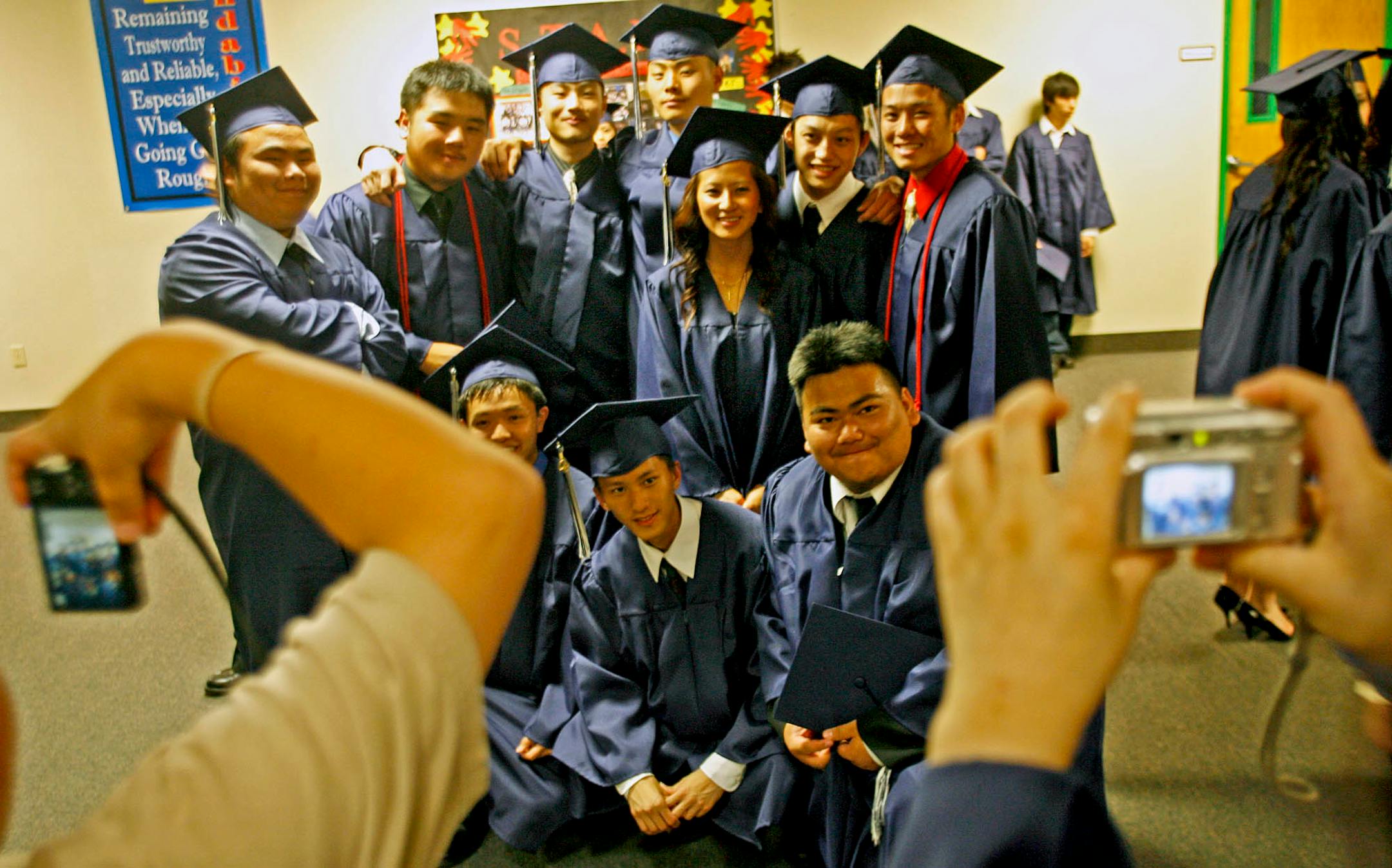
Hmong Academy in St. Paul graduated its second class last week. Just about every senior at the charter school walked across the stage, smiled and grabbed a diploma.
In fact, the school's graduation rate is 94 percent. What's the big deal about that? Well, for starters, 99 percent of Hmong Academy's 450 students live in poverty, 99 percent are from minority groups and 83 percent are learning how to speak, read and write English -- groups that often struggle in high school.
They're doing just fine at Hmong Academy, where community leaders and educators have forged a school founded to reinforce Hmong values and culture while at the same time girding students to succeed in the western world. Christianna Hang, the school's director and chief financial officer, said Hmong Academy was started to stop kids from slipping through the cracks of the school system while strengthening their identities and obligations as Hmong-Americans.
"We wanted back-to-the-basics: Respect your elders. What should you do if you want to be a leader? How to care for your community. And how to commit to your culture," said Hang, who worked for years in the Minneapolis Public Schools and at Seed Academy charter school in Minneapolis. "We wanted a school that addresses how do you become a Hmong-American in this society."
Back to the basics does not mean basic education, Hang said. It means focusing on core values and strong families. "Our culture is based on leadership, community service and caring about more than yourself," she said.
And the curriculum itself is far from basic. Of the school's 40 graduates last year, 35 are enrolled in college and five joined the military, Hang said. This year, the school graduated nearly 90 students; almost all have applied to multiple colleges and universities.
This fall, the school will organize itself into four universities -- each with a program focus, such as fine arts and humanities or math, technology, science and medicine -- and each university will offer a variety of courses and subjects, all designed to get students thinking about college and careers as early as ninth grade.
Each month of the school year will focus on one of the three C's, Hang said: caring, college and careers. By the time they are seniors, students will have visited colleges, worked at internships, job-shadowed, taken the PSAT, SAT and ACT college entrance exams, and applied to multiple colleges or vocational schools, she said.