
St. Paul's fight against emerald ash borer leaves a trail of stumps

No money in city budget to remove ugly remnants of ash borer infestation.

April 15, 2017 at 11:13PM
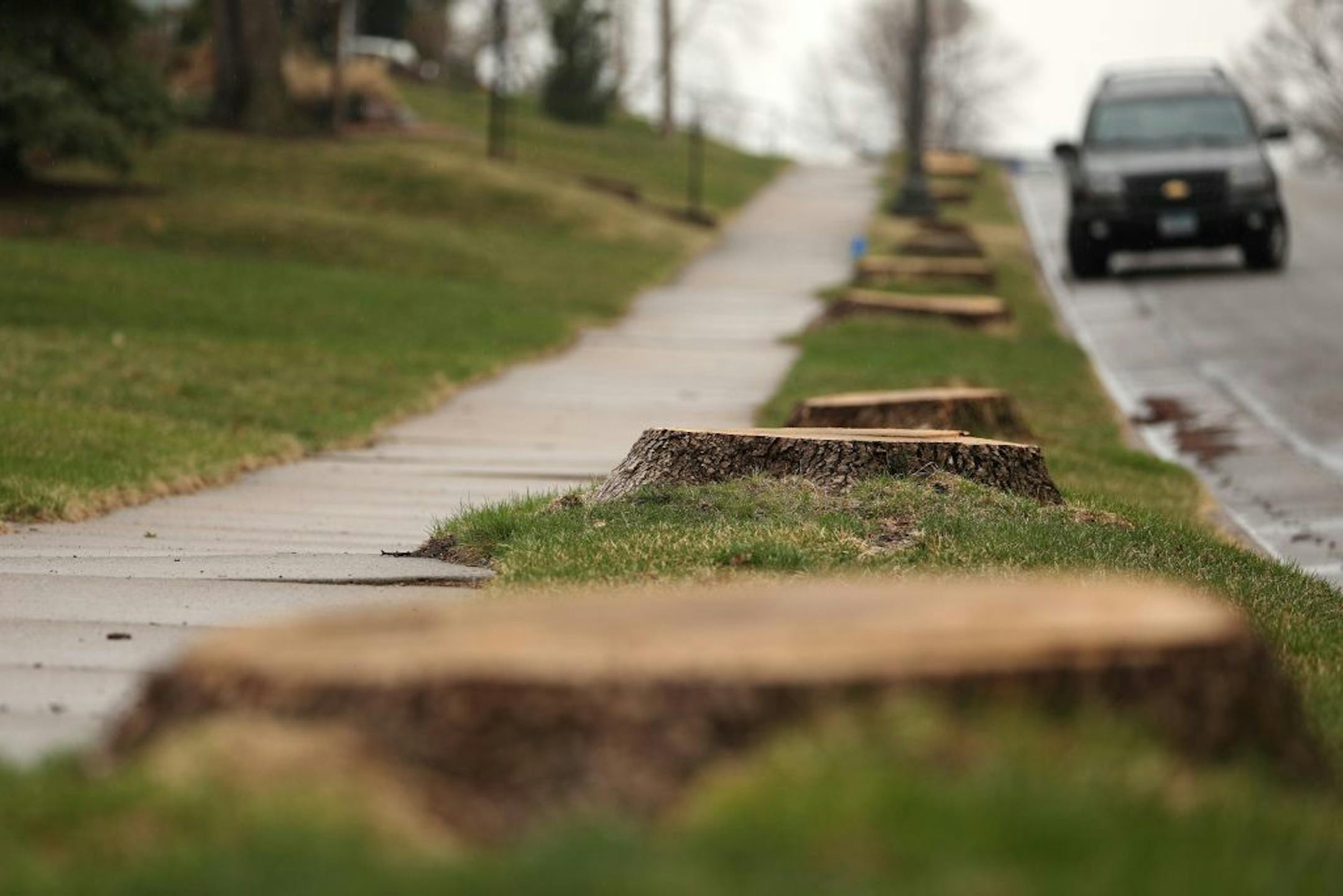
A row of stumps lined Montana Avenue west of Grotto Street after the trees were cut down in attempt to manage Emerald Ash Borer by the city of St. Paul.
Stumps line Montana Avenue west of Grotto Street in St. Paul. So far this year, city crews have cut down 800 trees. (Star Tribune/The Minnesota Star Tribune)

Jean Kern's block on Montana Avenue in St. Paul will hold its 43rd annual July 4th parade this year. When the kids who grew up here come back for the festivities, some with kids of their own, they'll notice a big difference in their quiet, friendly, ask-a-neighbor-for-anything block.

A lot less shade.

The ash trees that once created a beautiful canopy over the street are gone, victims of emerald ash borer infestation and city chain saws. Left behind are stumps — wide, sad stumps that the city lacks the money to remove. In fact, the ash borer problem has been so substantial that officials say they're spending all their tree budget on tree removal, with nothing left for stumps or replacements.

"I thought I heard a city crew the other day and I thought 'Oh good!' " Kern said of hoped-for stump removers. "But it wasn't."

This wasn't how it was supposed to be.

Clare Cloyd, a spokeswoman for the city's Parks and Recreation Department, said St. Paul Mayor Chris Coleman sought to add $900,000 this year to the $1.2 million the city budgeted for boulevard trees because of the severity of the ash borer infestation. That money would have covered the removal — including stumps and replantings — of 700 additional trees.

But the City Council, facing a budget crunch, instead voted to put that money into a contingency fund, Cloyd said, leaving the same amount of money budgeted for trees this year as last. At the same time, the pace of the infestation has accelerated.

"Last year, we were able to keep up. This year, there is just an insane number of trees declining or dead," Cloyd said.

Since it's critical to remove infested trees before the pest spreads further, crews kept cutting. Cloyd said 800 trees have been cut down in 2017 — twice as many as in 2016. Removing the stumps and replacing the trees will still happen, she said, "but not for a while."

As part of an awareness campaign, crews have placed green bands around ash trees. It does not mean the tree has been slated for immediate removal, but it will come down in the next few years. In all, the city planted about 18,000 ash trees along boulevards.

In the Como area alone, 160 trees were removed this winter, said Michael Kuchta, executive director of the Como Community Council, including one in front of his house. People expect the stumps to be removed.

"I would imagine as word spreads on this that people aren't going to be happy," Kuchta said.

Council Member Amy Brendmoen, who represents the Como and North End areas, said the severity of the infestation — along with a $30 million budget hole caused after a state Supreme Court ruling that the city cannot use a special assessment for routine street maintenance — gives the city little choice.

"We simply don't have it. I think we all wanted to put significantly more money into the parks budget for ash borer and other things this year," she said. "But we can't do it."

Brendmoen has been talking with area homeowners on the neighborhood Facebook page and said she hopes to at least find money to remove the stumps, perhaps in other areas of the public works budget.

"Losing your trees is painful enough … but then you have to look at a stump? They look bad and remind us of the loss," she said. "I don't know if I can, but I'm going to try."

Tim Hanson, who has lived on Montana Avenue for 34 years, joked that the block now "looks like the suburbs." But he said he understands why the city had to clear away the trees.

"Several of them were ready to go or were struggling," he said. "What really hurts is they're all gone."

Still, he said, "I'd like to see them replaced. It makes the street look so much better when you have trees alongside it."

James Walsh • 651-925-5041

about the writer

about the writer

James Walsh

Reporter

James Walsh is a reporter covering social services, focusing on issues involving disability, accessibility and aging. He has had myriad assignments over nearly 35 years at the Star Tribune, including federal courts, St. Paul neighborhoods and St. Paul schools.

See Moreicon

More from No Section

See More
FILE -- A rent deposit slot at an apartment complex in Tucker, Ga., on July 21, 2020. As an eviction crisis has seemed increasingly likely this summer, everyone in the housing market has made the same plea to Washington: Send money — lots of it — that would keep renters in their homes and landlords afloat. (Melissa Golden/The New York Times) ORG XMIT: XNYT58
Melissa Golden/The New York Times

It’s too soon to tell how much the immigration crackdown is to blame.