How would St. Paul’s mayoral candidates fix Midway?

We walked Snelling and University avenues with Mayor Melvin Carter and challenger Kaohly Her.

The Minnesota Star Tribune
October 26, 2025 at 11:00AM
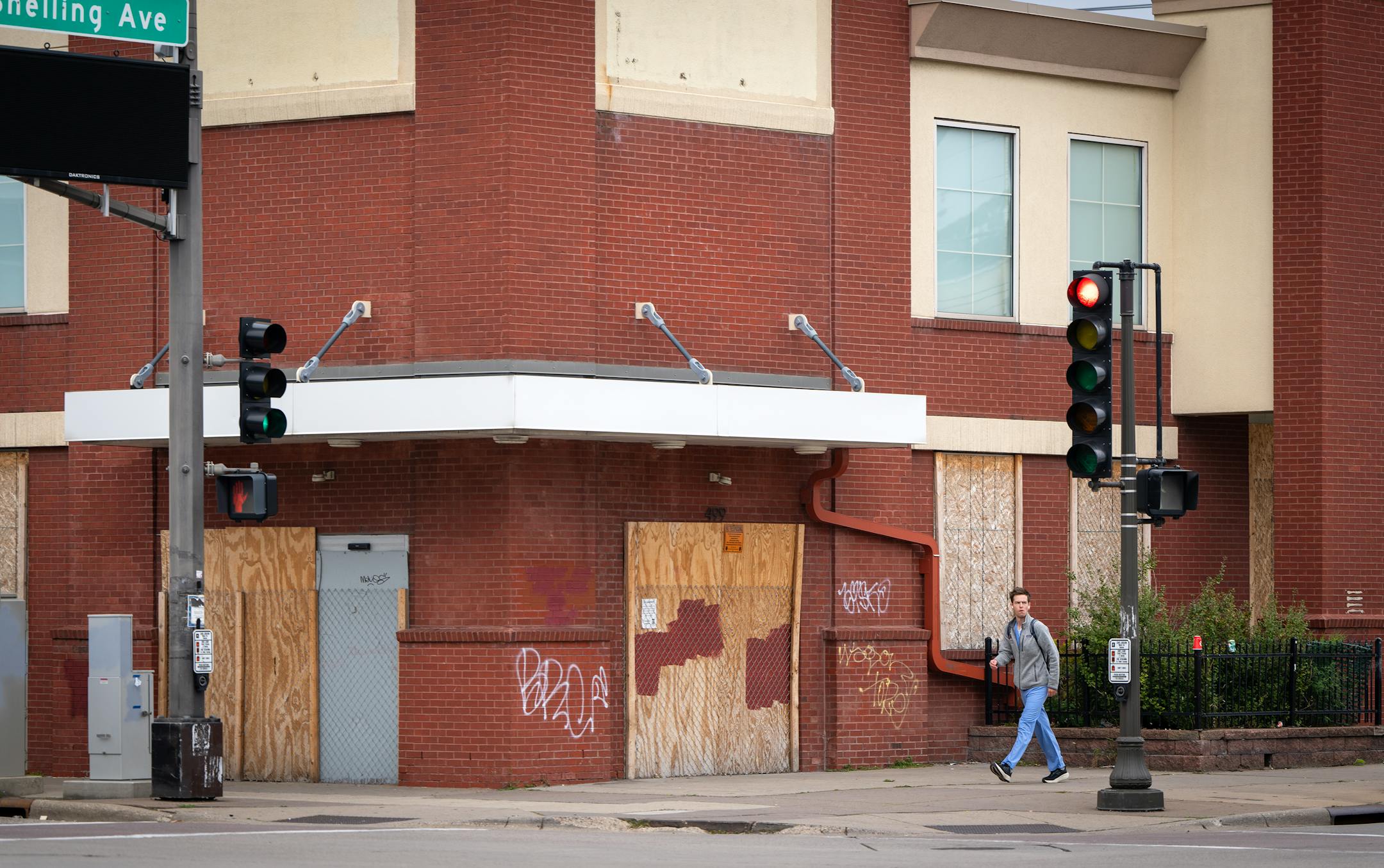
A pedestrian walks toward the light-rail train stop past the boarded-up CVS at the corner of Snelling and University avenues in the Midway neighborhood of St. Paul on Sept. 9. (Leila Navidi/The Minnesota Star Tribune)

The four corners of Snelling and University avenues show both St. Paul’s strengths and the city’s most intransigent challenges.

The two major streets and light-rail line bring millions of people a year through St. Paul and to destinations in the Midway neighborhood and boast a row of small businesses and a soccer stadium surrounded by future development — as well as an aging office building, an abandoned pharmacy, and transit stations that are known more as hangouts for people experiencing homelessness and addiction than for timely train and bus service.

To get a sense of how St. Paul’s two leading mayoral candidates, incumbent Mayor Melvin Carter and state Rep. Kaohly Her, would address these challenges, the Minnesota Star Tribune visited the intersection with each of them, and asked about the different issues on each of the four corners and at the light-rail stations.

Here’s what they had to say about the different facets of Snelling and University.

The empty CVS

The vacant pharmacy building on one corner is just one empty chain store in the city, but it has become a symbol in the campaign to allow St. Paul to issue “administrative citations,” or civil penalties such as a ticket or a fine that would give teeth to code enforcement.

St. Paul voters will decide if they want the city to be able to issue administrative citations, and both Carter and Her are in favor of the measure. The two have even campaigned together in support of the question.

“The owners of this building and CVS haven’t had, for some reason or other, haven’t had the same sense of urgency that we have,” Carter said. He hopes administrative citations will help the city prevent properties from becoming such big problems in the future.

Once the CVS is torn down — and that is likely, with the City Council set to vote on the issue early next month — Carter thinks the property owner will want to develop or sell the property soon, rather than wait for more development across the street around Allianz Field.
“There’s economic opportunity here that somebody’s going to want to realize,” Carter said.

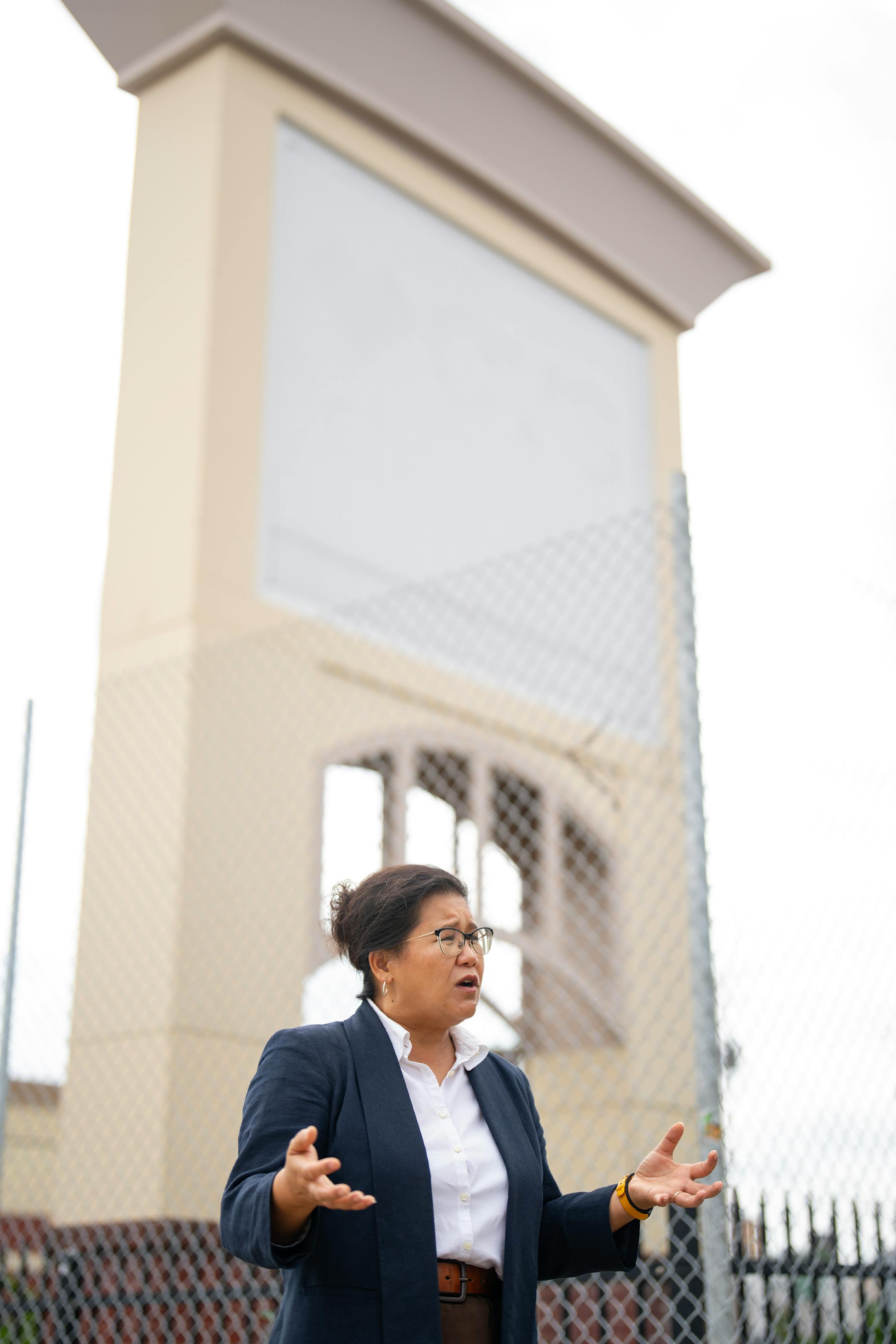
Her supports the administrative citations push but wants to see the city engage earlier with the owners of vacant buildings and empty lots.

“The owners of this building received a nuisance order and they didn’t respond,” Her said. “We think we send off a letter and we’ve done our job.”

As a legislator, Her said she prefers to make a phone call — even when it comes to the biggest developers or multinational companies — and establish some kind of working relationship with another person, rather than just sending a letter into the ether.

Ideally, she said, the city would proactively engage with some of the biggest property owners in St. Paul before buildings become derelict.

“When you let an issue fester and then you wait until the outcome, it is a lot harder to fix.”

“We think we send off a letter and we’ve done our job," said mayoral candidate Kaohly Her about nuisance properties like the former CVS at the intersection of University and Snelling avenues in St. Paul. (Alex Kormann/The Minnesota Star Tribune)

Spruce Tree Center

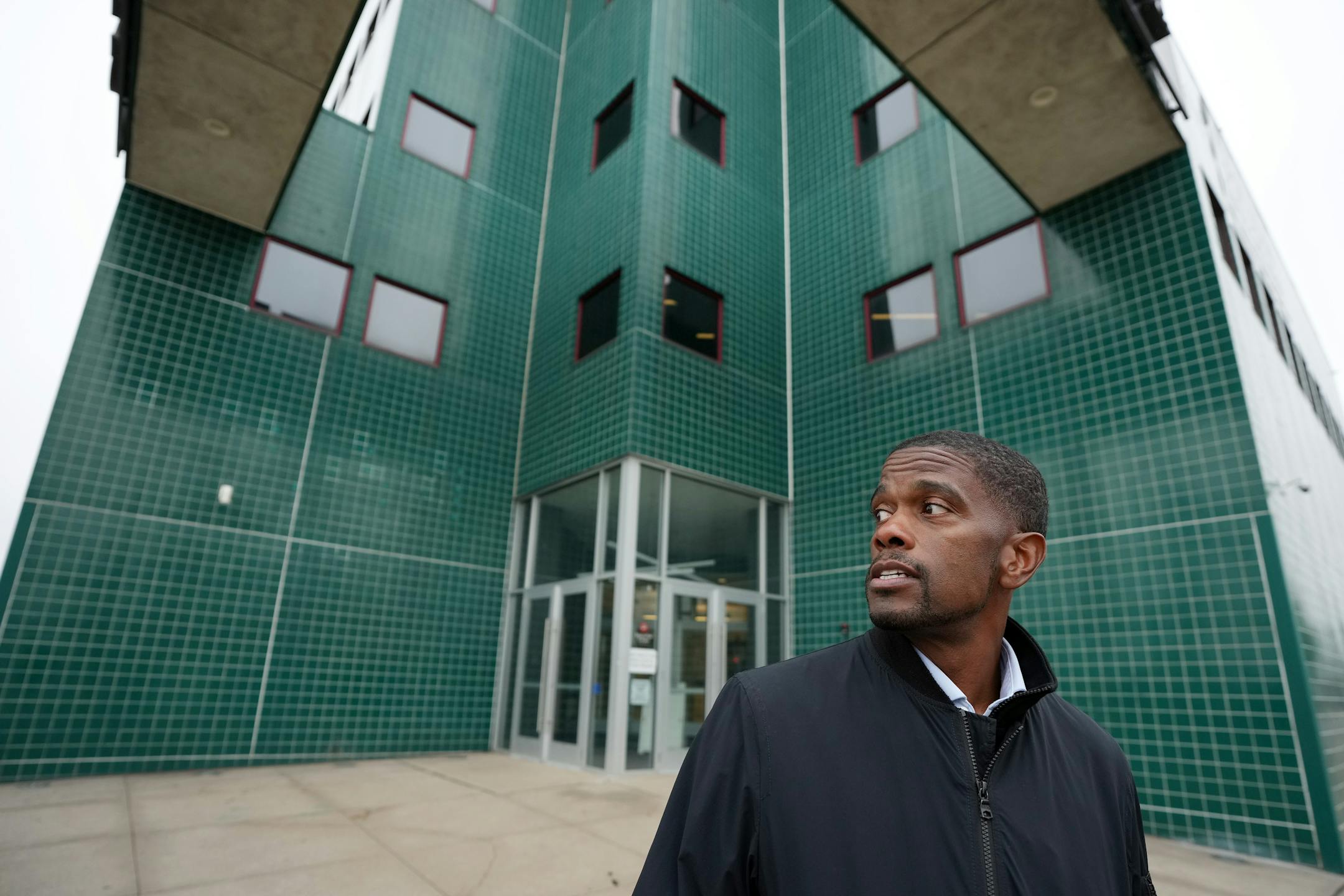
Across University Avenue from the CVS is the Spruce Tree Center, the green-tiled building that has become a St. Paul landmark, even as it struggles to fill office space.

The building is emblematic of metro-area office buildings, especially older ones, that have remained stubbornly emptier than before COVID-19. University Avenue has several such office buildings along its St. Paul stretch.

Carter said office buildings will have to upgrade or adapt post-pandemic.

“We’ve got an office building coming up right here,” he said, pointing across Snelling to the construction around Allianz Field. “And they are getting leases.”

Carter’s administration has also pushed for office buildings to be converted to apartments. But that work has come at great expense, and so far has also required a city subsidy in the form of tax-increment financing. Carter said he still thinks it’s still worth the effort and expense to bring people to live in St. Paul.

“You actually need those additional residents, particularly the University Avenue, particularly downtown,” he said. “That’s what helps to drive some of the restaurants that are coming in. That’s what helps to drive some of the amenities that are coming in.”

Her said she does not consider an office building like the Spruce Tree Center in isolation.

At Snelling and University, Her said more restaurants and more housing will help make the intersection more appealing to companies and office workers — which means the intersection has a lot riding on the success of the development around Allianz Field.

“When you look at what you’re trying to envision as a community, it starts to make more sense,” she said.

Her said she also wanted to see a citywide analysis of office buildings with high vacancy rates, blighted properties, mixed-use buildings with vacant retail spaces and open lots to understand better where city intervention might make a difference in underused space.

“The city can’t be built one building at a time,” Her said.

St. Paul Mayor Melvin Carter stands in front the Spruce Tree Center, which is emblematic of metro-area office buildings, especially older ones, that have remained stubbornly emptier than before COVID-19. (Anthony Soufflé/The Minnesota Star Tribune)

Development around Allianz Field

Minnesota United soccer club owner Bill McGuire has sky-high aspirations for turning the area around Allianz Field from vacant acres into a “slice of Paris.”

In a presentation Oct. 9, McGuire spoke about plans to bring a French bakery, a high-end pizzeria and an upscale diner to the plaza, along with a hotel and office building he says will open in the next two years, and eventually a garden and an ice-skating rink.

Carter says these plans are evidence something is going right in Midway. He hopes to see more such development along University Avenue, replacing some of the vacant big box stores such as the closed Cub Foods and former Walmart, and changing the way the avenue has been “underutilized” for Carter’s entire life, he said.

For Her, loitering and drug use are limiting growth in the neighborhood. She said she has been impressed with the efforts of private security on the stadium property to move people along. Keeping people from sleeping or using drugs in public will help others feel more at ease, and more apt to spend time and money in Midway.

“If we don’t enforce that, and bring you somewhere you’re going to be safe, we’re always going to have public safety issues,” she said. “Enforcement does make a difference.”

But she said that has to be coupled with offering real help to people with nowhere to go.

Small-business struggles

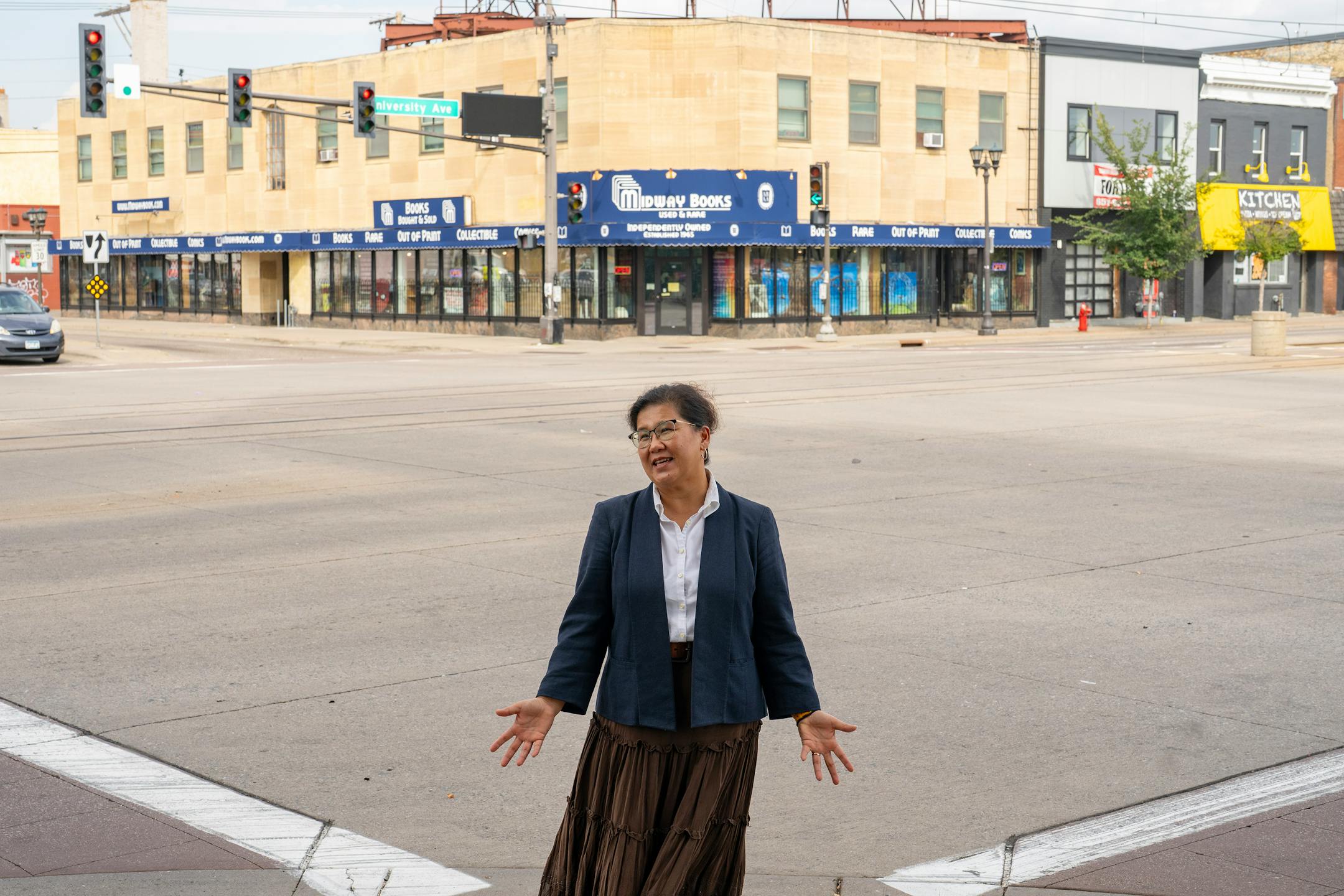
The northeast corner of Snelling and University is home to a handful of smaller businesses, including a book shop, a liquor store, and a bar and restaurant.

Her said that quality-of-life issues in Midway threaten mom-and-pop businesses, whose customers will go elsewhere if they don’t feel at ease.

“This is an ideal location. We have to figure out how to make people want to come down here,” Her said. “There’s so much richness, but you have to invest in that richness.”

Carter pointed to the city’s Commercial Corridors program, which gives local businesses and neighborhood business organizations funds for storefront improvements and fresh signs.

“We want to make sure that you look all along [University] and say, ‘Hey, we should stop there some time and go buy a book. That looks like a great place to have lunch.’”

But Carter said the city’s limited budget means that funding the program cannot reach every business.

Beautifying storefronts is not enough, Her said.

“If people can’t get into your establishment because of what’s happening around it, you lose that.”

Her said she has heard complaints from business owners that city bureaucracy has been unresponsive on small permitting matters.

She said she would also work more to connect the city with neighborhood chambers of commerce and cultural business that are already working to support small businesses.

Kaohly Her, a Minnesota state representative and candidate for mayor of St. Paul, at the intersection of University and Snelling avenues in the Midway neighborhood of St. Paul. (Alex Kormann/The Minnesota Star Tribune)

Light-rail stations

The Green Line has not recovered its pre-pandemic ridership, although the Metropolitan Council has deployed more police and fare enforcement and has worked to clean up stations, the train has yet to shed its pandemic-era reputation for smoking and drug use on the trains and at the stations. The stop at Snelling and University is one that has become notorious.

Her said she wanted to see St. Paul work more closely with the Met Council on these issues.

“People are willing partners if you are a willing partner,” she said, wondering if St. Paul could help with cleaning the stations, or even painting them to look more inviting.

“I wish I had this magic solution of: These are the big grand things you would do. But the solutions are so simple. It’s these conversations,” Her said. “Convene the people with the solutions and the resources. It is as simple as that.”

From Carter’s perspective, that collaboration is already happening.

“I have been encouraged by the additional controls and additional staffing that Metro Transit and the police are putting on here,” Carter said. “That feels like it’s already making a difference.”

St. Paul Mayor Melvin Carter, standing at the light-rail station near the intersection of Snelling and University avenues, discusses his vision and plans for tackling some of the city’s biggest challenges. (Anthony Soufflé/The Minnesota Star Tribune)
about the writer

about the writer

Josie Albertson-Grove

Reporter

Josie Albertson-Grove covers politics and government for the Star Tribune.

See Moreicon

More from St. Paul

See More
card image
Leila Navidi/The Minnesota Star Tribune

Music, stories and more make up “An Evening of Children’s Literature” at Ordway hall.