

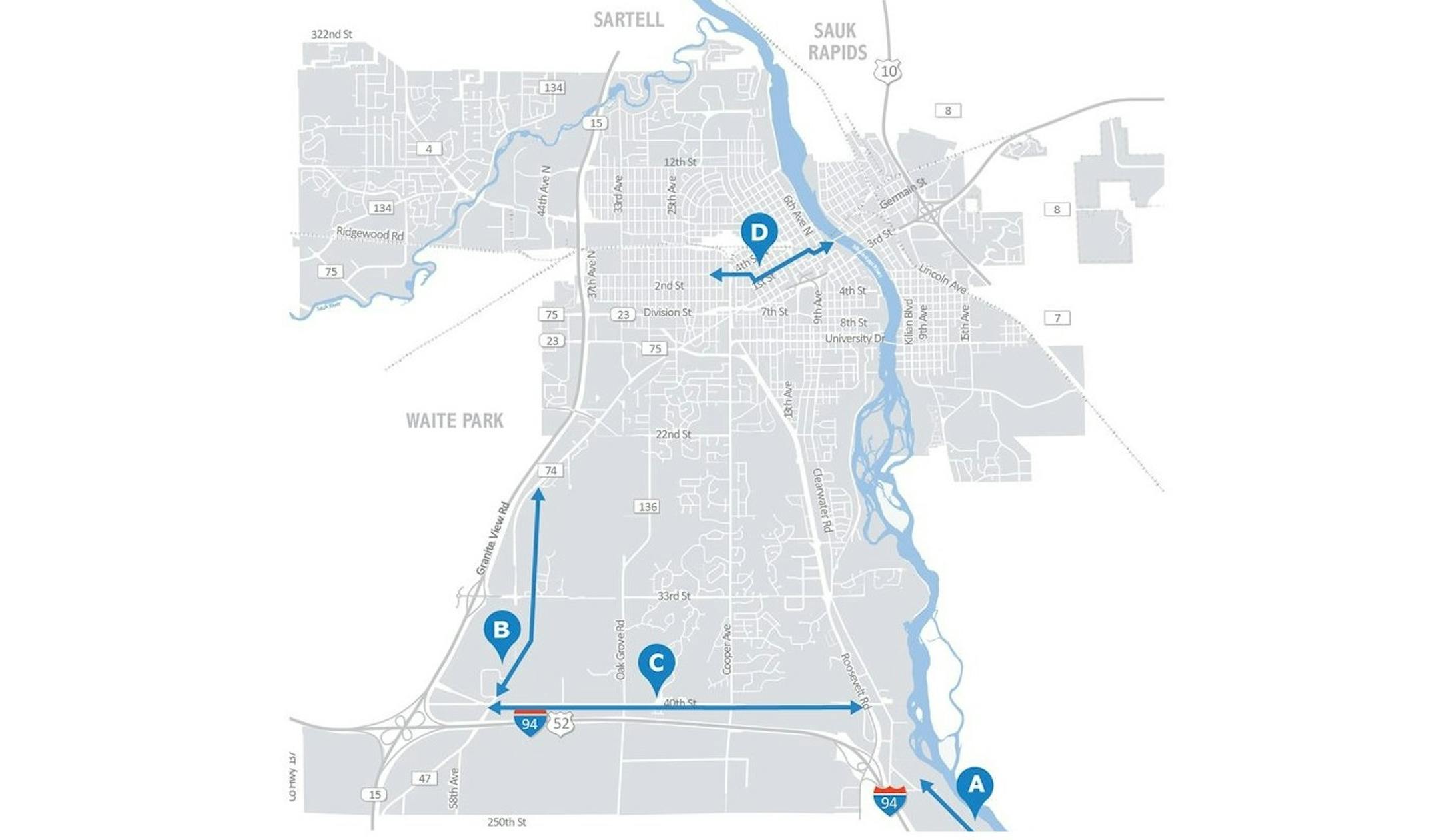
ST. CLOUD — City officials here are looking to reduce traffic congestion and enhance economic development by overhauling four regionally significant roads — and plan to ask voters to approve a sales tax pay for it.
The St. Cloud City Council on Monday unanimously approved asking the Legislature for permission to put a special question on the ballot this fall that would, if approved, implement a new half-cent sales tax to pay for the road projects.
The ballot already includes a special question on using sales tax proceeds to fund improvements at the St. Cloud Municipal Athletic Complex; the Legislature approved that request last year.
The city has sought legislative approval for the road projects for the last two years but legislators denied the request in 2020 and 2021.
The proposed tax would be in addition to the half-cent sales tax already collected in St. Cloud. The city, along with neighboring cities, started collecting a voter-approved sales tax for projects of regional significance nearly two decades ago. In 2014, voters approved extending the sales tax through 2038, with proceeds helping pay for the St. Cloud Area Family YMCA, as well as projects at the airport and on regional trails.
The new half-cent sales tax, if approved, is estimated to collect about $109 million in proceeds over 20 years. The proposed road projects include:
- Extension of Heatherwood Road and replacement of outdated sewer main on the south side of city to create access to new and existing businesses along the Interstate 94 corridor — $35 million over eight years.
- Widening and improvements on Stearns County Road 74, which connects Hwy. 15 and I-94 to St. Cloud's west side — $11.5 million over three years.
- Expansion of S. 40th Street, which will close the 6-mile gap between Hwy. 15 and Stearns County Road 75 on the city's south side — $7.5 million over two years.
- Constructing a continuous three-lane corridor along N. 2nd Street and N. 3rd Street from Hwy. 15 to one of the three Mississippi River crossings, which will increase capacity and reduce travel times near the city's central business district and downtown — $26.8 million over six years.
The estimated costs do not include debt-related costs.
In addition to denying the city's request last year, the Legislature ultimately amended state law to "specifically exclude regionally significant road projects from the statutory definition of capital project," according to Matt Staehling, city administrator.


