

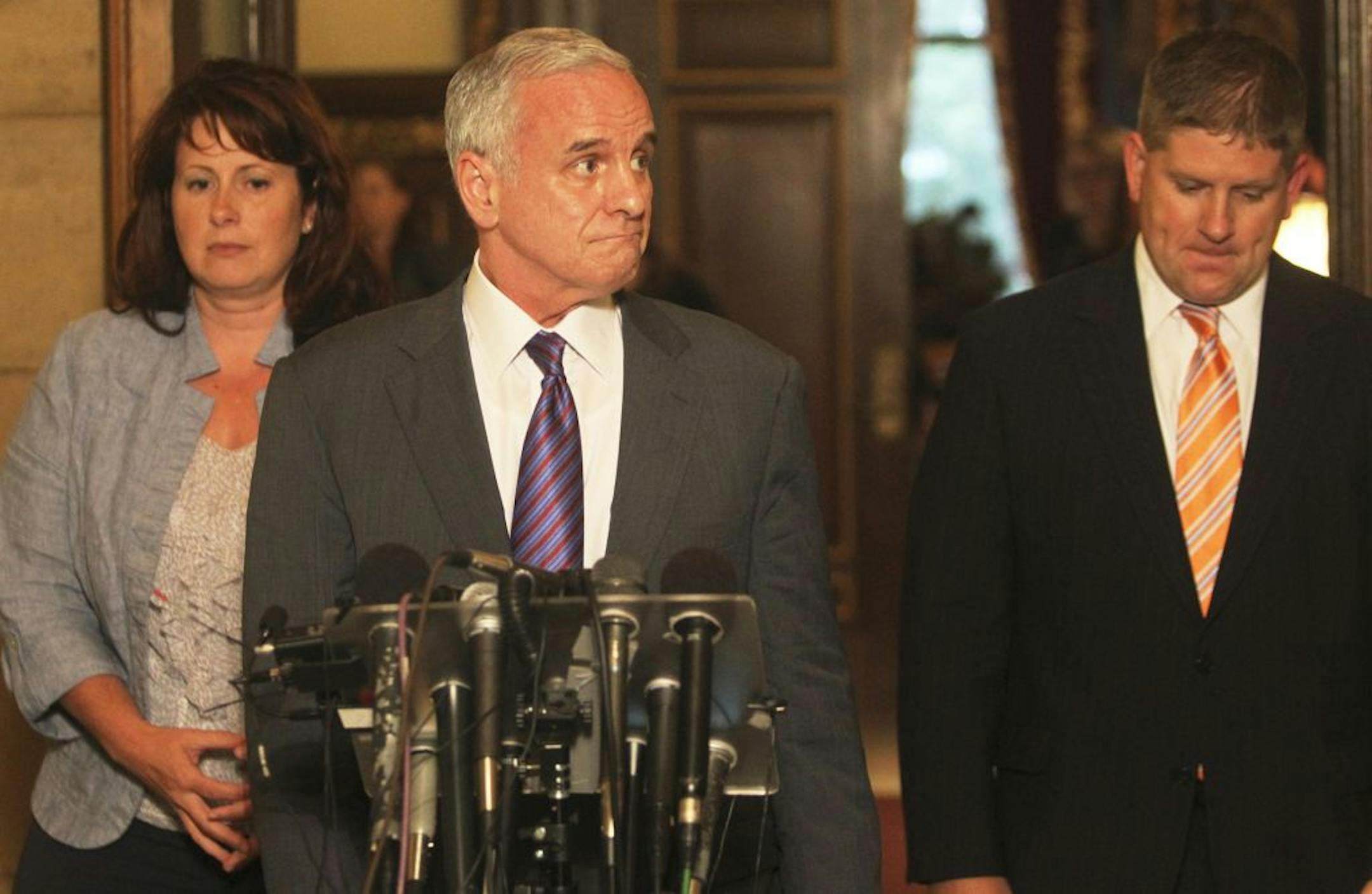
Gov. Mark Dayton will call a special session of the Legislature to begin Monday in the hopes of ending the state government shutdown sometime next week.
The DFL governor announced a tentative schedule Friday, a day after he and Republican legislative leaders reached a budget deal that had eluded them since July 1.
Appearing on Minnesota Public Radio, Dayton said legislative committee chairs and his commissioners have a deadline of 10 p.m. Friday to shape the bills that must be passed for state government can resume functioning. Those bills will then be turned over to the Revisor of Statutes. Once that office's work is done, the final bills will be presented to legislators.
Dayton and the leaders said Thursday they believed the special session can be wrapped up in a manner of days.
Government can start back up and 22,000 state workers can return to work as soon as the bills are passed and signed into law.
During an hour-long interview, Dayton both defended and denigrated the budget deal. "I feel very good actually about the result," he said. "Nobody's entirely satisfied with it…What's important about this agreement is that the level of spending for essential services is the one I established about six weeks ago." Within moments of calling the deal "a good budget for the future of Minnesota," Dayton also said "there's plenty for anybody not to like." Dayton also said a misunderstanding between the two sides in the final hours before the shutdown began may have contributed to it. Dayton and his aides didn't realize at the time that the Republicans' final offer – which Dayton accepted Thursday – had dropped their demand to include social policy changes in budget bills while supporting his call for a $500 million bonding bill. "We were in constant communication," he said. "I don't know whether there was miscommunication or subsequent revision. I don't know. What's done is done. The important thing now is to get an agreement very quickly." Dayton said he plans to push for laid-off state workers to receive back pay they lost while out of work. He's confident that last-minute disagreements won't derail the agreement. "I don't think anything's going to scotch the deal," he said. "The rough edges and details can certainly be resolved." As for criticism from some DFLers that he he caved in to the Republicans, Dayton replied, "I didn't give in – I got the budget level that I wanted." He said his support for raising income taxes on the wealthy is undiminished, despite his experience this year. "I'm not going to give up on this. I'm going to come back, if not next year, the year following in the next budget session and make the same case," Dayton said. "I believe in it. It's an essential part of making this society fair … I'll advocate for it, campaign for it, press for it for as long as I'm drawing breath." A laid-off state employee calling in to the radio show said Dayton's decision "feels like capitulation to me" and was willing to endure a longer shutdown. "A absolutely agree with you," he said, reiterating his long-standing pledge to raise taxes. "I the last six months I ran into an absolute stone wall with Republicans," he said. "This was making the best solution possible under [the] circumstances." Dayton has low expectations for how much support the deal will get from legislators of his own party. "It may be there are some [bills] they find they can support," such as the education bill, he said. "There will be bills that have bipartisan support. The tax bill, I wouldn't vote for, either."


