

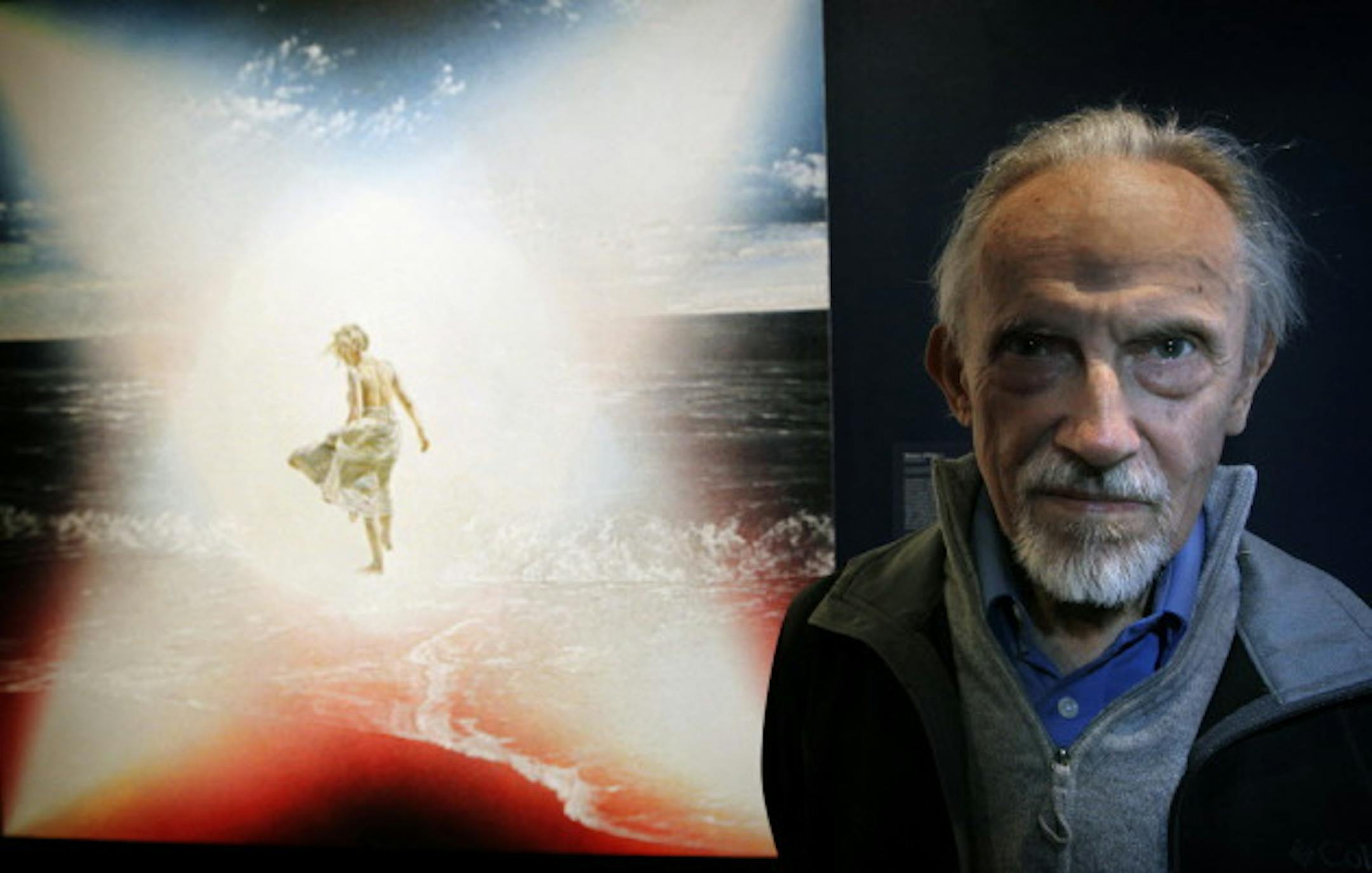
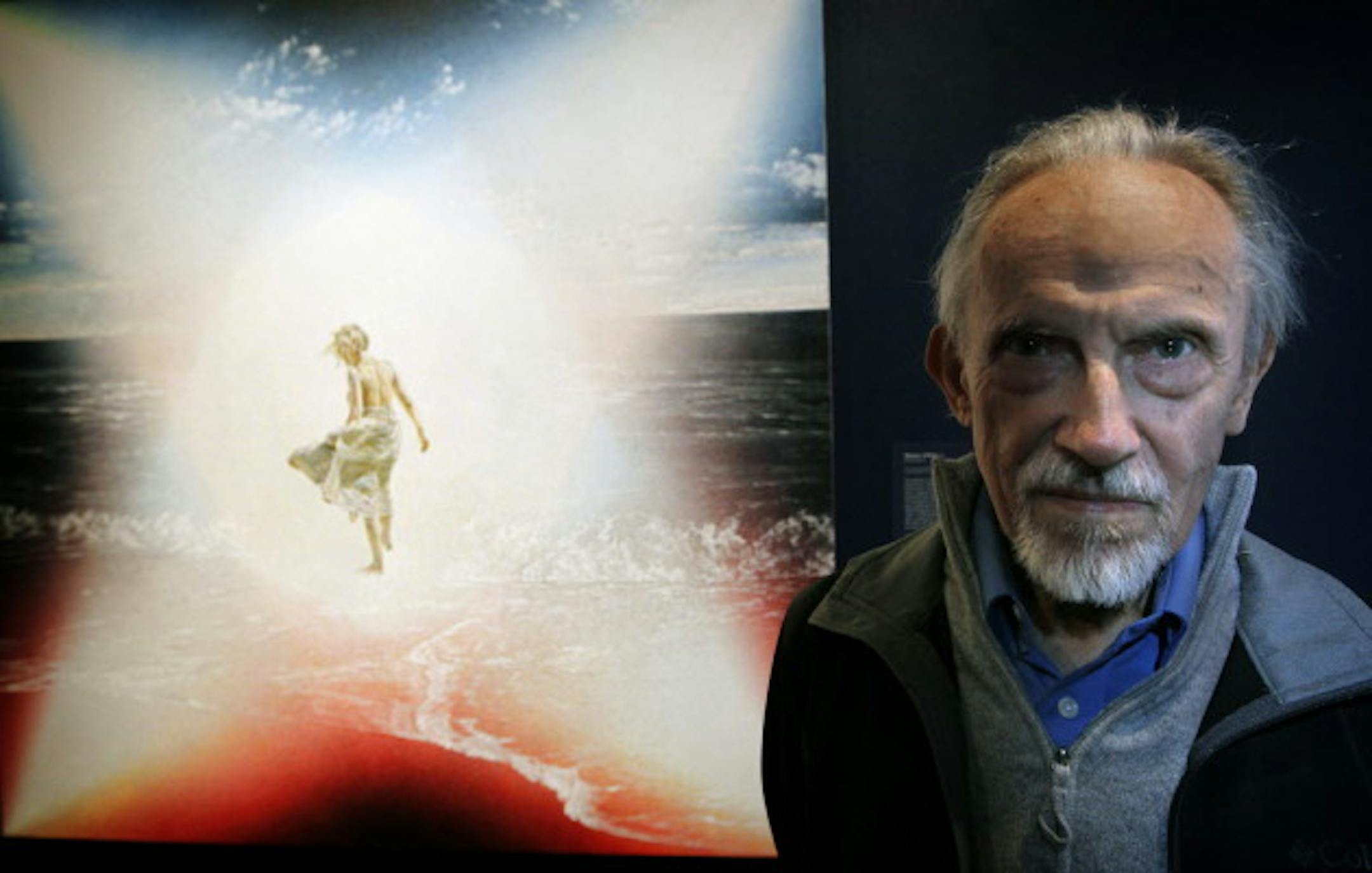
Portrait of Oleg Vassiliev with his painting of his wife Kira walking from a beach into a bowl of light. Star Tribune photo by Tom Wallace taken in November 2011.
Internationally known for his serene paintings and elegant graphic designs, Oleg Vassiliev was officially scorned in his Soviet homeland for his failure to embrace the government's aesthetic dictates. Despite foreign fame, he never had an official exhibiton in his homeland until after the U.S.S. R. dissolved in 1991.
Vassiliev died Friday, January 25, 2013 at a hospice near his home in Shoreview, MN, a suburb of St. Paul. He was 81 and had been ill with cancer for more than a year, although he continued to paint until shortly before his death.
After the Soviet Union collapsed, Vassiliev and his wife Kira emigrated, first to Paris and then to New York City. His wife died in 2010, after which he moved to Shoreview to be closer to his son Alexei who survives him.
His death was announced by The Museum of Russian Art (TMORA) in Minneapolis on behalf of his family. The museum staged two exhibitions of Vassiliev's art in 2011. One was a quasi-retrospecitve featuring more than 20 of his paintings. The other showcased a suite of 30 etchings inspired by a story by Anton Chekhov. Executed in Paris in 1991, the Checkhov suite had not been exhibited previously in its entirety.
The Russian museum also threw a gala to mark Vassiliev's 80th birthday in November 2011. The event attracted friends and admirers -- artists, publishers, collectors -- from Paris, Moscow, New York and even Columbus, Ohio.
Born in Moscow in 1931, Vassiliev graduated from the Surikov Art Institute in Moscow in 1958 and spent the next three decades designing and illustrating books including children's tales which he injected with unusual sophistication and wit. The innocuous profession enabled him to earn a living while pursuing his own art in private.
Non-confrontational by temperament, he slipped into a kind of internal exile to avoid antagonizing authorities. "The path to socio-political struggle . . . was impossible for me," he wrote in a 1997 biographical essay. "What we created for ourselves in the studio, we tried not to show to the officials. Our only viewers were friends and a narrow circle of acquaintances."


