

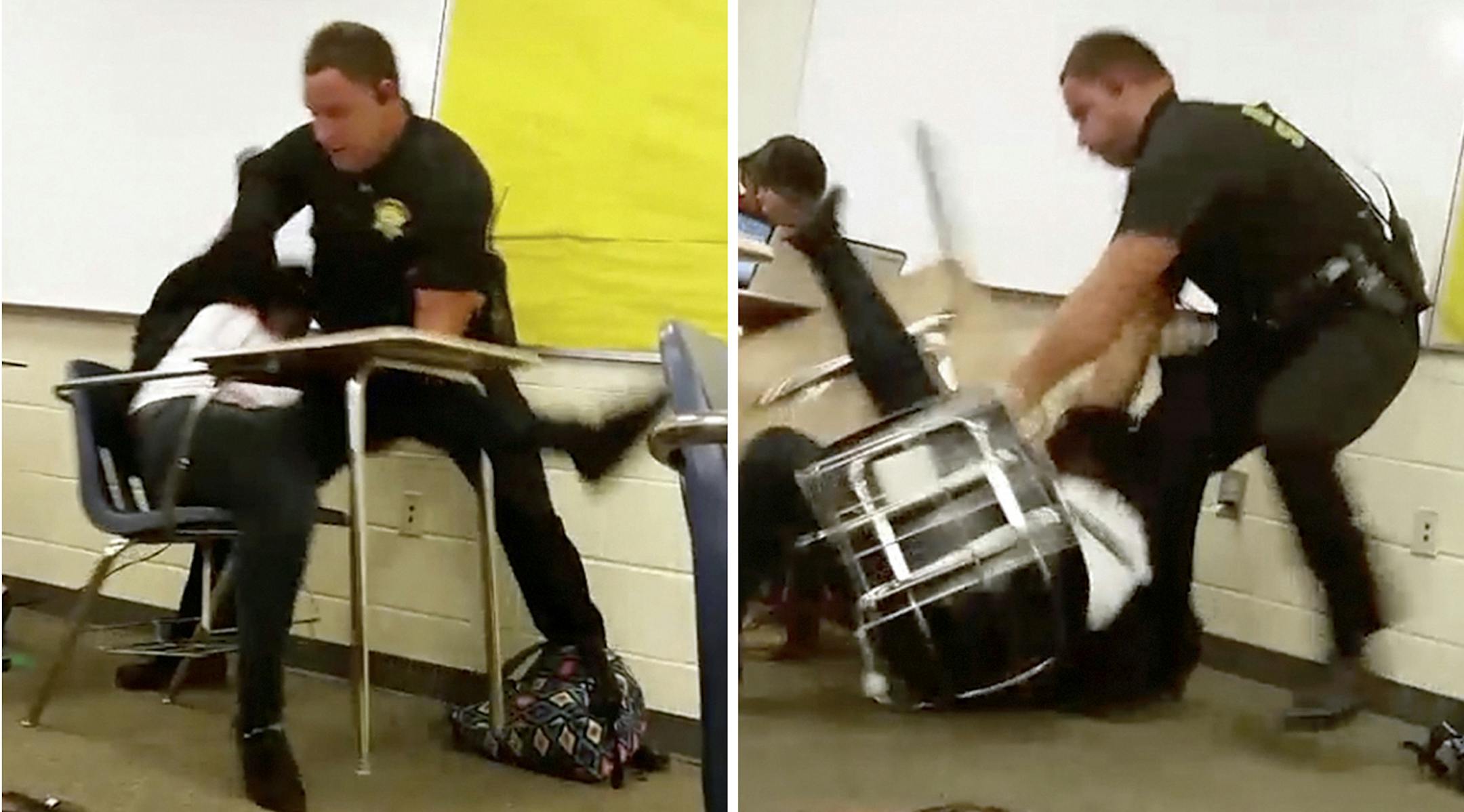
The media coverage of police confrontations is changing the mantra of young officers to: "Serve and protect — but for God's sake, if you want to stay employed, don't enforce anything!"
In the wake of the "Tossed Teenager" in Columbia, S.C., police officers may be coming to the conclusion that inaction has certain career-enhancing possibilities that enforcement lacks.
So, were the actions of the Richland County sheriff's deputy appropriate? Before that can be answered, let's consider the situation he was called to. A student violated school policy by texting in class and was ordered by her teacher to surrender her phone. The student refused, and the police liaison officer was called to enforce the teacher's request.
That officers should be stationed in schools is a no-brainer. They should be there to safeguard the students and to investigate crimes both against students and committed by students. However, they should not be used to enforce school discipline. And while I know from experience both as a police officer and as a teacher that enforcing school rules can be a slippery task, it is not the police officer's job.
After the student refused to give up her phone, the teacher should have asked the student to leave the classroom and make her way to the principal's office. If the student refused that, the principle or dean of students should have been notified, and the student should have been intercepted by school personnel (or private security, if employed by the school) in the hallway after class.
In a worst-case scenario where a student becomes verbally or physically threatening or abusive (read: "assaultive") and the police are called, a minimum of two officers should always be called to respond.
The reasons are manifold. First, if force is required to bring the student under control, there is much less chance of violence and injury if the student sees that the odds are not in his or her favor. Second, if a physical confrontation ensues, it's much simpler for two officers to control and, if necessary, subdue a student. Finally, if other students enter the imbroglio, two officers have a much better chance of de-escalating the situation than does a single overwhelmed officer.
So, back to the question of the officer's questionable actions: Let's first consider physiological factors. Being in a confrontation, in a full classroom, "on stage" so to speak, with a disruptive, uncooperative, bratty, disrespectful young lady, is a very uncomfortable situation. When humans enter such situations, their adrenaline starts to flow, giving them a boost of energy that can save their lives if a reserve of strength is needed. Unfortunately, if an officer is not careful, this adrenaline rush can distort his or her actions.


