
Souhan: Ed Sabol reeled in the modern NFL

Ed's creation of NFL Films helped the sport become an American obsession.

February 11, 2015 at 1:42PM
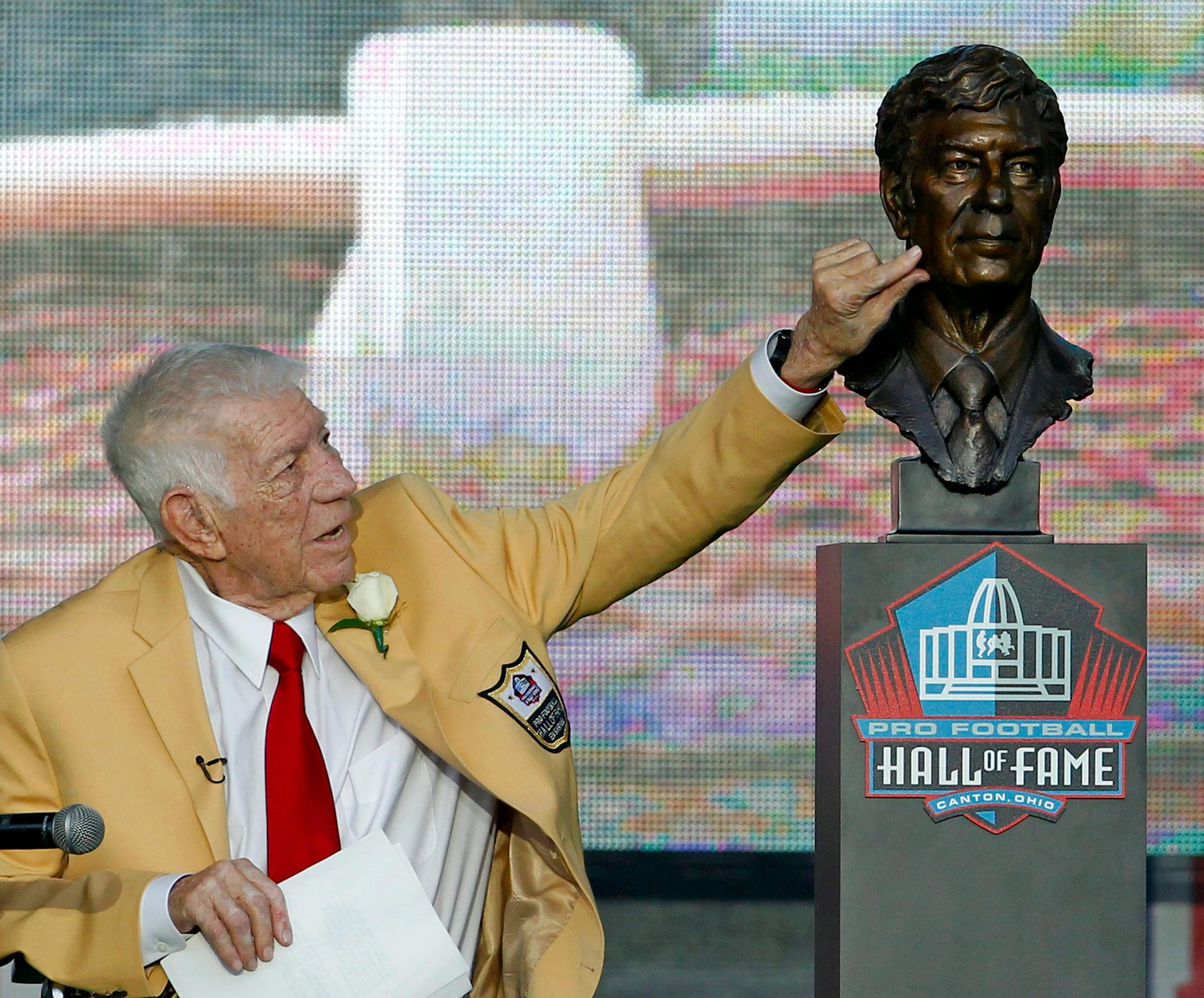
Ed Sabol touches a bust of himself after it was unveiled during the induction ceremony at the Pro Football Hall of Fame in Canton, Ohio. Sabol, the NFL Films founder, died Monday, Feb. 9, 2015, the league said. He was 98. (AP Photo/Ron Schwane, File)
Ed Sabol touches a bust of himself after it was unveiled during the induction ceremony at the Pro Football Hall of Fame in Canton, Ohio. Sabol, the NFL Films founder, died Monday, Feb. 9, 2015, the league said. He was 98. (AP Photo/Ron Schwane, File) (Brian Stensaas — ASSOCIATED PRESS - AP/The Minnesota Star Tribune)

Southerners used to say their two most popular sports were football and spring football.

There was a time when that saying was cited by Northerners as proof of the simplemindedness of Southern sports fans.

Even as that saying has moldered, a new nationwide reality has replaced it. In today's America, there are four seasons: NFL draft season, NFL free agent season, NFL training season and NFL game season. It is never not football season, and the credit for that belongs as much to Ed Sabol and his son, Steve, as anyone.

One form of genius is seeing that which others can't or won't. That the world is round. That the forward pass could become the most reliable way to move a football. That the ugly, bloody, mud-strewn, primordial game of professional football in the early 1960s could be remade into populist opera.

On Monday, Ed Sabol died at the age of 98. His son, Steve, died of brain cancer in 2012.

They, along with former NFL Commissioner Pete Rozelle, were perhaps the first men in America to recognize that professional football could become something more than stop-action rugby. That football could surpass baseball and all other sports to become a year-round national obsession.

One of Sabol's wedding gifts was a $100 gift certificate with which he bought a 16-millimeter camera. He used that device to film everything in his path, and especially Steve's football exploits.

Ed eventually quit his job as a coat salesman for his father-in-law and outbid competitors for the right to shoot the 1962 championship game between the New York Giants and the Green Bay Packers.
Somewhere along the line, Ed Sabol told Vince Lombardi that Sabol would make him the John Wayne of the NFL. Lombardi liked the idea. He liked the eventual reality even more.

Sabol's work in those early days led to the Pro Football Hall of Fame, a business that eventually produced more than $50 million a year, and the exponential increase in popularity in a sport that once seemed to be hopelessly lagging behind baseball. No matter how many hundreds of millions Sabol made, NFL Films did more for the league than the league did for him.

It's difficult for younger generations to grasp these days, but in the early '60s, baseball could call itself "America's Pastime" without irony.

Pro football was an intriguing oddity.

Sabol made the NFL cinematic. He took raw and often uninteresting footage and added martial scores, slow-motion replays, reverse-angle camera shots, closeups of bleeding limbs and battered faces, and added the basso profundo of John Facenda. Sabol didn't just improve the persona of the NFL. He created it.

Sabol did for football what the great Japanese director Akira Kurosawa, one of his influences, did for the action film — made it romantic, even strangely beautiful.

The director Sam Pekinpah watched Sabol parse pass plays in slow-motion and adopted the device for his shootout in "The Wild Bunch."

Today, highlights of NFL games are available on multiple platforms and devices and a dozen cable channels. In Sabol's early years with the NFL, home games were often blacked out, and access to highlights often was limited to halftime of the Monday Night Football broadcasts. Sabol helped make those highlights the most exciting minutes of the week for any football fan.

Vikings coach Jerry Burns once told me of his sideline view, "Ah, you can't see anything. It's just bodies flying around. It's a mess."

Sabol saw that, with the right camera angles and craftsmanship, the NFL could look and sound like violent ballet. He sped pro football's rise to its current perch atop the North American sports world. Football may have reached these heights without him, but not as quickly, and not as surely, and not with so much infused grace.

Jim Souhan's podcast can be heard at souhanunfiltered.com. On


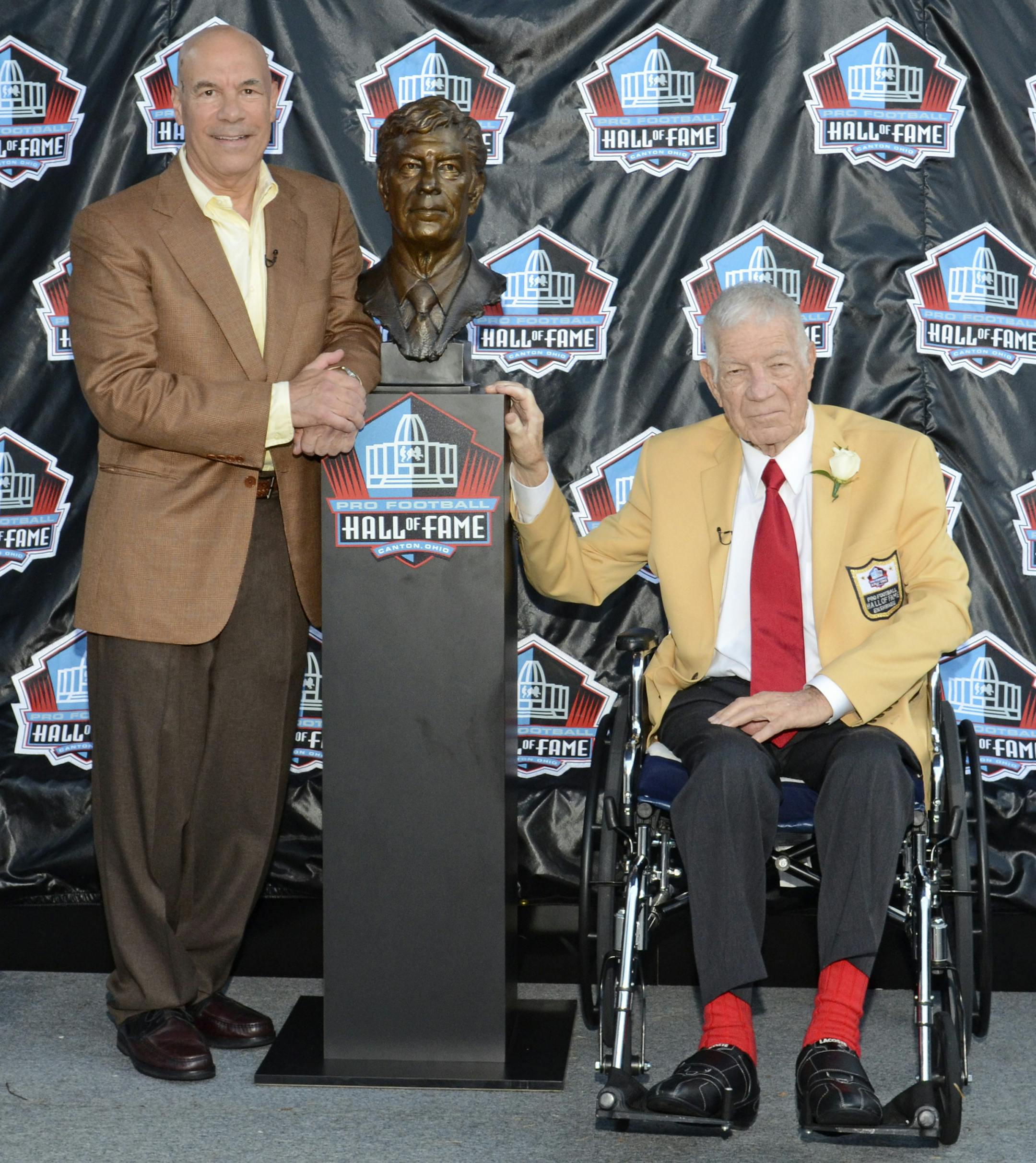
FILE - In this Aug. 6, 2011 photo provided by the Pro Football Hall of Fame, Ed Sabol, right, poses with a bust of himself and his presenter Steve Sabol during induction ceremonies at the Pro Football Hall of Fame, in Canton, Ohio. NFL Films President Steve Sabol has died from brain cancer. He was 69. The NFL said Sabol died Tuesday, Sept. 18, 2012, 18 months after he was diagnosed with a tumor on the left side of his brain. Sabol started working with his father Ed, NFL Films' founder, in 1964,
Ed Sabol, right, posed with a bust of himself and his son Steve Sabol at the Pro Football Hall of Fame in Canton, Ohio. Ed, the founder of NFL Films, died on Monday at 98 years old. (The Minnesota Star Tribune)
about the writer

about the writer

Jim Souhan

Columnist

Jim Souhan is a sports columnist for the Minnesota Star Tribune. He has worked at the paper since 1990, previously covering the Twins and Vikings.

See Moreicon

More from No Section

See More
FILE -- A rent deposit slot at an apartment complex in Tucker, Ga., on July 21, 2020. As an eviction crisis has seemed increasingly likely this summer, everyone in the housing market has made the same plea to Washington: Send money — lots of it — that would keep renters in their homes and landlords afloat. (Melissa Golden/The New York Times) ORG XMIT: XNYT58
Melissa Golden/The New York Times

It’s too soon to tell how much the immigration crackdown is to blame.