
Some Cubans worry diplomatic thaw will shift after Obama presidency

Residents who like their lives fret about becoming more like the U.S.

June 13, 2015 at 9:10PM
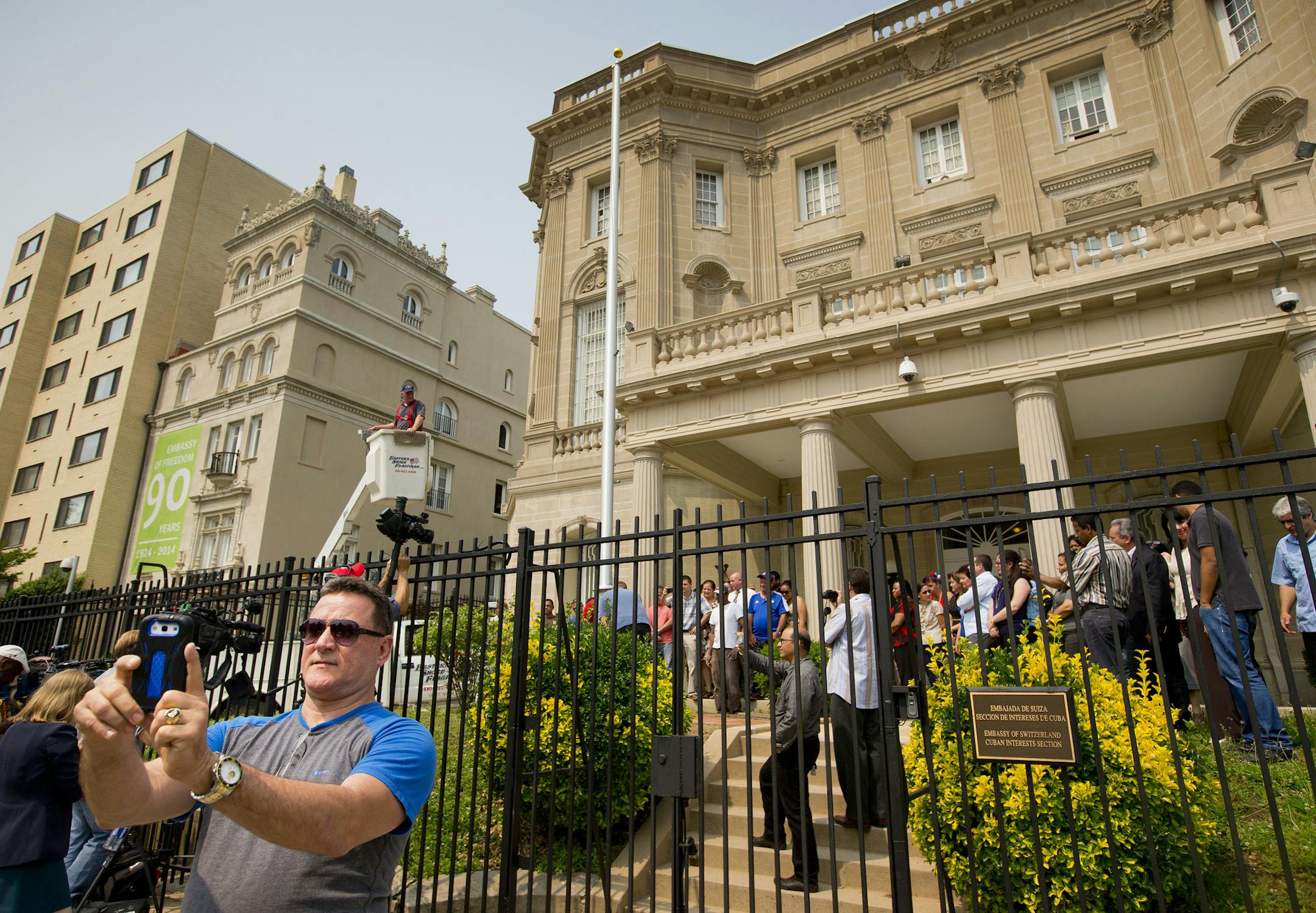
Fernando Rodriguez, left, uses his cellphone to take a selfie as workers from Eastern Shores Flagpoles raise a flagpole at the Cuban Interest Section in Washington in preparation for re-opening of embassies in Havana and Washington, Wednesday, June 10, 2015. Rodriguez from Lancaster, Pa., but originally from Mantanzas, Cuba, was visiting Washington to get his passport renewed and wasn't aware of the event until he saw all the commotion. Currently the Cuban Interest Section in US is under the aus
Fernando Rodriguez, left, took a selfie outside the Cuban Interest Section in Washington, D.C. (The Minnesota Star Tribune)

HAVANA – For all of his 27 years, Yaniel Nunez has been obsessed with one question: What becomes of Cuba in the post-Castro era?

It's a question that has obsessed the entire nation. But with the thaw in U.S.-Cuba relations begun by Presidents Obama and Raul Castro, there's a new question, one that also underscores concerns about an uncertain future.

"What becomes of us, Cuba, in the post-Obama era? That's the real question," said Nunez.

Will a flood of U.S. investment change the very nature of Cuba and its communist system? Or will a new U.S. administration slam the door on any further openings?

Havana is in a hopeful mood these days. But the mood is tempered with trepidation.

"I have lived my entire life in Cuba and have never felt so much hope about our two countries finally putting an end to this sad chapter," said Marta Rojas, an author and journalist who covered the beginning of the Cuban revolution in 1953. "The expectations are high, perhaps too high, with too many questions without immediate answers."

A poll last month by the Miami-based Bendixen & Amandi agency showed that Cubans overwhelmingly support normalizing ties with the U.S. and are optimistic about the future. Eighty percent have a positive opinion of Obama, compared with 47 percent for Raul Castro and 44 percent for his older brother Fidel.

The poll found that 97 percent of Cubans think normal ties with the U.S. would be good for Cuba. The majority support Cuba's free education and health care, but an overwhelming majority is dissatisfied with the political system and wants to own businesses.

Havana, the capital, remains a charming, unique and intriguing place, largely because of its relative isolation from U.S. culture and commerce. But a flourish of activity is underway, with the construction of new hotels and an expanded port for international commerce.

"U.S. business will be swarming all over Cuba in the next few years," said Dallas author Ben Fountain, who visited Cuba last year. "I just hope Havana doesn't end up looking like Orlando when it's all said and done."

For many Cubans, the most immediate worry is the upcoming U.S. presidential election. Many are warily keeping tabs on the campaign for signs of what may happen after Obama leaves office. Will the next president undo diplomatic ties and return Cuba to the list of countries considered sponsors of terrorism?

For now, Nay Melgar, 30, not only waits but dares to dream of something better.

Melgar works at a souvenir shop in Old Havana and practices English on customers — "be patient; I'm learning as I go" — as she sells flags and anything with the face of revolutionary icon Che Guevara.

She's grateful that the Cuban revolution has given the nation stability, she said, but at times feels her island is just an economic or political move away from disaster.

She'd like to see more opportunity. "Let us dream of what may be," she said. "I've waited all my life for this moment. Let us believe in the moment that Obama and Raul have given us."

Most Cubans lead a relatively peaceful existence but in a country riddled with charges of human rights violations and with limited media freedoms, Internet access and economic opportunity. Still, it ranks fifth in Latin America and the Caribbean for good governance, according to Transparency International.

"We're a peaceful, friendly country, where my family doesn't have to worry about schools, or getting sick," said Nunez, who has three children. "What's the alternative? A U.S.-style life with racial tensions, like Baltimore?"

"Or do we want to live like Mexico," he continued, "with more freedoms, and so much violence? Those are questions we have to figure out as we go along. We want to live better, that's for sure, but not lose what we have gained."

about the writer

about the writer

Alfredo Corchado, Dallas Morning News