

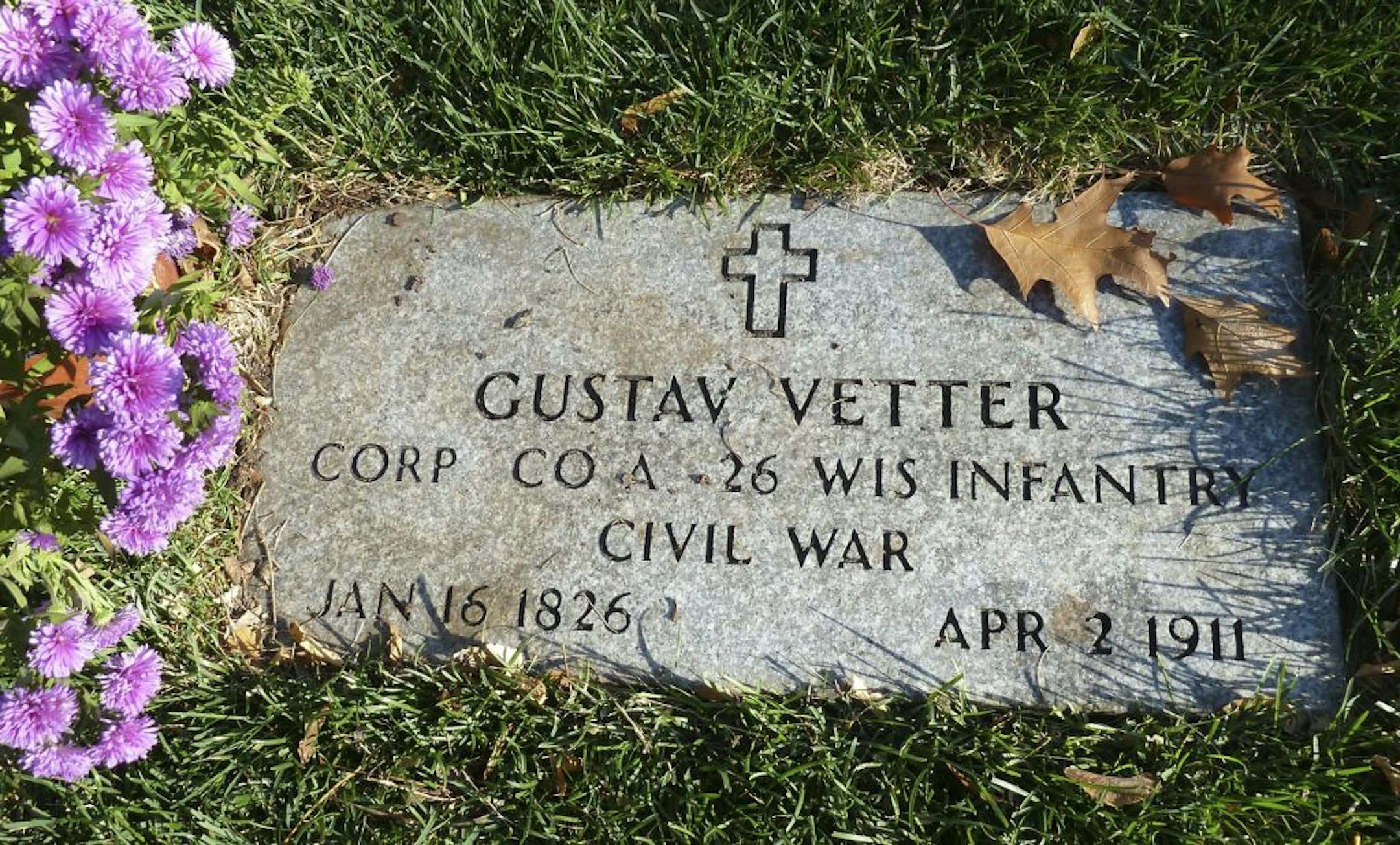
For 45 years, Gustav Vetter's grave at Lakewood Cemetery in Minneapolis was virtually anonymous.
A small marker in the ground simply said "Father." Next to it was a marker for "Mother and son Charles." The tall family marker that had once dominated the Vetter plot had been vandalized and apparently shattered in 1965.
Thanks to the Veterans Administration and Minneapolis/Richfield American Legion Post 435, the Civil War veteran who died a century ago has a grave marker again. The stone was dedicated last weekend with a post ceremony that included an honor guard, a rifle salute and a flag presentation.
"It's about recognizing a veteran who served our country, even though it was 150 years ago," said Craig Dineen, post commander. "Part of our mission is to help out with stuff like this."
Vetter has a marker again because of his great-great-granddaughter, Susan Sullivan of Andover. Sullivan, a retired social worker, was doing some genealogical research a few years ago and tracked down the Lakewood plot.
"I knew other Vetters were there, but I was shocked to find that Gustav was buried there and I didn't know it," she said. "I was horrified to discover it had been vandalized when I was still a teenager. Just the base of the monument remains. I ran around the cemetery looking for the headstone; I thought 'Father' belonged to someone else."
Gustav was 85 when he died in Minneapolis in 1911. Sullivan's research showed that he was born in Germany and emigrated to America in 1848, a year of turmoil and revolutions across Europe. He married another German immigrant, Jeanetta Kuby, in Pennsylvania. They moved to St. Louis, Detroit and Wisconsin, raising eight kids along the way.
Gustav, who worked as a miller and a carpenter, joined the Union forces in 1862. He was part of Wisconsin's 26th Regiment, an all-German unit. During his tenure they fought at Chancellorsville, Gettysburg and Wauhatchie. Gustav was honorably discharged as a corporal in 1864 after he became ill.


