
How smoke from Canadian wildfires is affecting trips to northern Minnesota

Northbound explorers can quickly determine where and when the smoke is bad, and make these adjustments.

The Minnesota Star Tribune
July 31, 2025 at 9:31PM
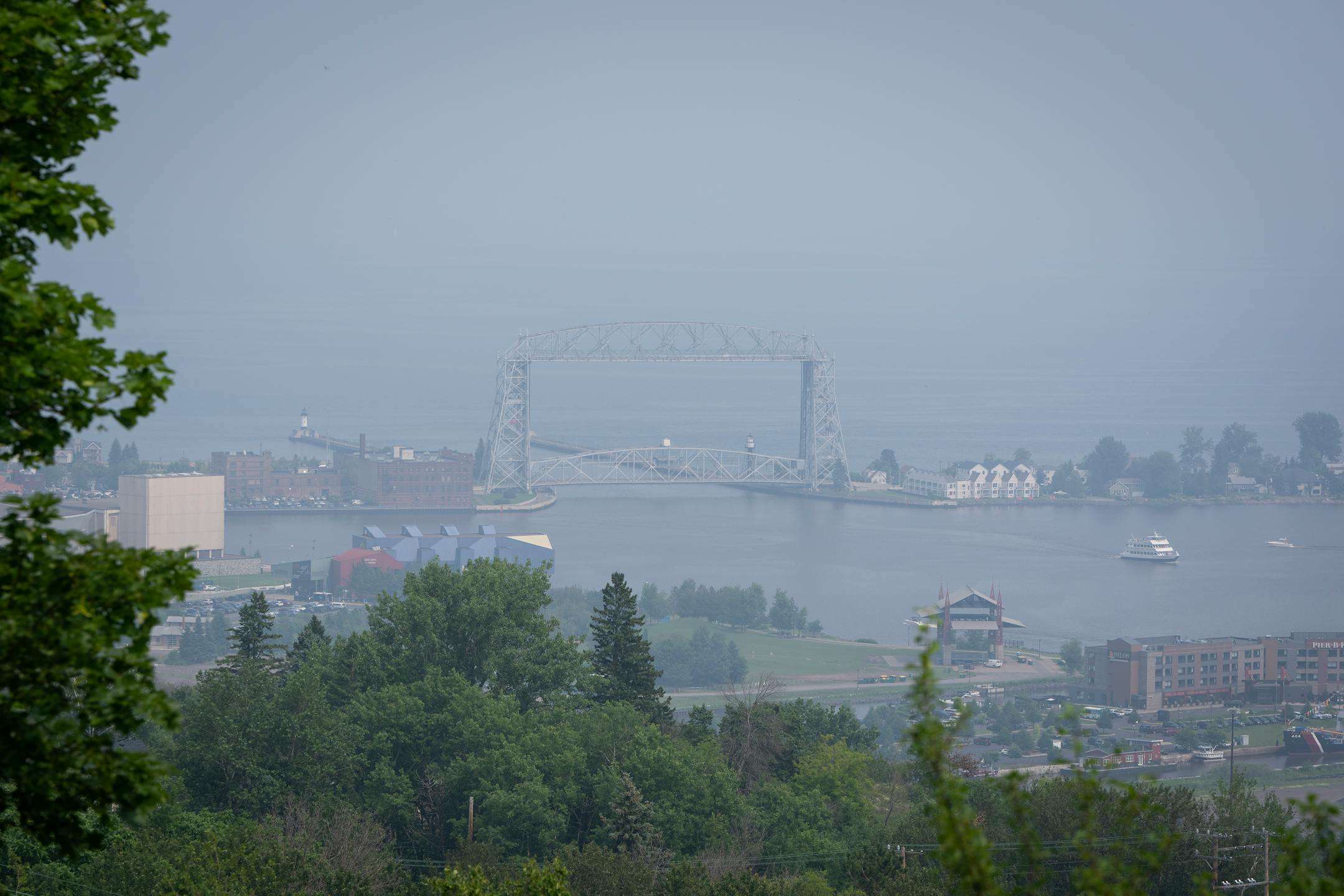
Smoke from Canadian wildfires, which has triggered an Air Quality Alert for much of Minnesota, is seen in Duluth on Thursday. (Leila Navidi/The Minnesota Star Tribune)

Summer smoke from Canadian wildfires is once again hazing out Minnesota skies — just in time for your long-awaited North Woods vacation. Not the pristine, fresh pine-forest air you were hoping for.

“It’s not really better or worse up here than the Twin Cities right now,” said John Fredrikson last Friday. He is co-owner of Cook County’s historic Gunflint Lodge, which overlooks Canada from the south side of Gunflint Lake.

The current air-quality alert for most of Minnesota is in effect until 5 p.m. Saturday.

It’s probably too late to cancel your accommodations. What can you do? Should you still go? And if you do, how can you prepare?

Assess the current situation by looking up the AQI for where you’re going.

The Air Quality Index (AQI) is a reliable indicator, with a six-part scale that ranges from “Good” to “Moderate” to “Unhealthy for sensitive groups” (such as asthma sufferers), on up to “Unhealthy,” “Very Unhealthy” and “Hazardous.”

The Minnesota Pollution Control Agency maintains a map of current air quality conditions based on fine particulates (what we’re experiencing now) and ozone, including readings at dedicated test sites throughout the state. Local readings can vary wildly even within a region, but you can get a good idea of how bad the air the may be where you’re going.

That website includes a link to sign up for air quality email alerts for a Minnesota region of your choice, courtesy of the EPA-sponsored EnviroFlash.

Google has a very handy, color-coded AQI map (simply search “AQI Minnesota” and click “View map”) that gives a quick live look at where it’s bad, somewhat bad, and just OK. This Thursday morning, the whole region was looking bleak, with ruby-red “Unhealthy” readings in most of the state. A notable exception for vacationers today was the Alexandria Lakes Area in a narrow swath of west-central Minnesota, which returned only a “Moderate” rating.

Consult air quality forecasts to find a last-minute destination.

The MPCA, again, has three-day forecast maps showing the conditions today, Friday and Saturday. Today’s forecast has most of the state rated “Unhealthy,” with “Very Unhealthy” reserved for the Duluth area, Grand Marais and the Arrowhead region.

Friday’s forecast shows the entire state uniformly “Unhealthy.” It starts to let up in Saturday’s forecast, with “Unhealthy for sensitive groups” in the Twin Cities and up north, but “Moderate” air quality south of the Twin Cities.

During a tough stretch of Canadian wildfires in 2021, I used a similar forecast from these maps to help choose a spontaneous weekend in the relative fresh air of Rochester and Lanesboro in southeastern Minnesota, in lieu of the smoky North Shore.

The good news from the current forecast maps: You should be able to wait it out this weekend. You might even find better air by the time you get to the cabin.

Take care of yourself.

Bearing in mind that one of the AQI categories is “Unhealthy for sensitive groups,” you may already know if you’re one of the affected. Sensitive groups include asthma sufferers, people with lung and heart disease, older people and kids, and people exercising outdoors.

Once you’re at the resort, you can favor indoor activities in air conditioning until the smoke blows over. If you are hiking outside, it’s not outlandish to break open a pack of those good old N95 or KN95 masks.

We genrally recommend bringing a portable carbon monoxide detector to the cabin just to be safe, and you can toss a small air purifier into the trunk as well. My sleek Levoit Core 300 air purifier has served me well in the toddler’s room, and the Core 200S model is a decent travel size.

Consider your own behavior

Since we’re going up to the country to enjoy nature, it may be a good time to think about our own contributions to climate change. Consider not driving when you arrive — or not driving at all. Choose a lower-emissions vehicle for road trips. Hiking or bicycling at your destination are good options when the air clears out.

Given all the unwanted smoke, is it OK to build a campfire? Gunflint’s Fredrikson thinks so. The Gunflint region has seen a wet July so far, so the dry conditions in Manitoba do not translate to greater fire risk here, he said.

about the writer

about the writer

Simon Peter Groebner

Travel Editor

Simon Peter Groebner is Travel editor for the Minnesota Star Tribune.

See Moreicon

More from Midwest Travel

See More
card image
card image