
Smith's neighbors testify he was increasingly frightened

Closing arguments are expected next week in the Little Falls murder trial in two teens' shooting deaths.

April 26, 2014 at 12:59PM
icon1:28

LITTLE FALLS, MINN. – In the days and weeks before Byron Smith killed two teenage intruders in his home, neighbors and friends saw him sleep-deprived and scared because of prior burglaries, they testified Friday in Smith's nationally watched murder trial.

"He just looked very upset and fearful and shaky," longtime neighbor Georgia Anderson told the court, saying she almost didn't recognize Smith when he showed up at her door shortly after a burglary that took place a month before the shootings.

Defense attorneys continued to build their case that the former State Department worker had become increasingly afraid in the fall of 2012 after several break-ins to his home and his adjacent property.

Smith claims that he acted in defense of himself and his home when he killed 18-year-old Haile Kifer and 17-year-old Nick Brady, cousins who broke in and went down his basement steps about 10 minutes apart on Thanksgiving Day.

Prosecutors wrapped up their case Thursday after presenting Smith's own chilling surveillance audio of the shootings. They argue Smith waited in ambush for the teens and went beyond the law by shooting the teens after they were no longer a threat.

Smith faces life in prison if found guilty on charges of first-degree premeditated murder. The Morrison County jury will have to decide whether he acted as a reasonable person would have under the circumstances. The trial has become the latest flash point in the national debate over how far a person can go to defend self and property.

On Friday, William Anderson, Georgia's husband, testified for the defense that Smith came over after an Oct. 27 burglary appearing "severely" frightened. That break-in was "number 5 or 6," Anderson testified that Smith told him.

City alderman and cemetery superintendent Brian-Paul Crowder testified that he stopped by Smith's property the Saturday before the shootings and Smith looked afraid while answering the door. Smith was "terribly worried because he had been broken in so many times," Crowder said.
The testimony capped an often-contentious week among the lawyers trying the case, including Friday as the trial was delayed for several hours. Defense attorney Steve Meshbesher had tried to call a firearms expert to the stand to testify about the effects of shooting a gun, including adrenaline and auditory ringing. But after much discussion outside the courtroom, the judge ruled against allowing it.

Earlier Friday, sheriff's deputy Jamie Luberts testified that he had met with Smith for a follow-up to the burglary investigation in mid-November and discussed security cameras that Smith had installed.

Luberts testified that Smith told him he had been sticking around his property because he wanted to catch whoever was breaking in. Luberts said he told Smith that if he happened to catch anyone he should call the sheriff's office right away.

After the shootings, Smith waited until the following day to call Anderson, asking him to find him a lawyer, according to testimony. Anderson then alerted authorities at Smith's request, he said.

Under cross-examination from prosecutor Brent Wartner, Anderson testified that Smith told him he had "solved the break-ins in the neighborhood."

Anderson testified that he had "great suspicion" that a neighbor girl was watching Smith come and go from his property. But he denied telling Smith's brother that Smith had moved his truck the day of the shootings to see if anyone would come to his house when he was away.

Sheriff Michel Wetzel also took the stand. Defense attorneys questioned him about how, after the shootings, an unnamed person led Wetzel to a gun that had been stolen from Smith in a prior burglary.

Meshbesher said outside the courtroom that he wanted the jury to see photos of the 12-gauge semiautomatic shotgun so they could understand what Smith feared might be used against him by thieves.

Defense attorneys are not saying whether Smith will take the stand. Closing arguments are expected early next week.

Pam Louwagie • 612-673-7102

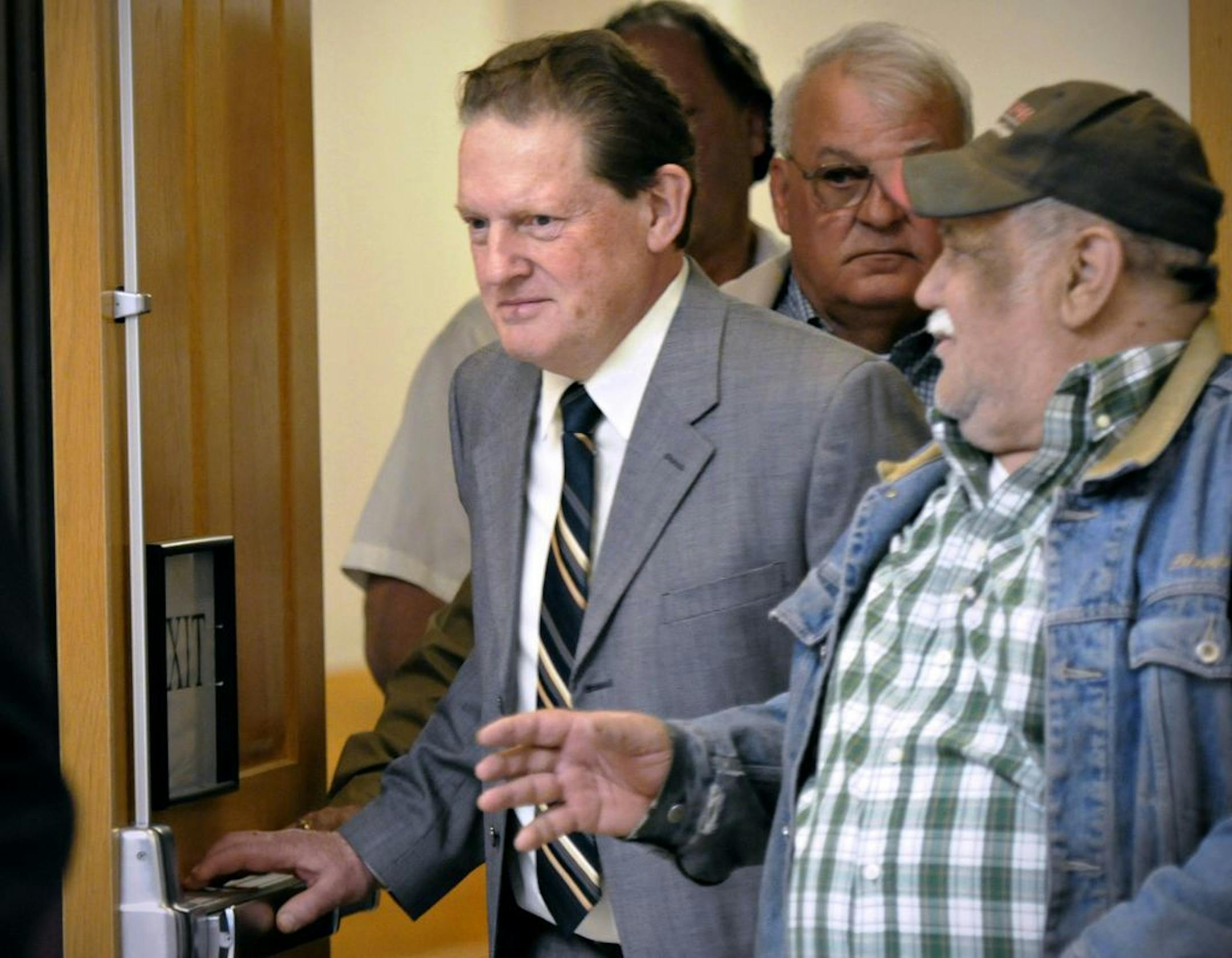
Byron Smith, center, comes out of a Morrison County courtroom in Little Falls, Minn., during a break in his trial.
Byron Smith, center, came out of a Morrison County courtroom in Little Falls, Minn., during a break in his trial. (St. Cloud Times via AP/The Minnesota Star Tribune)
Byron Smith's attorney Steve Meshbesher, made his way to the courtroom at the Morrison County Courthouse, Monday, April 21, 2014 in Little Fall, MN. The 65-year-old is charged with the killings of Haile Kifer, 18, and Nick Brady, 17, who broke into his home on Thanksgiving Day, 2012. ] (ELIZABETH FLORES/STAR TRIBUNE) ELIZABETH FLORES • eflores@startribune.com
Byron Smith’s attorney Steve Meshbesher, center, said Friday that the defense wanted to introduce evidence of a gun of Smith’s that was stolen in a previous burglary. The reasoning: they wanted the jury to understand why Smith would fear that such a gun might be used against him. Closing arguments are expected next week. (The Minnesota Star Tribune)
about the writer

about the writer

Pam Louwagie

Reporter

Pam Louwagie is a regional reporter for the Minnesota Star Tribune. She previously covered courts and legal affairs and was on the newspaper's investigative team. She now writes frequently about a variety of topics in northeast Minnesota and around the state and region.

See Moreicon

More from No Section

See More
FILE -- A rent deposit slot at an apartment complex in Tucker, Ga., on July 21, 2020. As an eviction crisis has seemed increasingly likely this summer, everyone in the housing market has made the same plea to Washington: Send money — lots of it — that would keep renters in their homes and landlords afloat. (Melissa Golden/The New York Times) ORG XMIT: XNYT58
Melissa Golden/The New York Times

It’s too soon to tell how much the immigration crackdown is to blame.