

So on Tuesday night Jon called me from his business trip. He was meeting with the Federation of State Medical Boards (FSMB), a national non-profit organization representing the 70 medical boards of the United States and its territories.
I was meeting with three children who didn't want to go to bed.
Jon: Duch, when you come out on Thursday bring a copy of your book, Regina wants one.
Duchess: (children in the background fighting over Wii)
Regina who? Haven't I told you that we're not giving these away, they're for sale.
Jon: Regina Benjamin!
Duch: Regina Benjamin? What's she doing out there? She's no longer the chair.
Jon: The immediate past chair serves for a year.
Duch: Why on earth does she want to read my book?
Jon: I told her about the Joycelyn Elders part. Don't tell me you don't want to give the future Surgeon General a copy.
(pause)
Duch: One free book going in my suitcase.
***
Joycelyn Elders' story resonated with me deeply in 1994 when she was labeled a "Condom Queen" and forced to resign as Surgeon General. The welfare queen is the defining social stereotype of the Black woman: a lazy, promiscuous, single Black mother living off the dole of society. She poses a threat to the Protestant work ethic that drives America and the American Dream of social advancement and acceptability. The welfare queen trope is a complicated social narrative in which race, gender, and class are interlocked. The welfare queen metaphor does not simply embody images of Black women; its broad-ranging scope is deeply embedded in almost every facet of our social and political discourse.
The episodes recounted in my book of Vanessa Williams, Anita Hill, Carol Moseley Braun, Lani Guinier, and Joycelyn Elders were all heavily influenced by the welfare queen narrative. Noted legal scholar Lani Guinier was branded a "Quota Queen" by conservative political groups in their effort to block her nomination to a top position in the Justice Department. As Patricia Williams observed, "'Quota Queen' evoked images of welfare queens and other moochers who rise to undeserved heights, complaining unwarrantedly all the way. Lani Guinier, the complex human with a distinguished history, was reduced to a far-left 'element'...."
As Patricia Williams so aptly concluded: "The use of the term 'queen' to describe Dr. Elders, another Black woman ultimately driven from her post in a doggedly-waged smear campaign, highlights the extent to which the connotations of the term demand some explicit consideration." The Clinton Administration did not establish a stellar record of interactions with outspoken Black women. Additionally, it was also particularly ironic and paradoxical that this convergence of the passage of welfare reform and continued manipulation of racist caricatures (especially about Black women) occurred within a "Democratic" administration.
Please get a copy of Black Feminist Politics from Kennedy to Clinton so you can understand that this was a critical moment in American politics and culture, a point where rational ideas about contraception fell to the hysteria of religious moral dogma and familiar racist constructs.
I am more hopeful about the Obama administration, and I wish Dr. Benjamin the best.
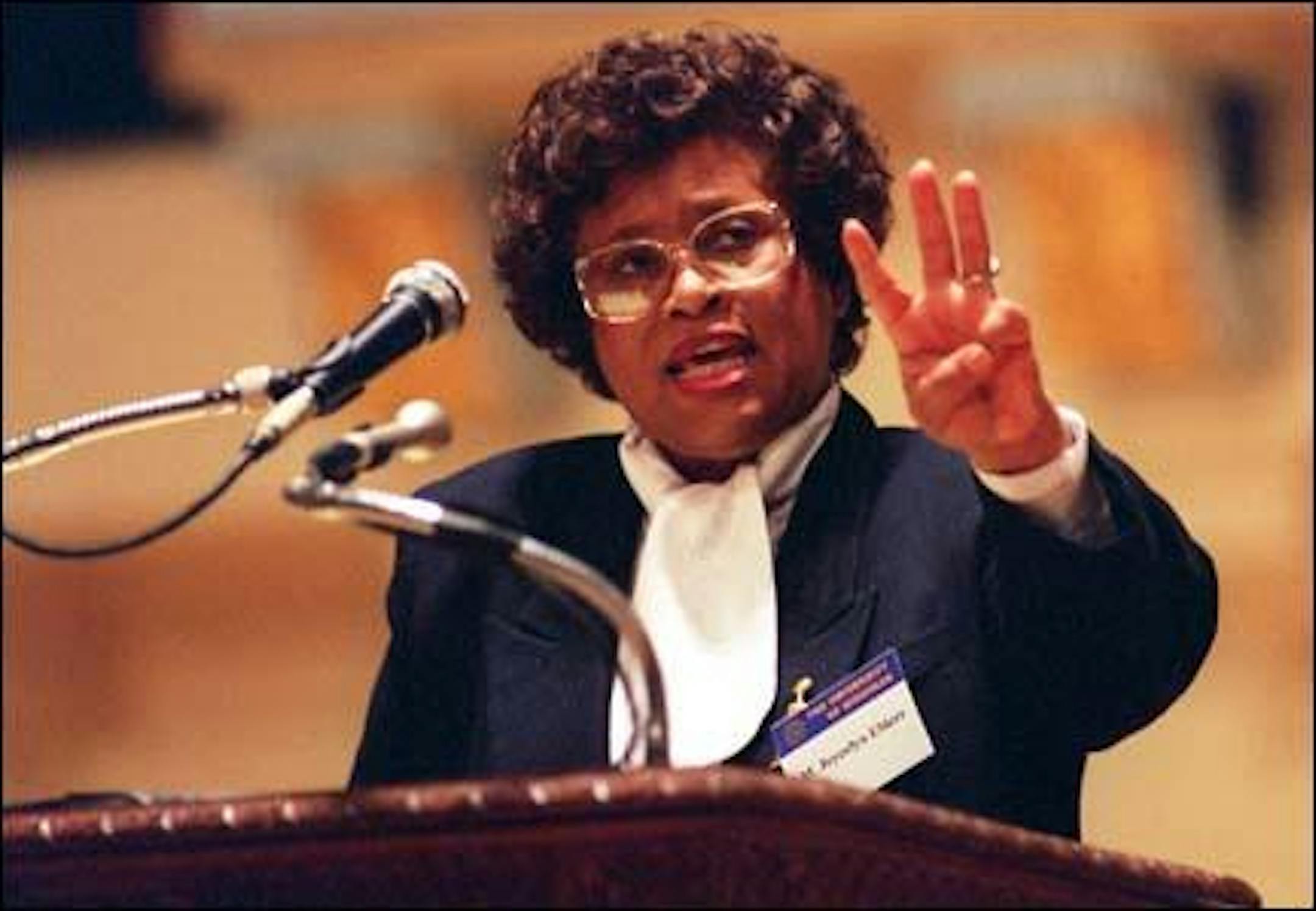
Sister Regina Benjamin and Sister Joycelyn Elders
Joycelyn Elders' story resonated with me deeply in 1994 when she was labeled a "Condom Queen" and forced to resign as Surgeon General. The welfare queen is the defining social stereotype of the Black woman: a lazy, promiscuous, single Black mother living off the dole of society. She poses a threat to the Protestant work ethic that drives America and the American Dream of social advancement and acceptability.
August 5, 2009 at 4:18AM

about the writer
sischolar

It’s too soon to tell how much the immigration crackdown is to blame.
