

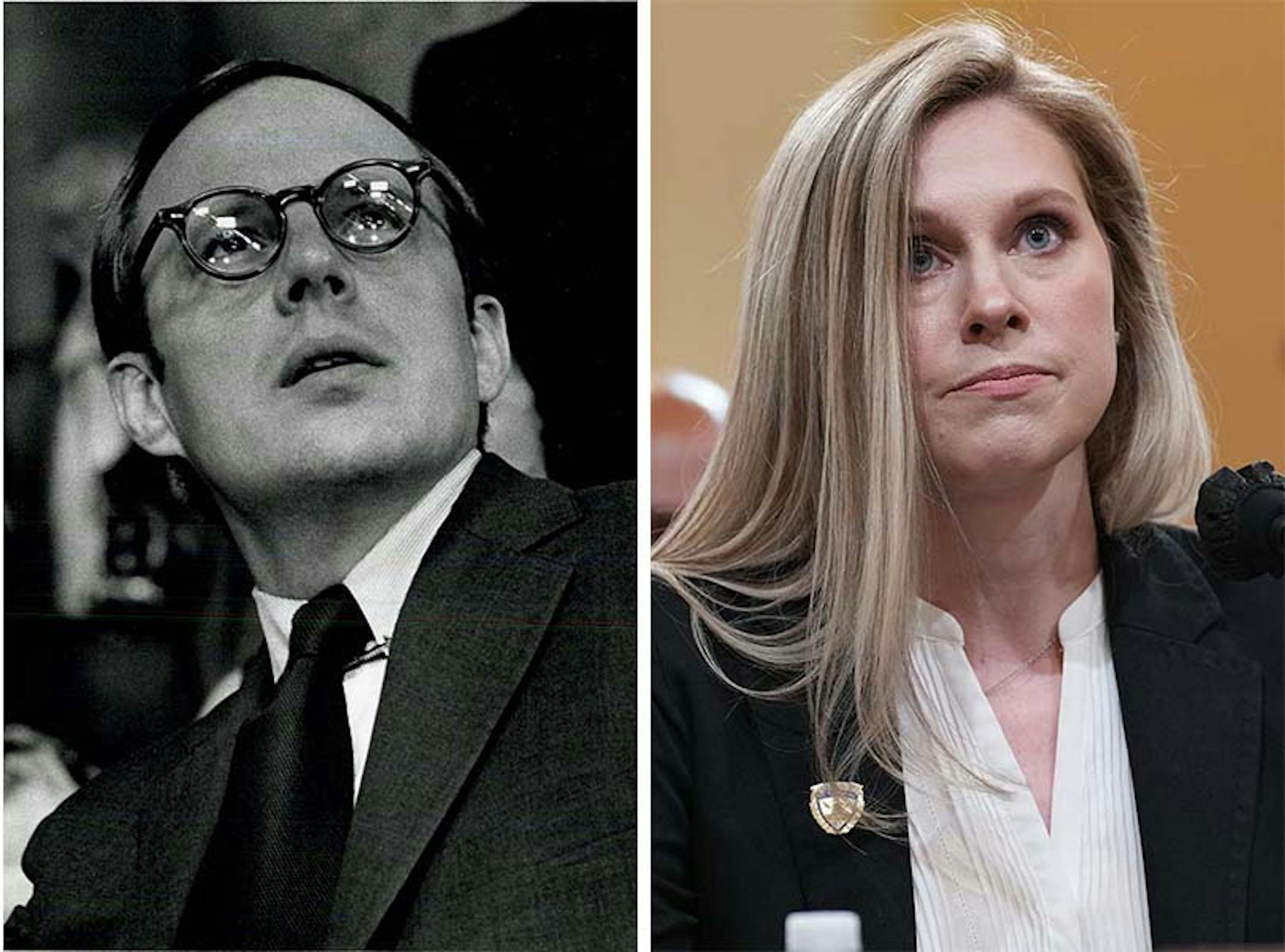
Fifty years to the week of the Watergate break-in, a congressional panel began to break down the Jan. 6, 2021, attack on the U.S. Capitol.
While there are clear distinctions between the two scandals, Watergate and Jan. 6 might actually be more similar than the political, social and media environments they took place in.
The media landscape, for instance, has seen seismic shifts. For weeks in the summer of 1973, network TV's daytime dramas were preempted for the political soap opera of the Watergate hearings. All three networks mostly went live with gavel-to-gavel coverage, and PBS prime-time repeats allowed others to catch up. In the pre-cable (and for many smaller markets, pre-independent TV channel) landscape, it was hard to miss, and most didn't.
Thursday's prime-time Jan. 6 hearing was still aired by the three traditional networks, but in some markets not by the fourth, Fox. CNN and MSNBC went wall-to-wall, but Fox News put up a wall, opting to relegate it to their lower-rated Fox Business channel, which allowed its conservative commentators to discredit the discourse in real time.
"I wish I could say I'm surprised, but Fox News arguably is an unindicted co-conspirator in the 'big lie' and the Jan. 6 protests and the storming of the Capitol," historian Garrett M. Graff, author of the recently published "Watergate: A New History," said in an interview on Tuesday.
Final Nielsen ratings for Thursday's hearing will indicate that some opted for alternative cable, satellite or streaming series, sports, movies or reality TV instead of the reality of an examination of an attack on America's democracy. During Watergate, Graff said, "it was a much more unified media experience," and the hearings were a "media phenomenon," with the average American household watching about 30 hours over the summer, "which really tells you something about the amount of this story that America ingested."
Regarding "the right-wing media ecosystem," Graff said with Watergate "there was no counterprogramming. You had Republicans asking questions out there of the witnesses, doing cross-examinations in the hearings, but there wasn't this drumbeat of conservative talk radio or Fox News, Tucker Carlson out there, saying all these people are liars and the whole thing is corrupt. And so it was an era when Americans had a lot more faith in the media in a way that we just don't see really take place right now."
Indeed, the media had a near 70% approval rating in the era, Douglas Brinkley, a professor of history at Rice University, said on the eve of Thursday's hearing. Brinkley, whose many works include books on Watergate and Walter Cronkite, said that "during Watergate people still trusted in the federal government." A new Pew Research Center poll released this week shows how steeply trust has fallen, from a Nixon first-term era high of 77% believing the federal government will do "what is right" always/most of the time to 20% today.


