

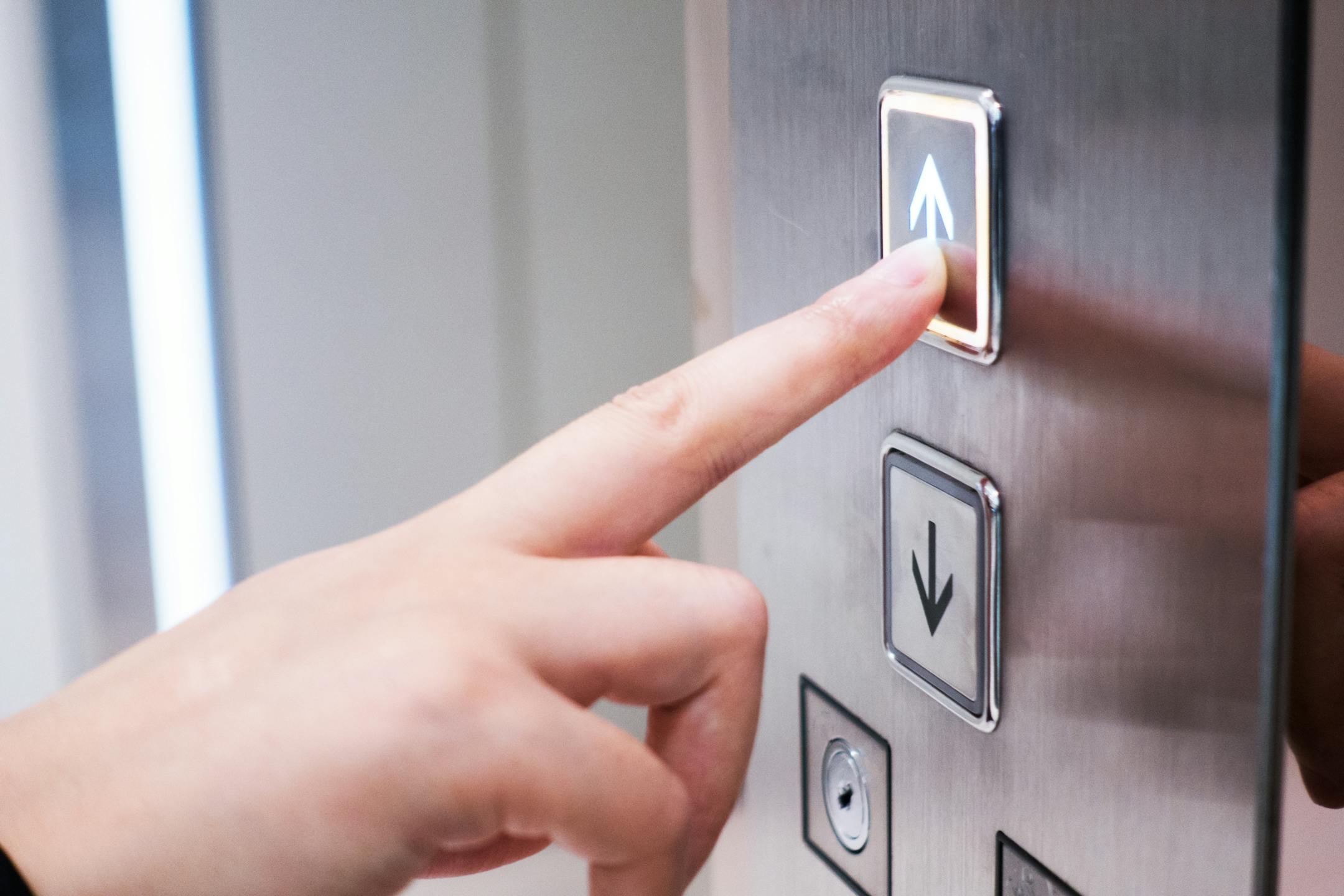
For most people, the accepted norm for an elevator ride is: Get in and position yourself as far from others as possible, face forward, be still, stand up straight and stare silently at the door, or your cellphone, until you get to your floor.
Is that really how it should be? Germany-based theyssenkrupp Elevator doesn't think so. The company has issued a challenge to us all: Start talking when riding elevators.
Seven billion elevator trips happen every day, according to a survey by the company, and two-thirds of the people riding do so in complete silence. If each journey lasts an average of 30 seconds, that adds up to more than 38 million hours in silence each day, theyssenkrupp's research suggests.
But according to various research projects and studies, even small and seemingly superficial encounters among strangers can have significant emotional and physical health benefits for the people involved.
A landmark study of Chicago commuters by Nicholas Epley and Juliana Schroeder found that people were overwhelmingly mistaken when they believed they preferred silence and isolation to an interaction with a stranger.
"To examine the experience of connecting to strangers, we instructed commuters on trains and buses to connect with a stranger near them, to remain disconnected, or to commute as normal," the authors wrote in a paper. "Participants reported a more positive (and no less productive) experience when they connected than when they did not. Separate participants in each context, however, expected precisely the opposite outcome, predicting a more positive experience in solitude. This mistaken preference for solitude stems partly from underestimating others' interest in connecting, which in turn keeps people from learning the actual consequences of social interaction."
Shawn Horn, a psychologist in Spokane, Wash., who specializes in shame, said some of the reasons behind our closed and wary behavioral norms around elevator use may have biological and neurological roots.
"We are bio-neurologically hard-wired to survive," she said. "The elevator is an intimate, closed container with no escape, and if you are stuck with someone you don't want to talk to and you can't leave, it does not feel safe. We're vulnerable and may go into a protective position, standing face-forward, waiting."


