
Shakopee confronts its noisy trains

City drafts letter to Union Pacific in its pursuit of "quiet zone."

July 1, 2014 at 8:00PM
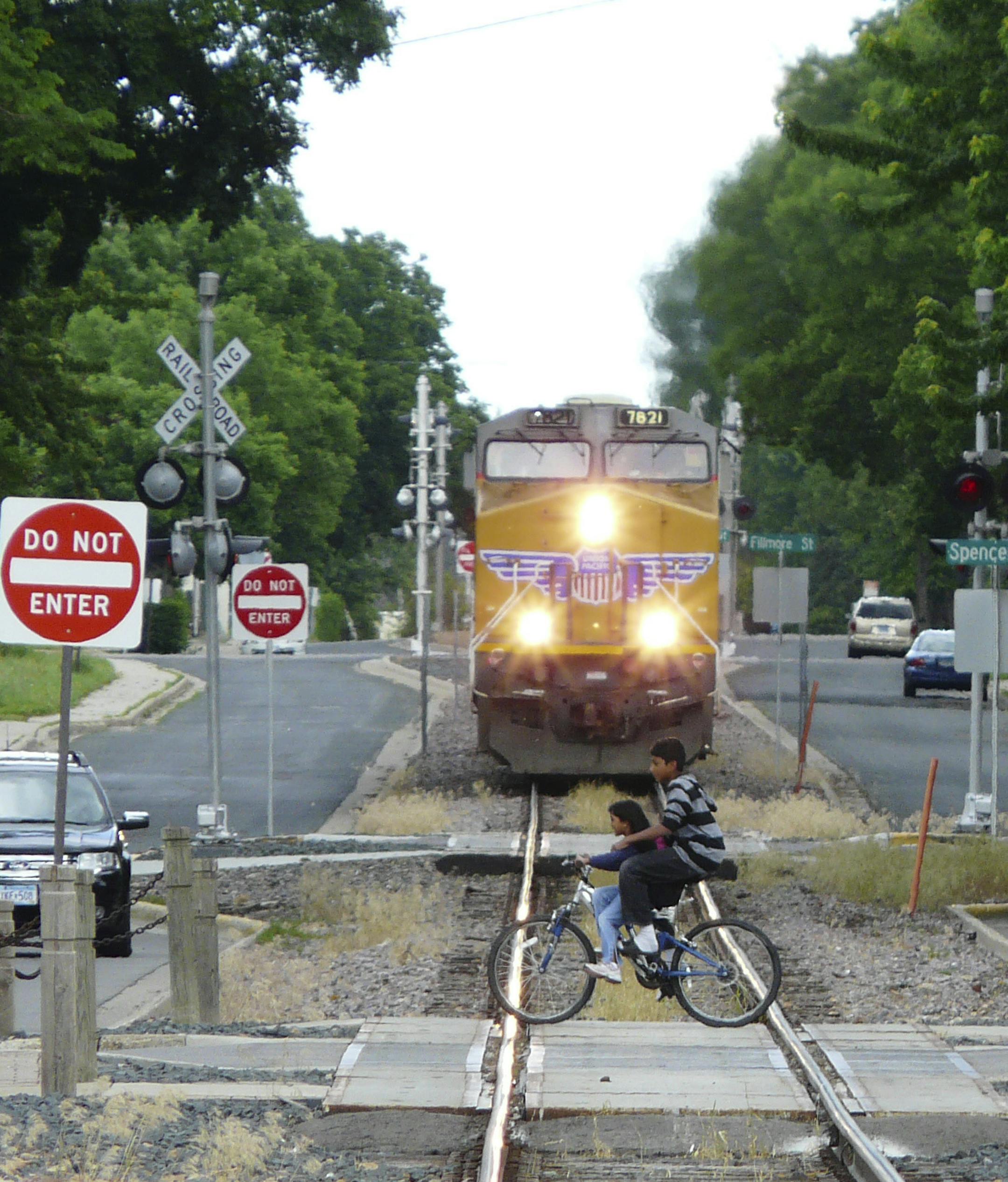
David Peterson/Star Tribune As trains approach in Shakopee when school is out, kids zip across in time; but the train moves extremely slowly and the telephoto lens here flattens the distance between them.
With a 10-mph speed limit, trains creep so slowly through central Shakopee that kids can zip across the track in time. (The Minnesota Star Tribune)

Nobody in Shakopee wants to see a fence built around the Union Pacific railroad tracks that run through the center of town.

Especially not when residents and the City Council alike are talking about revitalizing downtown and attracting visitors who aren't there just there to pick up a specific something and then leave.

As part of that plan, the city wants to establish a "quiet zone" that would allow the community to enjoy the downtown, as well as its neighborhoods, without all the long, deafening whistles of warning.

The issue has long been simmering, but there are signs of a renewed determination to tackle it.

The railroad itself wants to talk: It says the current 10 mile-per-hour speed limit through a milelong section of the city is creating an "operational bottleneck" and wants approval to increase it.

The city has drafted a letter to the railroad, based in Omaha, explaining its position. Council members discussed it during a workshop last week.

Among other things, it seeks a "financial partnership" with the railroad to help cover what could be considerable costs.

The nub has always been the cost of ensuring safety if trains speed up — the cost in dollars to put up protective devices to keep cars from crossing as the trains approach, or the cost in convenience to close off some roads. Or both.

The city's letter says it's "aware that there are numerous safety concerns which will need to be dealt with in order to meet Quiet Zone criteria set by the Federal Railroad Administration … [including] the need for street crossing upgrades, warning devices and potentially the closing of some at-grade crossings.

" … We hope that a 'win-win' situation might be created by cooperatively working to establish a Quiet Zone, which … would allow the city to support an increase from the existing 10 miles per hour, potential to as much as 29 miles per hour.

"We understand that at speeds of 30 mph and above, a pedestrian fence would be required for the entire length of the corridor, which we do not believe benefits the city nor the railroad."

Fewer crossings?

The letter seeks a copy of a computerized inspection of the condition of the railway itself, done by the railroad in May. The goal is to assure citizens that a speedup wouldn't make things less safe.

Council Member Matt Lehman asked:

"Are we comfortable closing some crossings in town? If they come back and say we have to close five crossings, do we want that? What are we willing to do before we start the negotiations?"

No one on the council appeared happy at the thought of closing five crossings. But Council Member Mike Luce told colleagues, "It's pretty much a gimme that we're going to have to give up at least one."

Members agreed on language saying, "We want to have as few [closings] as possible."

Since there was no discussion of the fence in the letter, Mayor Brad Tabke asked whether that issue should be included. With a 29-mph speed limit, a fence isn't necessary. Council members agreed that the speed limit should not go beyond that.

But Lehman said that before the city agrees to that speed limit, he wants a consultant to determine whether trains moving at 29 mph would damage the foundations of nearby buildings. He also expressed concern about the potential for train axles to break and cause oil cars to spill in the city.

The letter is to go out, and the next step is a response from the railroad. Among the items mentioned: The current council is motivated to solve the problem, but it won't necessarily have the same set of members after December 2015.

Pat Pheifer • 952-746-3284

about the writer

about the writer

Pat Pheifer

Reporter

See Moreicon

More from No Section

See More
FILE -- A rent deposit slot at an apartment complex in Tucker, Ga., on July 21, 2020. As an eviction crisis has seemed increasingly likely this summer, everyone in the housing market has made the same plea to Washington: Send money — lots of it — that would keep renters in their homes and landlords afloat. (Melissa Golden/The New York Times) ORG XMIT: XNYT58
Melissa Golden/The New York Times

It’s too soon to tell how much the immigration crackdown is to blame.