

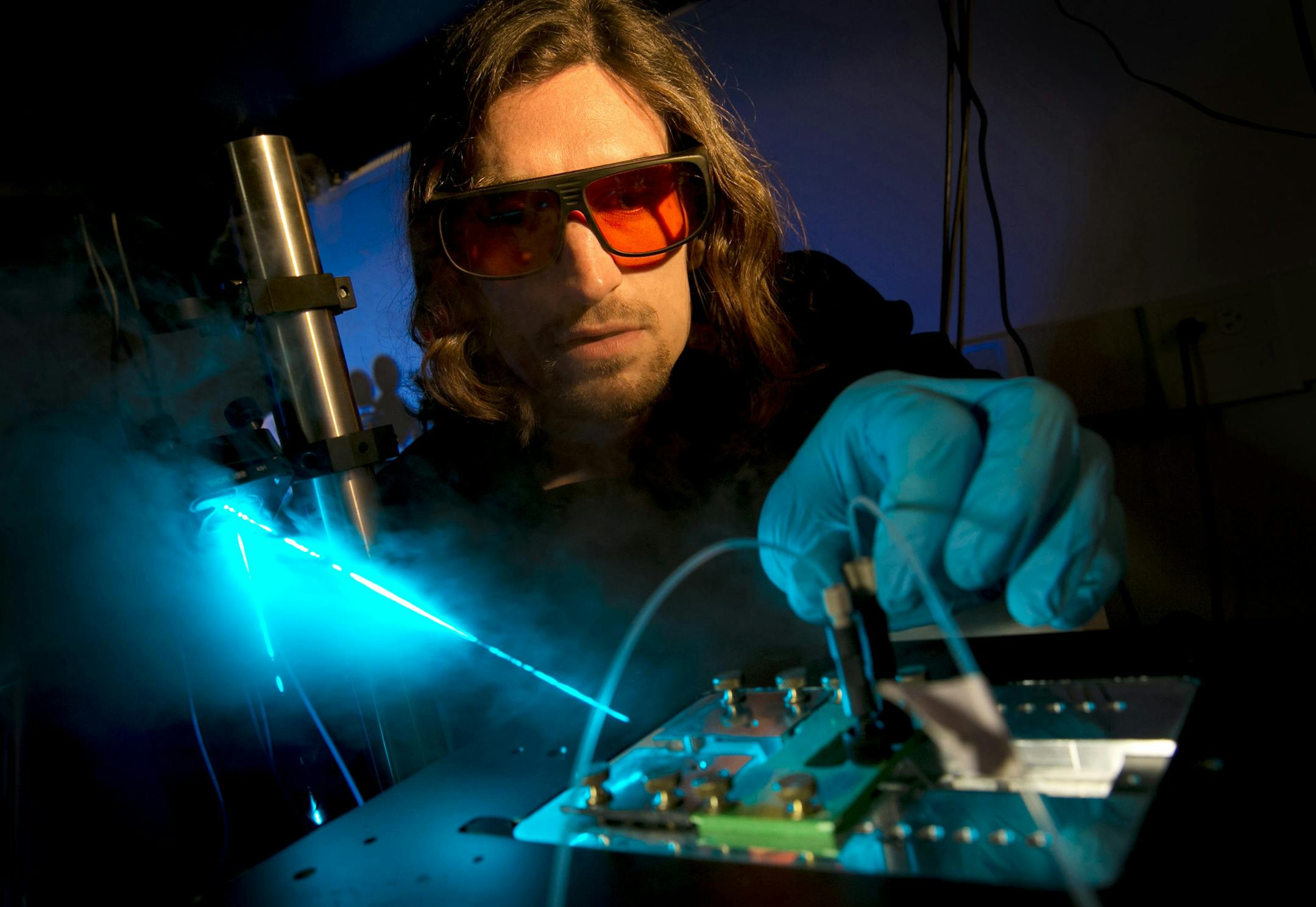
AUSTIN, Texas – Ilya Finkelstein chuckles when recounting the origins of the project that landed the University of Texas scientist and his colleagues in the prestigious academic journal Cell.
According to a peer-reviewed article, they found a way for scientists to more safely use a new kind of gene editing technique called CRISPR — a technology that has embroiled much of the scientific world in seemingly fantastic debates, such as whether creating mushrooms that don't brown in supermarkets could lead to people creating new animals or ordering babies with designer DNA.
Finkelstein and his colleagues have developed a technique that basically makes CRISPR less likely to scramble the genes it modifies, according to their paper. They say their work could enable scientists to cure a disease such as diabetes while significantly reducing the risk of a side effect such as cancer.
As an assistant professor in the Department of Molecular Biosciences — and someone whose lab is dedicated to studying the how the human genome is linked to aging — Finkelstein had been looking for an opportunity to work with CRISPR.
The technology — whose name is short for "clustered regularly interspaced short palindromic repeats" — was discovered by scientists performing experiments on yogurt cultures. They found that bacteria have immune systems that fight viruses quite effectively. Other scientists expanded on the idea; eventually came CRISPR, which exploits the system that bacteria use to protect themselves. It allows researchers to use proteins to cut out selected segments of DNA and, if needed, insert new ones.
Scientists are still determining the various ways CRISPR molecules interact with various types of DNA. A key question: how accurate are CRISPR molecules? Do they sometimes confuse one sequence of DNA for another, snipping one instead of the other? How do you test for that?
Finkelstein is among the scientists excited about what the technique can do for humanity by, for instance, improving crop yields. But he cautions that the technology is nowhere near ready for the mind-bogglingly complex task of modifying the DNA of each cell in an adult, and is still not ready for use in human embryos.
"That said, no one is listening to me," he said. "So why not try to make this safer?"


