2:58
2:58Asked what they'd most like to see at the Science Museum of Minnesota, visitors overwhelmingly said a show about the Maya, the ancient Central American civilization whose monumental stone pyramids and temples slumbered for centuries under rain forest jungles.
Four years and $4 million later, "Maya: Hidden Worlds Revealed" opens today at the St. Paul museum.
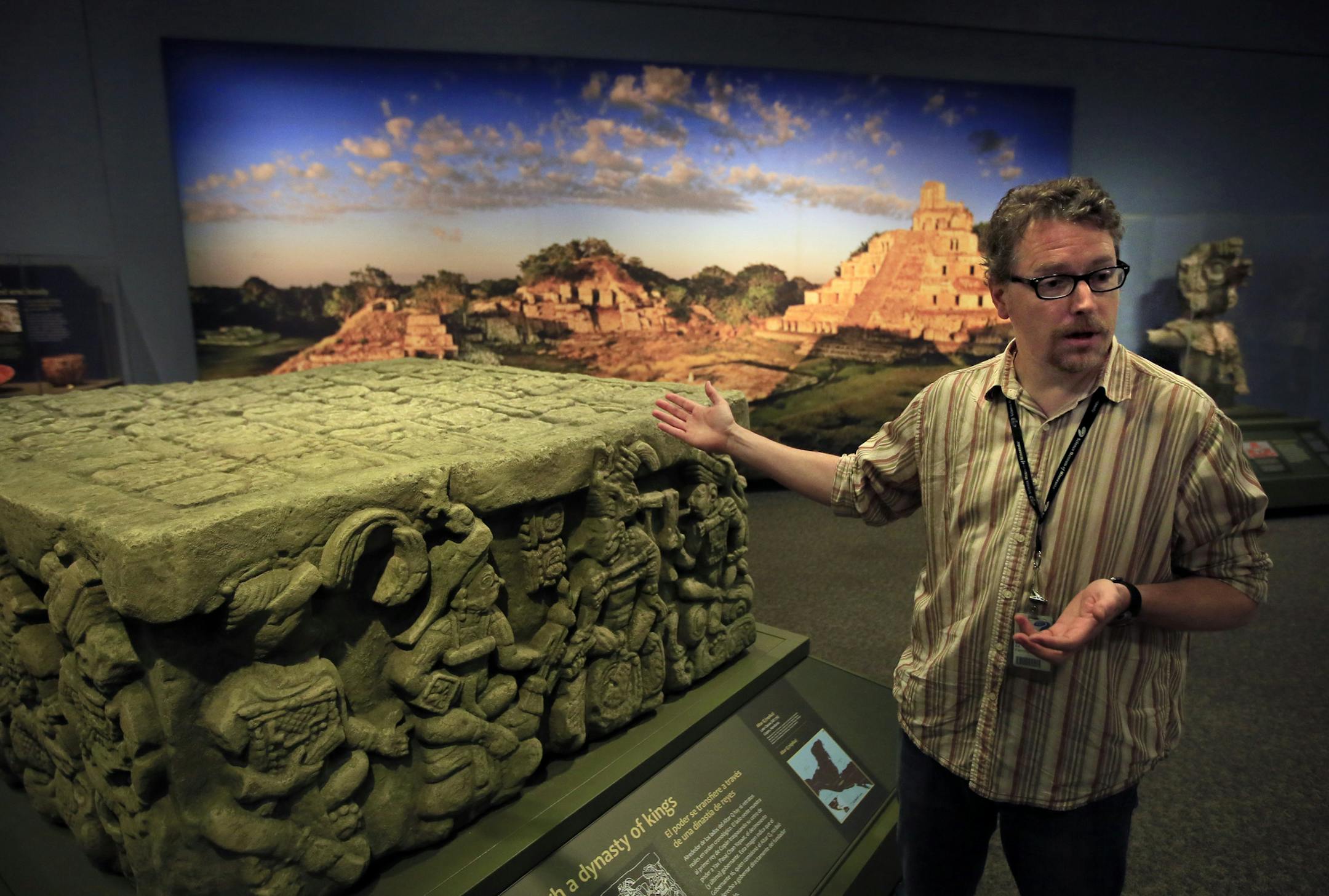
With its serpentine galleries, dramatic lighting and sound effects, priceless artifacts, up-to-the-minute scientific discoveries and kid-friendly activities, "Maya" is the largest and most complex show the Science Museum has produced in decades. Layered with information, it illuminates the lives of people whose astronomy, agriculture, calendars, mathematics and trade systems were as sophisticated as any in the world during their "Classic Period," from 250 to 900 A.D.
"I don't think it's hyperbole to say that no other museum in the world could do this," said Mike Day, the museum's senior vice president, during a preview tour. Other museums have shown Maya art or archaeology, he said, but no others have the capacity to include activities for young people, or to recreate murals, monuments and even a cave in which the Maya communicated with their underworld gods.
In conjunction with the National Film Board of Canada, the museum also updated an Omnitheater movie about Maya sites and their 19th-century rediscovery, including re-enactments of archeological expeditions. The Science Museum organized the show in cooperation with museums in Denver, Boston and San Diego, to which it will travel when its Minnesota run ends Jan. 5.
"People always think that Maya civilization collapsed and the Maya disappeared after Europeans arrived, but that's not true," said Ed Fleming, the Science Museum archaeologist who co-curated the exhibit with Dr. Marc Levine of the Denver Museum of Nature and Science. "They changed, but they did not vanish, and there are between 6 million and 7 million Maya people living in Central America today."
Into the jungle
Foliage rustles, birds call and monkeys howl as visitors enter via a gallery lit to evoke a shadowy jungle glade, hike past a modern archaeologist's field camp (note the Coleman lamp and yellow plastic water cooler), and then spy two massive, mossy pillars in a clearing. The theatrical effects smartly ramp up the Indiana Jones drama of the 14-foot columns (known as stele) incised with grimacing figures surrounded by hieroglyphic writing.
Scholars first assumed the figures were Maya gods, but in the 1950s architect-linguist Tatiana Proskouriakoff deciphered the hieroglyphs and realized that the carvings depict real kings and their historic exploits. Rivals for power and control of the jade trade, one king captured and beheaded the other in 738 A.D.