

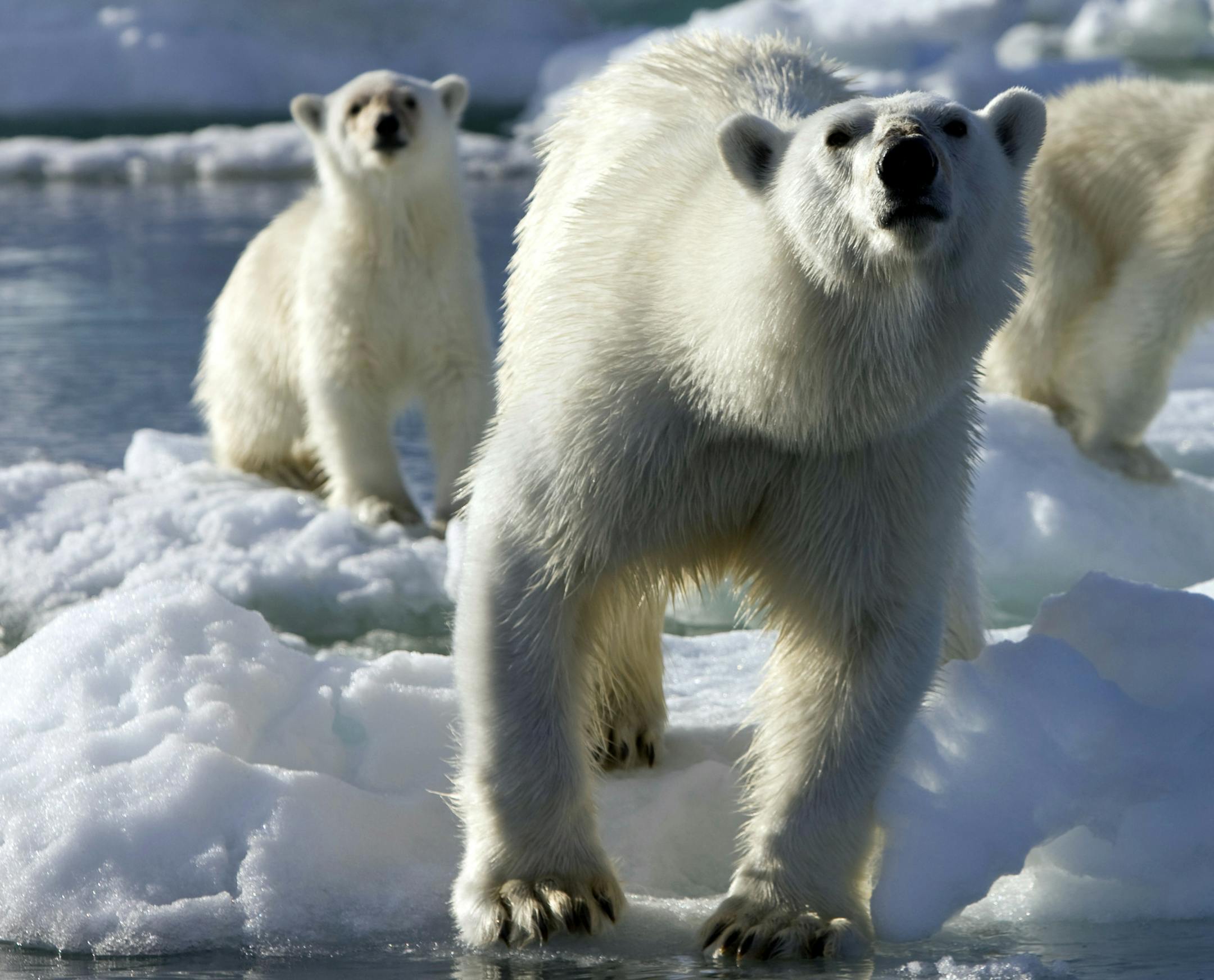
Polar bears looking for mates appear to be following their noses over the sea ice. Like brown and black bears, polar bears make a practice of sniffing scents left behind by other members of their species. But unlike brown and black bears, which leave their odors on trees or other vertical surfaces, polar bears have to rely on paw prints left on the horizontal surface of snow-covered ice. They appear to be using these scents to decipher messages about the other polar bears that are nearby, said scientists from the San Diego Zoo's Institute for Conservation Research, Polar Bears International and the U.S. Geological Survey. The study was published online in the Journal of Zoology. If the sea ice is serving as polar bears' smell-message board, that could spell trouble for the animals, said Steven Amstrup, chief scientist for Polar Bears International and a co-author of the scent study. "The spring sea ice is far less extensive and more fragmented than it was historically."
House cat not far from being wild
It may not surprise the average cat owner, but a team of researchers has discovered that the genome of domestic mousers differs only slightly from that of wild cats. In other words, after 9,000-odd years of living alongside humans, the house cat remains only semi-domesticated. After comparing the genome of an Abyssinian cat named Cinnamon to those of humans, tigers, cows, dogs and another white-pawed cat breed known as the Birman, researchers discovered that cats retain many of the hunting, sensory and digestive traits of their wild kin. Where researchers — led by Wes Warren, an associate professor at the Genome Institute at Washington University in St. Louis — did find a signal for human influence on cat evolution, however, was in fur color and pattern, as well as a set of genes that are thought to be associated with tameness.
New frog found in New York City
Scientist have discovered a new species of frog in New York City. Known colloquially as the Atlantic Coast leopard frog, and more formally as Rana kauffeldi, it is only the second new frog to be reported in the United States and Canada since 1986. The last time a new amphibian was described in New York or New England was in 1882. The frog was discovered by Rutgers University ecologist Jeremy Feinberg, who encountered it six years ago. No one knows how the Atlantic Coast leopard frog defied detection for so long. But it is a "cryptic species," meaning it looks nearly identical to another species, in this case the southern leopard frog. Scientists now know that the two species have a slightly different pattern of markings on their hind legs as well as different genetic makeups.
News services


