

Coral reefs comprise 1% of the ocean floor yet are home to 25% of marine fish. Scientists have only a rough idea of the extent of reefs worldwide; a reef thought to be 1,000 acres might be 1,500 or just 500. Of the reefs that have been accurately mapped, little is known about their health, the kinds of fish that live there, or the composition of coral species.
The oceans' surface is difficult for satellite and airborne cameras to see through. Now, a team of scientists led by Greg Asner and Robin Martin of Arizona State University has developed a suite of technologies to overcome these obstacles. The instruments are mounted on a low-flying plane and together make up the Global Airborne Observatory, which effectively can peel back the seawater and map the seafloor to a depth of 50 feet, in three dimensions.
Mapping reefs typically involves swimming with sonars or dragging them behind a boat, which makes for very slow progress. The Global Airborne Observatory can map 250,000 acres a day.
Prehistoric wolf's head discovered in Siberia
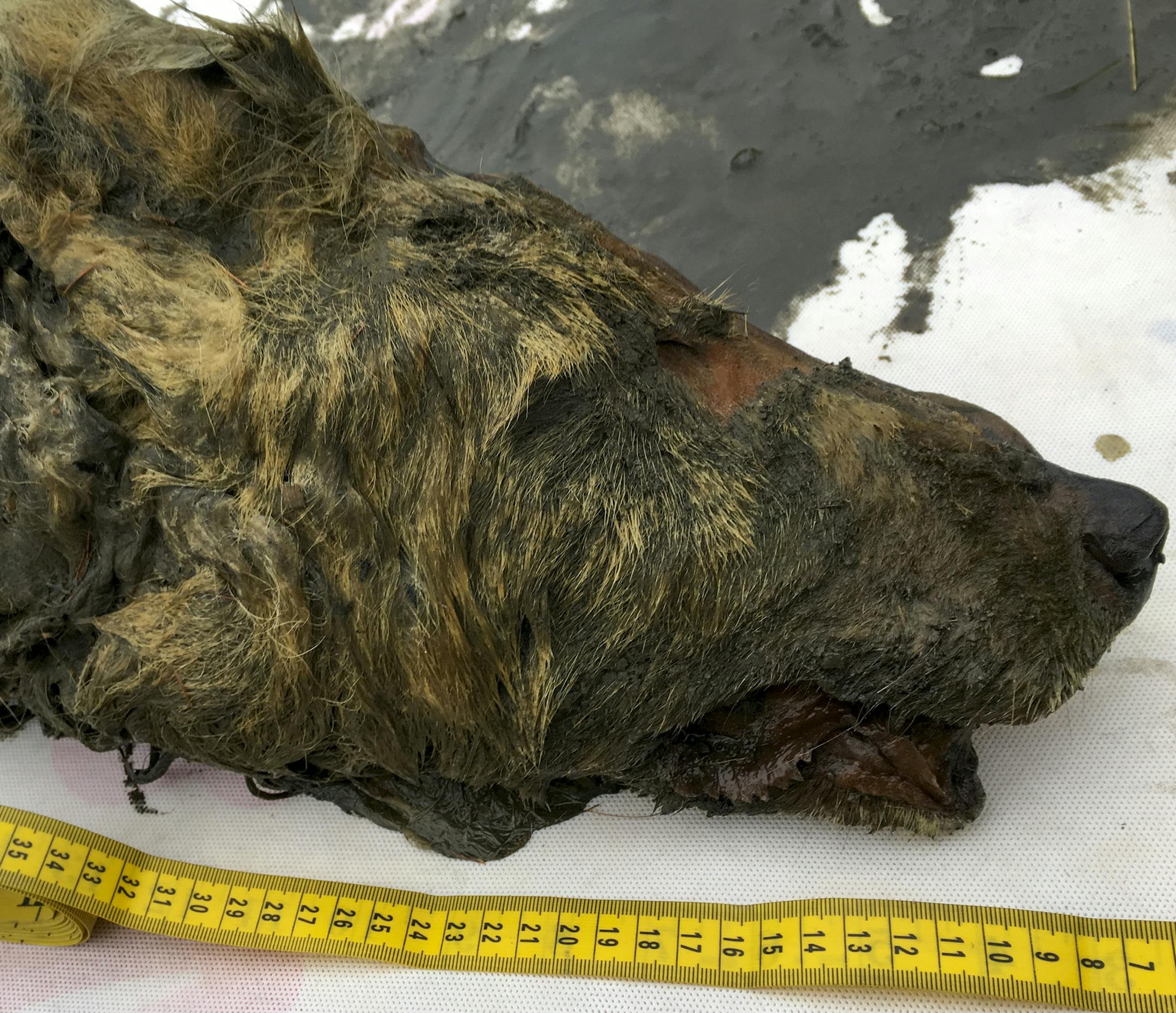
Russian scientists have found the furry head of an Ice Age wolf perfectly preserved in the Siberian permafrost.
The head of a wolf, which died 40,000 years ago, was discovered in the Russian Arctic region of Yakutia. Valery Plotnikov, a researcher at the Russian Academy of Sciences, said the animal belonged to an ancient subspecies of wolf that lived — and became extinct — alongside the mammoths. Scientists believe the wolf was fully grown at 2 to 4 years old when it died and was about 25% bigger than modern wolves, the Siberian Times said.
A photo of the head shows it measures 15.7 inches long, which is notably bigger than the 9.1-to-11-inch length of the modern gray wolf's head.
Scientists had previously only had found wolf skulls without tissues or fur, while this head has ears, a tongue and a perfectly preserved brain.
The Swedish Museum of Natural History plans to study the wolf's DNA, the Times reported. Scientists also are creating a digital model of the brain and the skull's interior, said Albert Protopopov, of the Republic of Sakha Academy of Sciences, "to understand how the species has evolved."
The Pleistocene Epoch stretched from 2.6 million to 11,700 years ago and included the most recent ice age of global cooling.


