

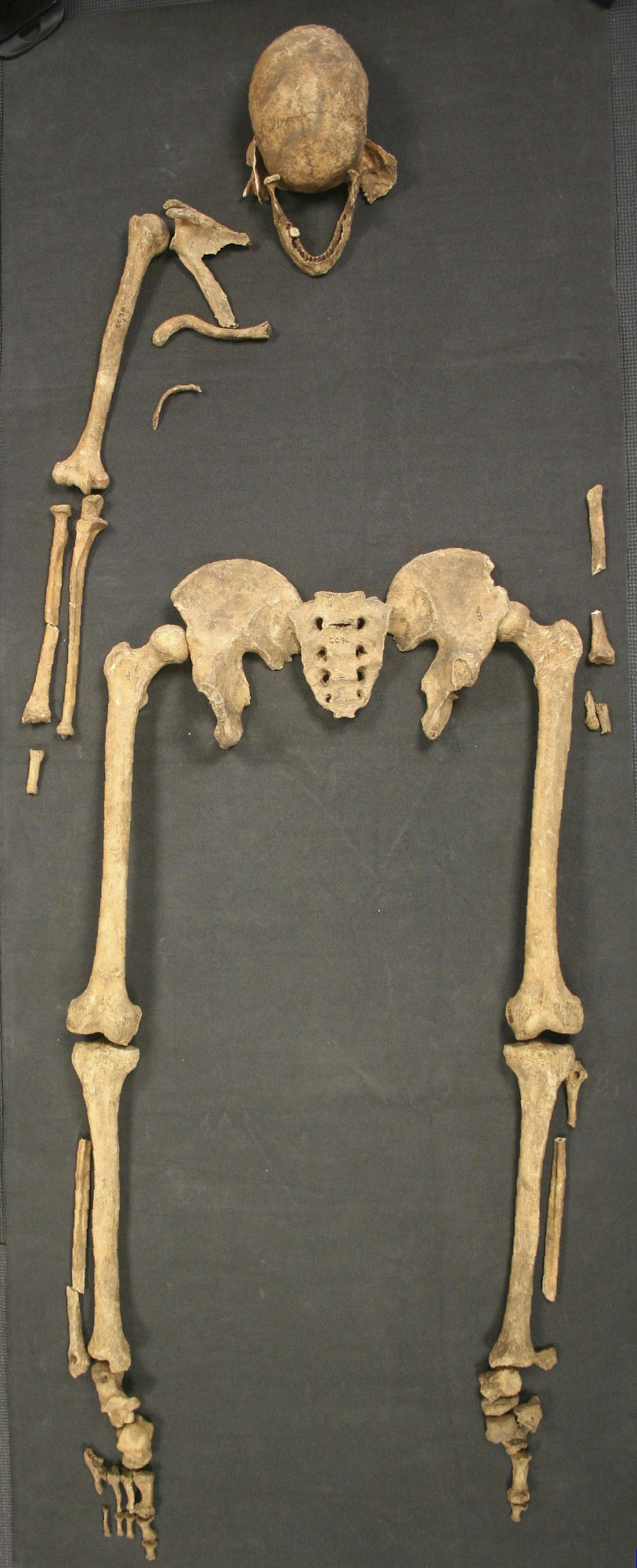
A 1,500-year-old skeleton suggests that leprosy may have spread to England from Scandinavia. The bones of the male skeleton show changes consistent with the disease, scientists found, including a narrowing of the toe bones and damage to the joints.
DNA and isotope analyses confirm the leprosy diagnosis and suggest that the man was from southern Scandinavia, possibly the region that is now Denmark. The strain of leprosy he carries dates to the fifth or sixth century A.D.
"We didn't expect to find leprosy at this early stage in Britain," said Sonia Zakrzewski, a bio-archaeologist at the University of Southampton in England and one of the study's authors. She and her colleagues reported their conclusions in the journal PLOS One.
The skeleton was discovered in Great Chesterford in Essex, England, during the 1950s. The findings make a strong case for researchers to revisit museum collections and perform DNA analyses on skeletons that were discovered long ago, Zakrzewski said.
Beetle found, no sign of relatives
A newly identified beetle species in the wetlands of South Africa has no direct relatives on the continent, a study reports.
"To the uninitiated, it looks like yet another black beetle," said David Bilton, an aquatic biologist at Plymouth University in England and an author of the report, published in Systematic Entomology. "The thing that's interesting about this one is that it doesn't have any relatives in the whole of South Africa."
The diving beetle, Capelatus prykei, is about two-fifths of an inch long — large compared with other diving beetles. Although diving beetles are found worldwide — there are more than 4,000 species — DNA analysis revealed that the new species has no relatives in Africa. "Its closest relatives are in Australia and New Guinea, and in the Mediterranean," Bilton said.
The beetle lives in the fynbos, an ecosystem in the Western Cape of South Africa. The climate is similar to the Mediterranean's, contributing to great biodiversity. The region has also been climatically stable for about 9 million years, making extinctions rare.
The researchers know of only one living population of Capelatus, in Table Mountain National Park in South Africa. Other populations may have died out because of urban development, Bilton said.


