
Schools turn economic crisis into lessons from real life

Teachers are using the nation's financial troubles to help students understand abstract economics concepts.

November 2, 2008 at 2:49AM
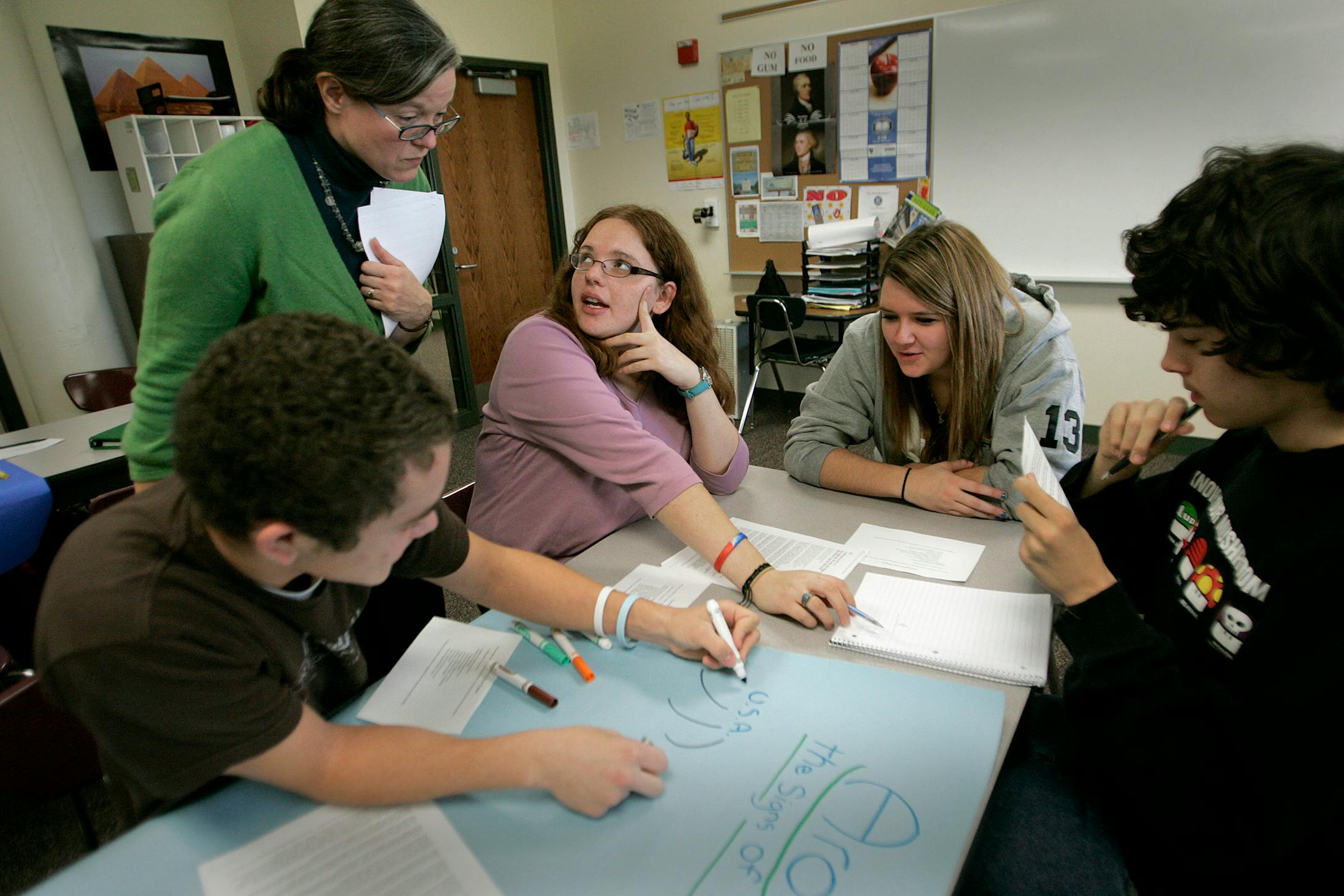
Henry Sibley High School students, from left, Jonathan Gould, 17, Tia Troy, 18, Anna Langevin, 17, and Kyle Clobes, 17, discussed their economics project with teacher Mary Beth Townsend. She uses current events to teach core economics concepts. (Star Tribune/The Minnesota Star Tribune)

You'd think the folks on Wall Street would have figured it out by now. If they haven't, they can always stop by Mary Beth Townsend's economics class at Henry Sibley High School in Mendota Heights.

That's where Townsend is using the market meltdown and the broader economic decline to teach core economics concepts. In doing so, Townsend is one of scores of teachers across Minnesota and the country who sees Wall Street in free fall one day and uses it the next to give students a real-life lesson about demand curves and other concepts traditionally considered too abstract and too boring.

"I use everything all the time from the news," says Townsend, who teaches advanced placement economics.

Kyle Clobes, one of Townsend's students, said he thought the decline in gasoline prices around town was a good thing. "But then I thought further," he said, noticing that gasoline prices fall because demand drops, and demand drops because the economy is weaker.

Recently, Townsend gave the class articles about the economy to read. She also gave them orders to apply economic principles to them.

Tia Troy, a senior, worked with the group of students who explained how economic turmoil spreads from one country to another. "The less demand there is, the more prices will decline, and the more prices decline the less producers will be willing to make things," Troy said.

Current issues are engaging

In education, being relevant is important, educators say.
"The classic teachable moment is the one that makes you get away from whatever you were going to teach that day and address something that is relevant," said Ben Jacobs, an assistant professor who teaches aspiring teachers at the University of Minnesota's School of Education.

Jacobs said he recently delivered a lecture on the need to use current issues to engage students. "I try to encourage my students not to avoid issues that might be controversial or complicated when they are teachers, but to pick issues that might make their students more thoughtful citizens."

Todd Hyland, who teaches economics and social studies at Park High School in Cottage Grove, is a witness. "While the economic crisis has been a source of anxiety for many, it has enabled us to make real connections for the students regarding the various topics we are addressing in class to their personal lives," Hyland said.

For example, Hyland's class has discussed such abstract concepts as the market for loanable funds and money supply, and how their impact is playing out in the current economic trauma. He assigned students to read articles about the proposed Wall Street bailout and draw conclusions about its potential effect on the economy.

"For the first time since I have been teaching, students actually remember the name of the treasury secretary and the chairman of the Federal Reserve," Hyland said. "The students are recognizing, like all of us, that we are living in an historic economic time that will be referred back to for many years to come."

Gregory A. Patterson • 651-298-1546

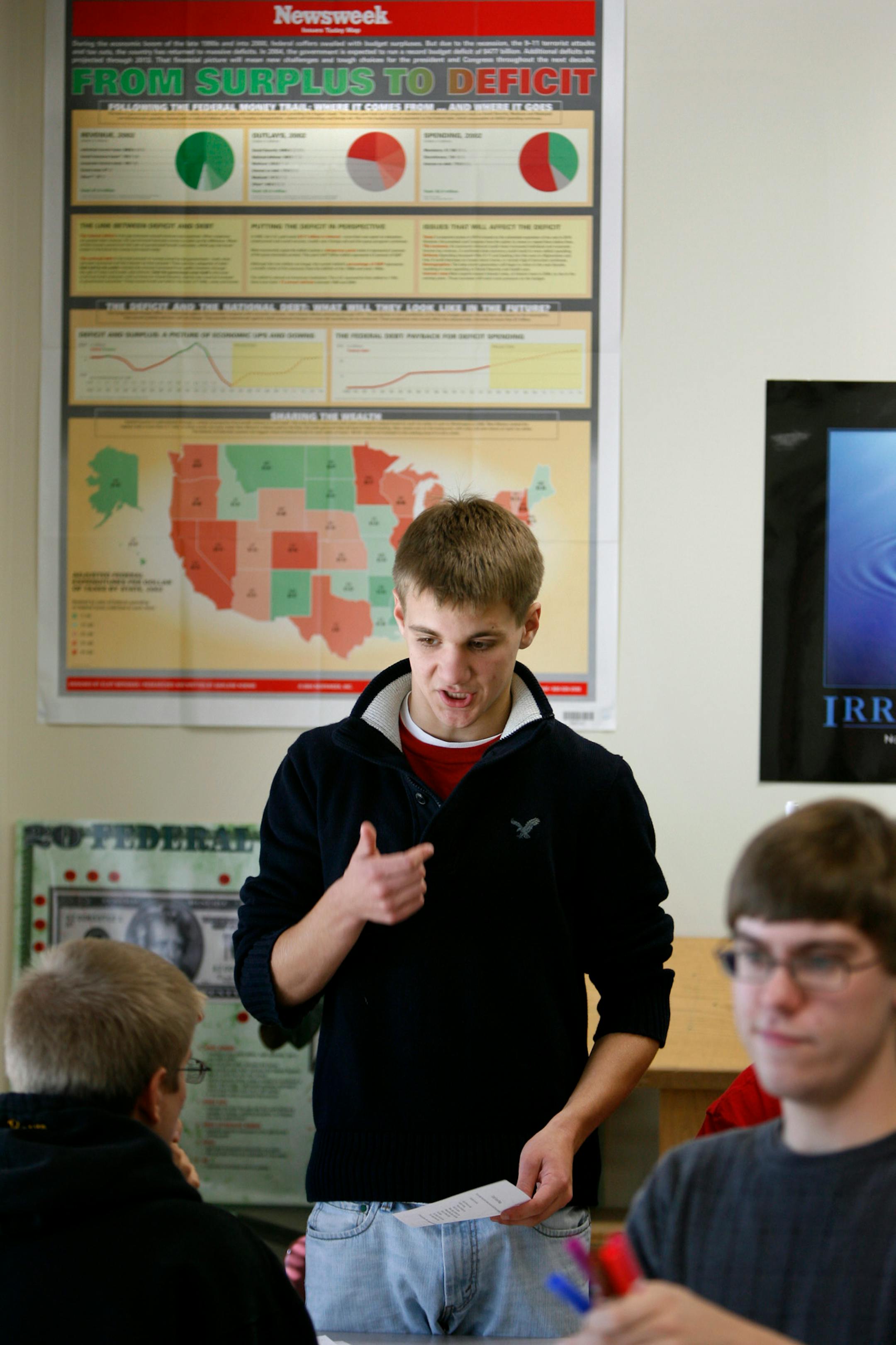
October 28, 2008 - Mendota Heights, MN - "The election motivates me because one of the major issues is the economic crisis that will effect my generation," said Charlie Berg, 17, during Mary Beth Townsend's economics class at Henry Sibley High School. Berg, who's father, a plumber that has been hit hard with the current housing crisis, is learning about current news articles regarding the current market and economic meltddown.
“The election motivates me because one of the major issues is the economic crisis that will affect my generation,” said Charlie Berg, 17, in class. The housing crisis has hit his father, a plumber, hard. (Star Tribune/The Minnesota Star Tribune)
about the writer

about the writer

GREGORY A. PATTERSON, Star Tribune

More from No Section

See More
FILE -- A rent deposit slot at an apartment complex in Tucker, Ga., on July 21, 2020. As an eviction crisis has seemed increasingly likely this summer, everyone in the housing market has made the same plea to Washington: Send money — lots of it — that would keep renters in their homes and landlords afloat. (Melissa Golden/The New York Times) ORG XMIT: XNYT58
Melissa Golden/The New York Times

It’s too soon to tell how much the immigration crackdown is to blame.