

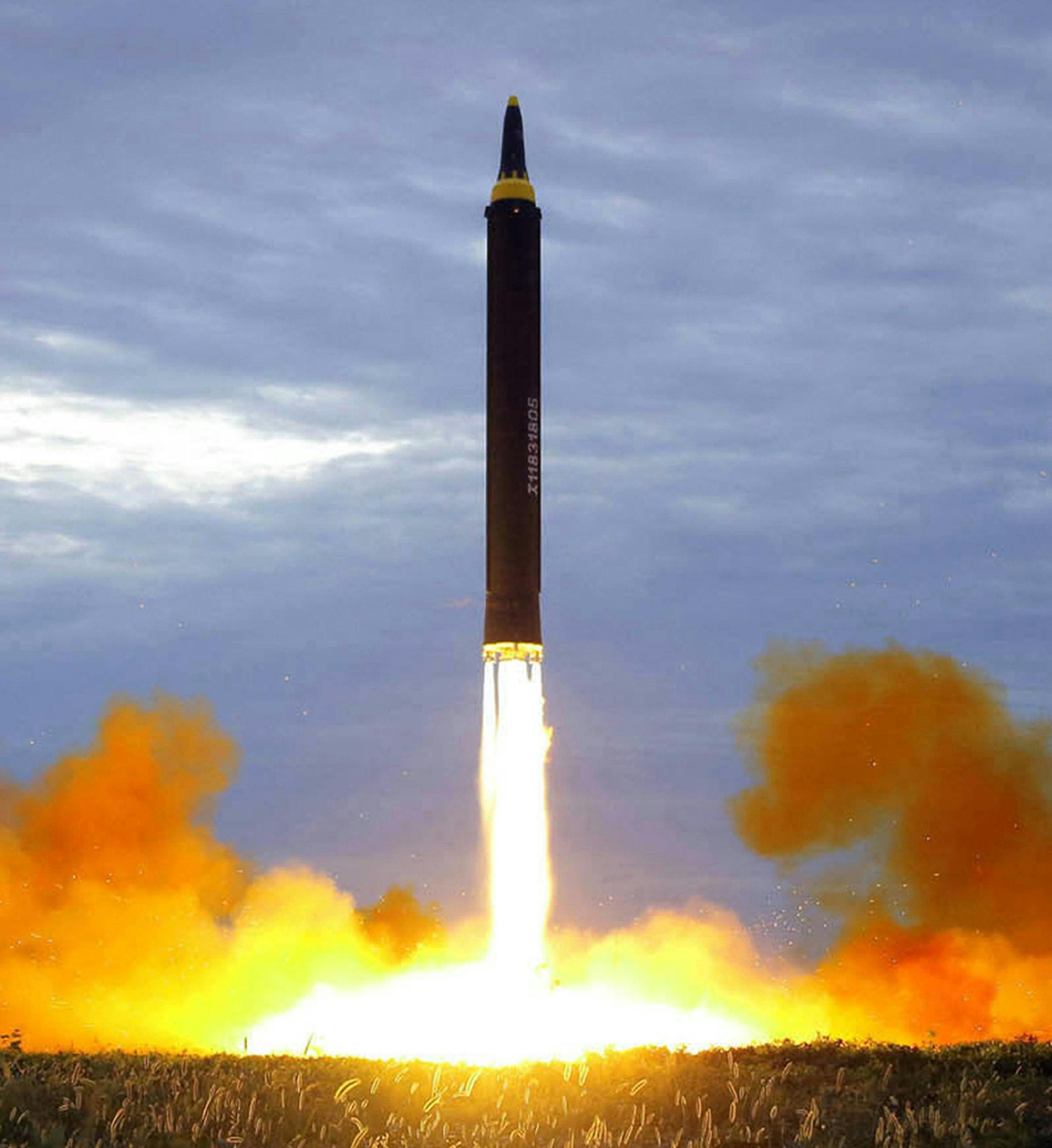
Kim Jong Un told the world this month that North Korea took steps to stop making nuclear weapons in 2018, a shift from his earlier statements. The evidence shows production has continued, and possibly expanded.
Satellite-imagery analysis and leaked U.S. intelligence suggest North Korea has churned out rockets and warheads as quickly as ever in the year since Kim halted weapons tests, a move that led to his June summit with President Donald Trump. The regime probably added several intercontinental ballistic missiles, nuclear proliferation analysts say, with one arms control group estimating that Kim gained enough fissile material for about six more nuclear bombs, bringing North Korea's total to more than 20.
"There is no indication that their nuclear and missile programs have slowed or paused," said Melissa Hanham, director of the One Earth Future Foundation's Datayo Project and an expert in using satellite imagery and other publicly available data to analyze weapons proliferation. "Rather it has reached a new stage."
Bolstering its arsenal
Recent reports have shown that North Korea continued to operate two suspected uranium enrichment facilities — one near its long-established Yongbyon nuclear center and another location suspected of being a gas centrifuge site. In July, Secretary of State Michael Pompeo acknowledged in Senate testimony that North Korea was still producing fissile material.
Other reports suggest North Korea bolstered its arsenal in the run-up to the Trump summit and still runs a plant believed to have produced Kim's first ICBMs capable of reaching the U.S. homeland. They say the regime recently expanded a factory probably making engines for new, easier-to-hide solid-fuel rockets and enlarged an underground base for long-range missiles.
The reports underline what's at stake as Trump considers holding a second summit with Kim, which the U.S. president says could come "in the not-too-distant future." While Trump has credited Kim's decision to halt weapons tests and dismantle a few testing facilities with preventing a war in the Western Pacific, those moves haven't prevented North Korea from building new weapons out of sight that could threaten the U.S.
Skepticism remains about Kim's denuclearization pledges, including his assertion in a New Year's speech that he agreed in 2018 to "neither make and test nuclear weapons any longer, nor use and proliferate them." A year ago, Kim ordered the mass production of warheads and ballistic missiles after suspending weapons tests following the launch of an ICBM capable of reaching the entire U.S.
Nonproliferation analysts say Kim's strategy appears to be quietly fortifying the arsenal he has while creating the diplomatic climate necessary for North Korea to get sanctions lifted and be tolerated as a nuclear state.


