
Saskatchewan offers ideal hunting spot

The province's wide-open land offers an ideal spot to hunt a bevy of birds.

November 3, 2008 at 4:02PM
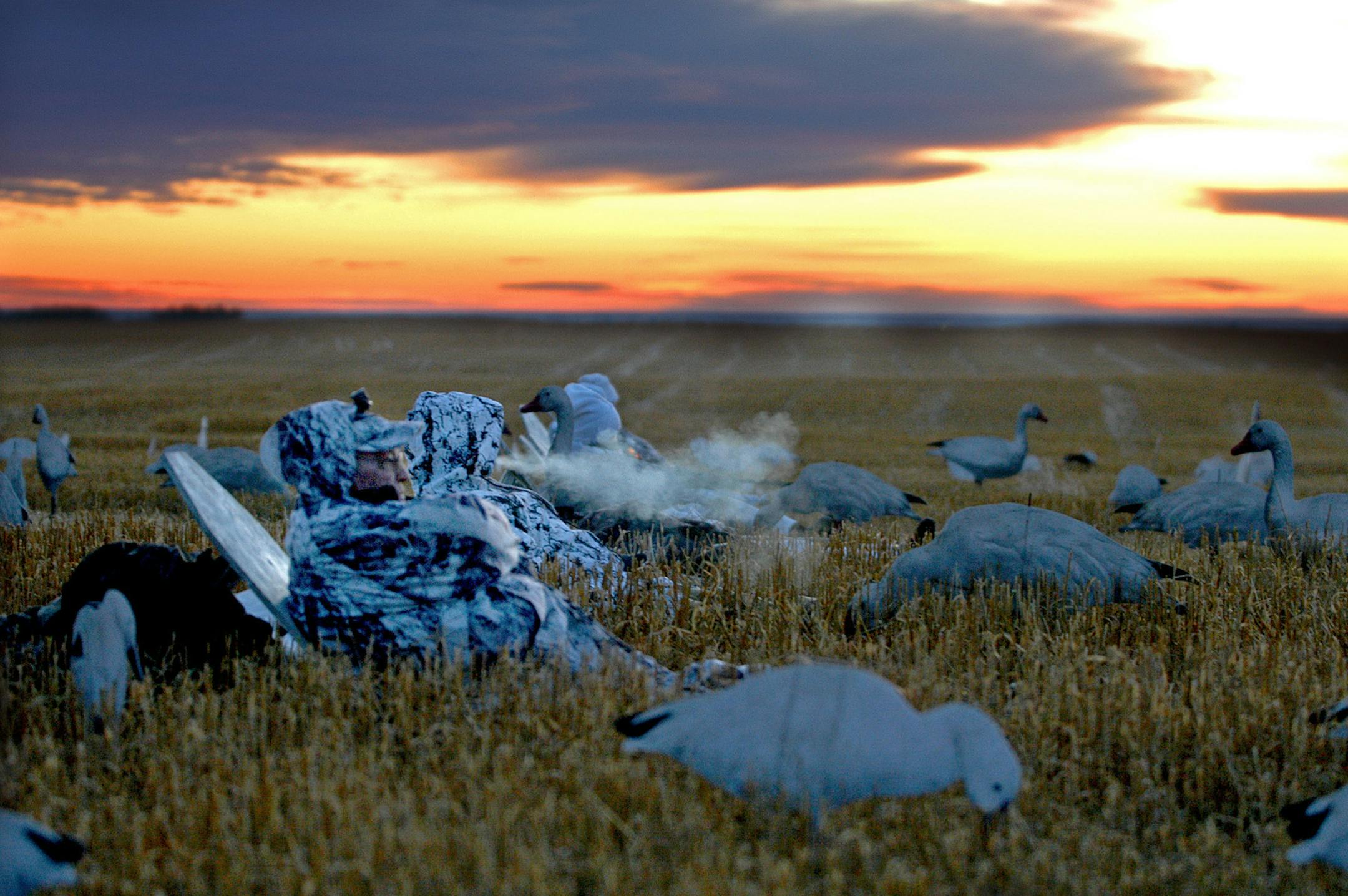
Joel Bennett, foreground, awaited incoming geese as the sun prepares to rise above the Saskatchewan prairie. Next to him in the line of hunters, amid about 300 decoys, is his son, Andy, who is exhaling.
Joel Bennett, foreground, awaited incoming geese as the sun prepares to rise above the Saskatchewan prairie. Next to him in the line of hunters, amid about 300 decoys, is his son, Andy, who is exhaling. (Star Tribune/The Minnesota Star Tribune)

PRAIRIE SASKATCHEWAN - Hereabouts, small towns with their clapboard houses are divided by railroad tracks and surrounded by unending expanses of cut wheat fields. On them vacant farms with their many collapsed buildings seem always to cast deep sighs of exhaustion. The only pickups that aren't muddy are those on "for sale" lots, and on Friday nights, beer drinking and laying rubber on main street offer homespun recreation for the locals.

We had come to hunt ducks and geese, though the evening before we had arranged ourselves for sandhill cranes, and in the magnificence of a prairie sunset these big birds silhouetted themselves against a fiery sky. The cranes had been staging in fens and prairie hollows in anticipation of flying south, and we intercepted some of them en route to a roost lake.

"We don't hunt cranes in Louisiana," said Sammy Achee, 12, of Houma, La.

Young Sammy was part of our group of a dozen hunters. We came from disparate places -- the Twin Cities, northern Minnesota, Louisiana --and before dawn each morning in mid-October we divided into two groups to erect hundreds of snow goose decoys.

The decoys were sillouettes and as the mornings grew colder the freezing ground became less receptive to their stakes. We clad ourselves entirely in white or white camouflage and when the decoys were set we hid among them as great waves of these geese washed over us, their raucous nasal honking falling upon us like rain, noisy as an aviary.

Some of the geese were fooled by our setups. Some weren't.

When they were, they circled, necks craning, and circled again. Finally, trailing downwind, they banked, slipped air through their wings, lost altitude, craned their necks still again, turned toward us completely, and locked their cupped wings against headwinds.

Below, on the landing strip coming clearly now into focus, we lay waiting, darkly.

Some of us blew calls, encouraging the geese toward us. Others cautioned against shooting too early. "Wait, wait."

Regardless, our heart rates red-lined. Everything that had come before this -- the trip planning, the travel, the license purchases, the decoy placements, the selections of clothing, guns and shells -- anticipated this moment.

When the geese were near enough to shoot, one of us said, "Take 'em."

• • •

By 10 or so each morning we stopped goose hunting. Our accommodations were spartan but sufficient, and we returned to them for lunch. Half of us stayed in a rented house, half in a Gunsmoke-era hotel about 20 miles distant.

At the hotel, curious about the suspensory qualities of his mattress, Benny Cenac, one of the Louisiana group, upon inspection found his fitted sheet covering what appeared to be a tin box.

"No springs, nothing," he said. "Never seen anything like it."

We gathered again to hunt in midafternoons. By then some of us had napped, others had cleaned guns, tossed a football against a blue prairie sky, or generally made work of nothing.

Joel Bennett of Sunfish Lake and his son, Andy, of Maple Grove, were along. One afternoon they and the Louisiana group, including Sammy Achee's sister, Ciera, 10, their dad, Sam, Weldon Eschette, and Benny, disappeared in their vehicles behind long clouds of dust leading to yet another harvested wheat field, where they hunted mallards.

Meanwhile, my brother, Dick, of Eveleth, Minn., his son, Brian, of Plymouth, and my two boys and I converged on a small wetland, or what some in Saskatchewan would call a prairie pothole.

As we approached, perhaps 2,000 mallards took flight, some in dark clouds of beating wings, others breaking off in small squadrons. Occasionally, also, singles and doubles arose, the drakes among them plumed in hues brilliant enough to shame a peacock.

"Let's throw the decoys out on this end," Dick said.

The small marsh dog-legged to the left and was thoroughly surrounded by willows.

A strong wind swirled from the west. The sky was clear and soon again the setting sun cast its kaleidoscope of reds and oranges against a midnight blue sky.

An argument has long been made by those who oppose hunting that "sport" is an inaccurate definition for it. There's truth here. Sport involves purchased tickets and entry gained to staged events.

Not so hunting, particularly not waterfowl hunting, least of all duck hunting. These birds answer to siren calls known to them alone, and their timeless collaboration with wind and moon phases and migration routes suggest an otherworldliness that hunters know to be more complicated than sport, and more nuanced. More akin to religion, duck hunting supposes no winners or losers, as sport does, but instead, simply, believers.

The first mallards returned one at a time, occasionally in pairs. We were hidden in the willows, and they had no idea. Most times mallards cloud above you in airy tornadoes, paranoid beyond reason, unwilling to land, fearful.

These birds, by contrast, came in feet first, unsuspecting.

Somewhere in the distance, farm machinery ground noisily into the late afternoon. Snow geese flew in endless strings that disappeared along the curves of the earth. Beneath these and with their faster wings beating, mallards wheeled and pitched into the gathering darkness.

The mallards wanted back into the prairie pothole to roost and sometimes when we shot one or another spilled to the ground in broad arcs.

Soon night came and we had our ducks.

Benny, Joel and their gang hunting in a field not far away had their ducks, too.

We retired to the rented house. Cajuns are trusting people. But when they travel north of the Mason-Dixon line, they bring their own food.

Benny toted with him a bag of rice the size of a pillow case. One night we had seafood gumbo, another night crawfish etouffee, and on this night, alligator sauce piquante. Crawfish dip came first, with crackers, also fried shrimp.

Outside, overhead, snow geese still squawked their eerie cries, migrating.

Dennis Anderson • danderson@startribune.com

about the writer

about the writer

Dennis Anderson

Columnist

Outdoors columnist Dennis Anderson joined the Star Tribune in 1993 after serving in the same position at the St. Paul Pioneer Press for 13 years. His column topics vary widely, and include canoeing, fishing, hunting, adventure travel and conservation of the environment.

See Moreicon