
Russians remember Stalin's legacy

They are painful memories to relive, but Russians say if the carnage is forgotten it could happen again.

The Washington Post
October 30, 2012 at 1:08AM
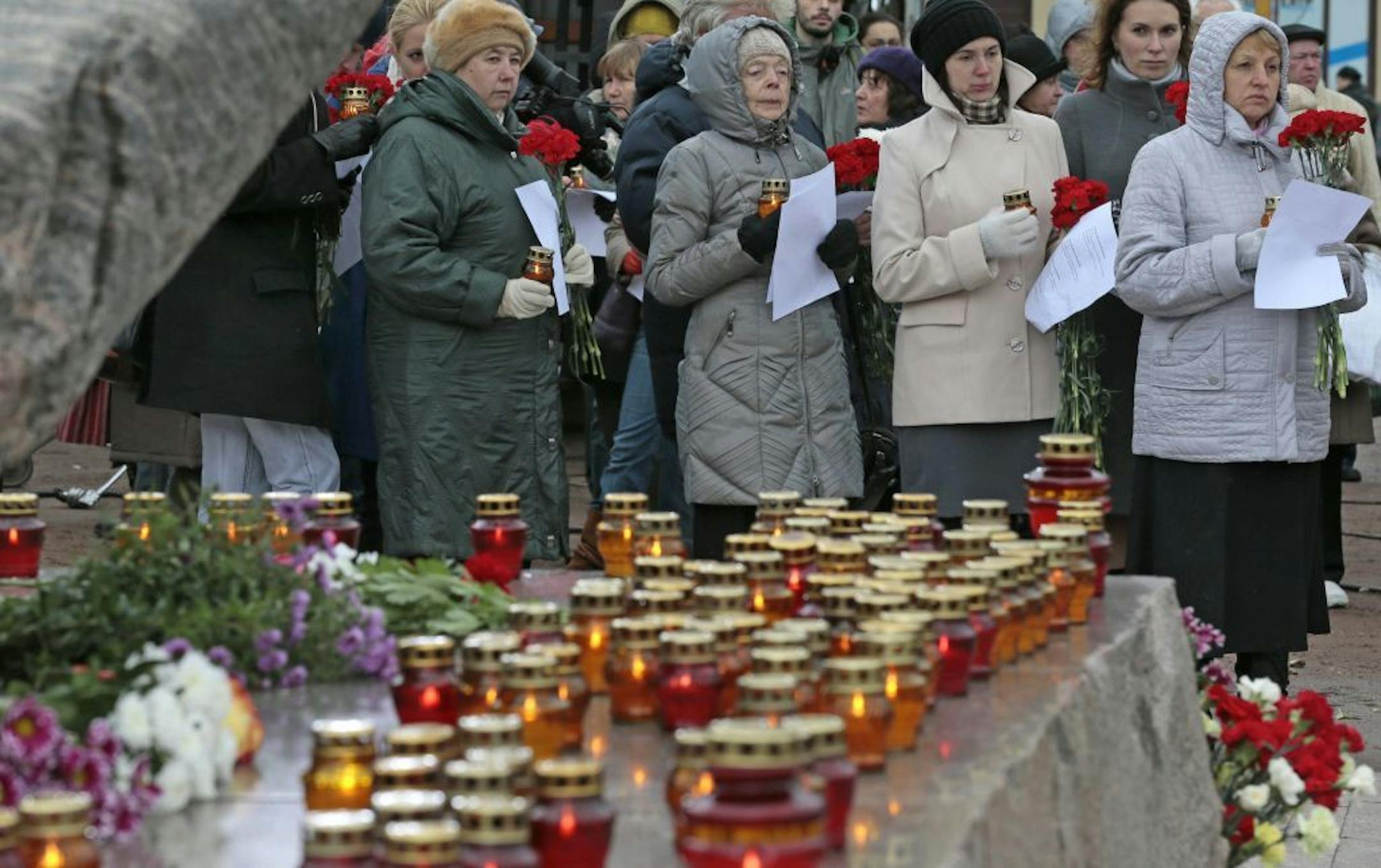
People line up to lay flowers at the Solovky Stone monument and to read out the names of victims of Soviet dictator Josef Stalin's purges in Lubyanka Square in Moscow, Russia, Monday, Oct. 29, 2012. On the eve of the Day of Victims of Political Repressions marked in Russia on Oct. 30, people gathered at the memorial, a giant slab of stone taken from a Soviet labor camp in the Solovky Islands, to commemorate thousands of victims of Soviet-era political repressions.
People line up to lay flowers at the Solovky Stone monument and to read out the names of victims of Soviet dictator Josef Stalin's purges in Lubyanka Square in Moscow, Russia, Monday, Oct. 29, 2012. (Associated Press - Ap/The Minnesota Star Tribune)

MOSCOW

The muddy slush numbed the feet. Voices trembled, not because of the freezing cold but because of the weight of their words. Russians gathered Monday in the shadow of the building where Stalin's secret police drew up their death lists, and spoke the names of the murdered.

Members of the Memorial human rights society, relatives of victims and others come here once a year to stand near the Solovetsky Stone, brought from the White Sea island where the Soviets organized their first prison camp in 1923, and read from a list of the 30,000 Muscovites executed in 1937 and 1938.

This year, the reading had more than the usual resonance. Some opponents of President Vladimir Putin have said that his crackdown on political opposition reminds them of those two years, the worst of Stalin's terror, when 1.7 million Russians were arrested and at least 725,000 of them shot. Others were sent to the gulag.

"No," said Vladimir Kantovsky, an 89-year-old survivor of the camps. "It cannot be compared. You cannot even imagine what it was like."

Even so, Kantovsky said, it was more important than ever to read the names. "We must make people remember," he said. "We can't let them forget. If they do, it can happen again."

Memorial organized the first reading in 2007, the 70th anniversary of the terror. The names are read on the eve of Oct. 30, the day set aside to remember victims of political repression. The names, along with the their age, profession and date of execution, are read to defy a totalitarian system that tried to obliterate its victims.

"It is our duty to return their names to them," said Yelena Zhemkova, Memorial's executive director.

Kantovsky was a 17-year-old high school student when he was arrested in 1941 for passing out leaflets defending his history teacher, who had been arrested.

He spent time in six different prisons and camps and served on the front in World War II with a penal battalion. After the war, he finished his sentence and then spent five years in Siberian exile, finally gaining his freedom in 1956.

He returned to school at age 33 and got an engineering degree. His old teacher, Pavel Dukovsky, had died in April 1942.

"Why were they arrested?" he asked rhetorically. "Why were they executed? Stalin did not like people to think and have their own opinions."

about the writer

about the writer

KATHY LALLY

More from No Section

See More
FILE -- A rent deposit slot at an apartment complex in Tucker, Ga., on July 21, 2020. As an eviction crisis has seemed increasingly likely this summer, everyone in the housing market has made the same plea to Washington: Send money — lots of it — that would keep renters in their homes and landlords afloat. (Melissa Golden/The New York Times) ORG XMIT: XNYT58
Melissa Golden/The New York Times

It’s too soon to tell how much the immigration crackdown is to blame.