
Ruling delayed on Al Barnes' medical decisions

Testimony left the case of Al Barnes unresolved, meaning a third party will have medical authority until a judge can rule on his care.

January 20, 2011 at 7:21PM
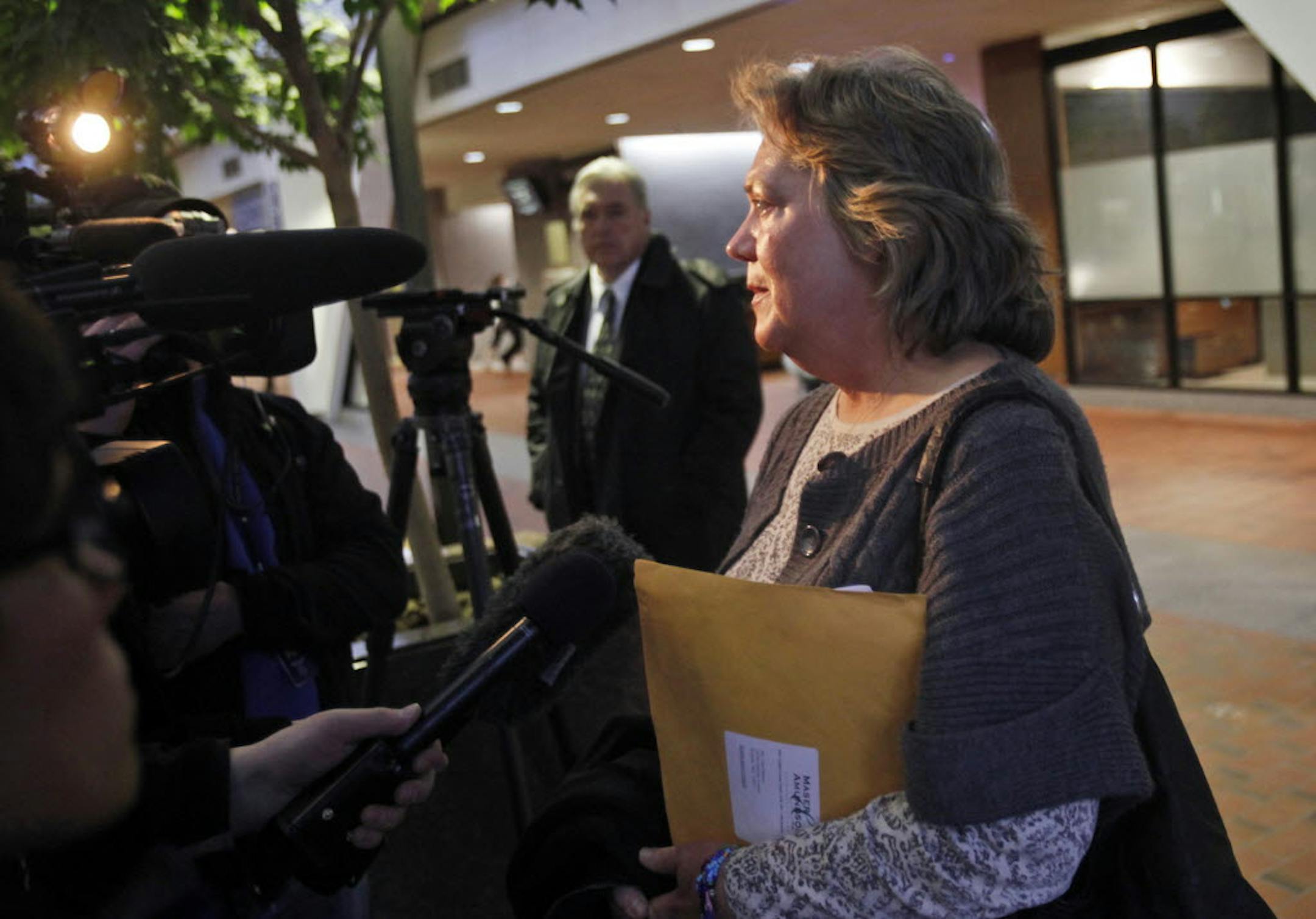
Lana Barnes spoke to media members while her brother, Lynn Hansch, looked on following Wednesday's Hennepin County Court hearing to decide the fate of her husband, Al.
Lana Barnes spoke to media members while her brother, Lynn Hansch, looked on following Wednesday's Hennepin County Court hearing to decide the fate of her husband, Al. (Stan Schmidt — Star Tribune/The Minnesota Star Tribune)

Wednesday's tense courtroom showdown on the fate of Al Barnes' medical care left the issue unresolved until next month -- assuming that the 85-year-old from Scandia, Minn., lives that long.

During testimony in Hennepin County Probate Court, a physician from Methodist Hospital in St. Louis Park said it's unlikely that Barnes, in whom doctors have diagnosed dementia, kidney failure and respiratory failure, will survive until a hearing set for Feb. 2.

The case pits Barnes' wife, Lana, against doctors at Methodist, who have asked the court to remove her decision-making authority over Barnes' care, arguing that she is making misguided and reckless choices.

Referee Dean Maus will eventually make a permanent ruling, but as of Wednesday placed temporary responsibility for Barnes' care with Alternate Decision Makers Inc., a Minneapolis firm that specializes in such disputes.

Doctors at Methodist and other hospitals believe that Lana Barnes, 56, is unrealistic about the prognosis of her husband, who needs a feeding tube to eat and a ventilator to breathe.

She believes the doctors' pessimism -- and subsequent refusal to provide life-sustaining dialysis treatment -- reflect a misdiagnosis. "I think the doctors are recommending a death order and I don't think my husband should die of a misdiagnosis," she said in an interview before the hearing.

Barnes appointed his wife as his medical decision-maker several years ago, and asked that she pursue aggressive care if there was any chance he could recover. The couple have been married 27 years and have two sons. "He's fearless," she said. "He's not afraid of dying. He fought in World War II courageously."

At the heart of the case is whether or not Barnes has irreversible dementia. In testimony, Dr. Abel Tello, a kidney specialist from Methodist, said Barnes meets the clinical threshold for dialysis to treat his kidney failure. However, Tello said, Barnes' level of dementia is so advanced that such aggressive treatment probably wouldn't improve or lengthen his life.

"Unfortunately, he's at a very slow but progressive decline," Tello testified. He recommended comfort care to make Barnes as pain-free as possible in his remaining days.

Lana Barnes represented herself in court and cross-examined Tello. It is her belief that her husband suffers from a swelling of the brain, called "normal pressure hydrocephalus," often misdiagnosed as a cause of dementia. If that condition is treated, and dialysis resumes, she maintains, her husband could recover.

Complicating the case is the fact that Barnes has been treated at 10 hospitals since last March, and that other hospitals have questioned Lana Barnes' views. Upon Barnes' discharge Dec. 25 from Regions Hospital, a doctor wrote that his wife had a "fixed delusion" about the cause of her husband's condition, according to court records. Lana Barnes called for an ambulance and had her husband admitted to Methodist that same day because he was choking.

Tello said that before filing his court petition, he had tried finding any hospital in the Twin Cities or Rochester that would take Barnes and provide dialysis. "We cannot find a place that will accept him," Tello testified. Lana Barnes disputed that claim.

'A very complex question'

While Lana Barnes was often halted by the referee for making statements instead of asking questions, she asked one that made Tello pause.

"Do you feel that Albert has a life?" she asked.

"That is a very complex question, Mrs. Barnes," he replied. "He has a heartbeat and he's not brain dead. By that standard, he absolutely has a life."

But if the standard is being able to offer any communication and connection with people around him, then, the doctor concluded, he does not.

Lana Barnes disagreed, triggering an emotional courtroom exchange. She said her husband has shown recent signs of cognition, including puckering his lips at home in mid-December when she asked for a kiss. She said a home care nurse witnessed the act.

Lana Barnes was stunned when a lawyer for Methodist called someone to rebut that claim. Jeanne Roudabush, a nurse case manager at Methodist, said she called the home care nurse to ask about the claim. The home care nurse admitted, Roudabush testified, that she put that comment in the record only to appease Lana Barnes. "What she witnessed was not what she wrote," Roudabush said.

With the question of Barnes' consciousness left unresolved, the referee heard testimony specifically to determine whether to order dialysis for Barnes until the next hearing. A ruling is expected Thursday.

A Methodist attorney called such treatment futile and Tello said it presents potential suffering to a dying man. Lana Barnes said it simply gives him a chance.

"There's always been controversy about my husband's condition," she said. "I do believe there is still hope."

Jeremy Olson • 612-673-7744

Al Barnes
Al Barnes (Star Tribune/The Minnesota Star Tribune)
about the writer

about the writer

Jeremy Olson

Reporter

Jeremy Olson is a Pulitzer Prize-winning reporter covering health care for the Star Tribune. Trained in investigative and computer-assisted reporting, Olson has covered politics, social services, and family issues.

See Moreicon

More from No Section

See More
FILE -- A rent deposit slot at an apartment complex in Tucker, Ga., on July 21, 2020. As an eviction crisis has seemed increasingly likely this summer, everyone in the housing market has made the same plea to Washington: Send money — lots of it — that would keep renters in their homes and landlords afloat. (Melissa Golden/The New York Times) ORG XMIT: XNYT58
Melissa Golden/The New York Times

It’s too soon to tell how much the immigration crackdown is to blame.