
Rosemount man who wants to build house on family land says city is treating him like a developer

Samuel Adams has to pay $62,000 in stormwater fees before constructing a home. A Rosemount official said the bill helps fund projects to control flooding.

The Minnesota Star Tribune
August 1, 2025 at 7:00PM
A Rosemount resident who wants to build a house on a plot of family land says the $62,000 in stormwater fees he must pay the city could make the project financially untenable. (Renée Jones Schneider/The Minnesota Star Tribune)

The leafy Rosemount property that’s remained in Samuel Adams’ family for four generations has matured into a gem. It’s one of a dwindling number of unspoiled areas in a south metro suburb developing at breakneck speed.

So when several acres became available to Adams after his grandparents died, the father of two knew the spot off McAndrews Road near Valleywood Golf Course was the perfect location for a “forever home” for his wife and two young sons.

“There’s something special about things being a little bit rural,” he said.

But Adams soon ran into a potentially costly problem.

Rosemount residents who want to build on properties must pay $6,865 per acre in stormwater trunk fees before the city will issue building permits. Those rates apply equally to out-of-town developers and small-time landowners like Adams, who faces a roughly $62,000 bill before constructing a home on ten acres of land.

“We’re being treated as developers,” he said, calling the fees “inordinately burdensome on people who just want to stay on their rural residential land.”

Rosemount city officials see the situation differently. Public Works Director Nick Egger said the stormwater fees are a key way the city pays for projects to minimize flooding and runoff.

As for Adams’ claim that it’s unfair to charge everyone equally?

“I’m indifferent toward that,” Egger said, adding officials were likely trying to “keep things simple” when they decided to bill all prospective builders the same rate. That method helps pay for stormwater improvements across the city if a development magnifies flooding a lot — or a little.

“There’s not a carve-out for individual residents subdividing property versus a for-profit developer subdividing property,” he said. “The impacts and the reasons for having to handle the surface water are still the same.”

Rural land in an urbanizing suburb

Adams’ grandparents, Donna and Earl, bought the roughly 25-acre swath in the 1960s, back when McAndrews Road was a gravel thoroughfare that ended at Johnny Cake Ridge Road.

It served as a home base — and endless source of fun — for generations.

Earl, a pilot for North Central Airlines, liked to take off in a tiny plane from a runway he built on the property. Adams’ dad, uncle and aunt grew up in a house tucked away from the main road. So did Adams, who remembers building forts with his cousins and running around the woods that sprawled in every direction.

“We grew up having a pretty cool childhood,” he said. “We’re pretty fortunate to have that land. Roll of the dice that my grandparents happened to buy it way back then.”

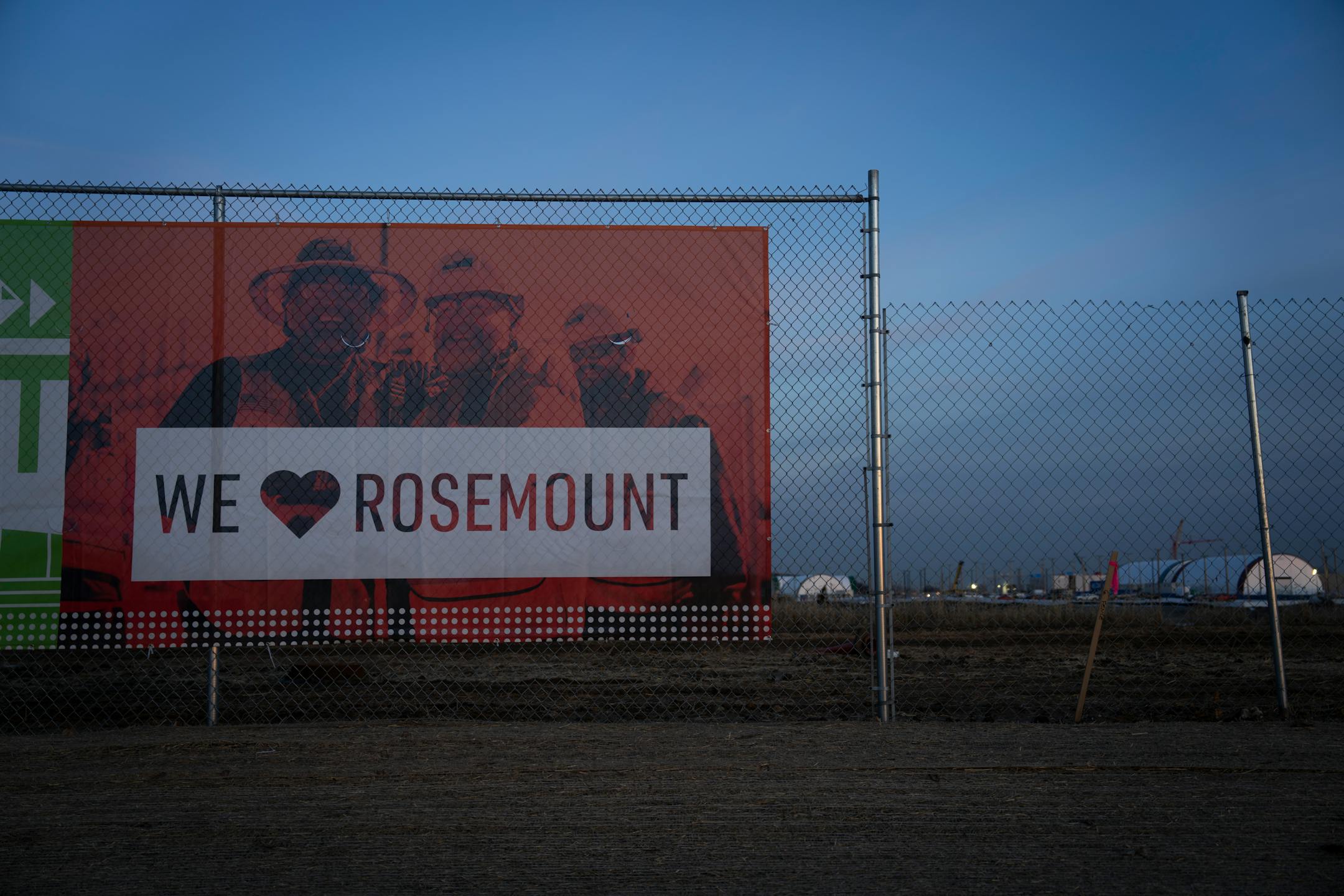
As the Adams family grew, so did the city around it. A Meta data center, new schools and a crop of apartments and homes have all taken root in Rosemount in recent years, whittling away the amount of vacant land. But the suburb’s expansion — the number of residents is expected to crest 42,000 by 2030 — has been happening for years.

Population has grown sevenfold from the time Adams’ grandparents bought their land to the early 2000s, when Egger said Rosemount created its stormwater fee structure. At the time, the city had just finished planning for future flooding and stormwater disruption — and deciding how to pay for ways to head-off those inevitable issues as Rosemount continued to grow.

Egger said officials settled on splitting the cost across the entire city by charging everyone who sought to subdivide property a per-acre fee for stormwater improvements. Other suburbs, he added, take a similar approach.

“This isn’t something that’s novel,” he said.

‘Don’t forget about us’

That approach would come to vex Adams 25 years later. He contends it’s unfair he must pay about $62,000 in stormwater management fees when his proposed single-family home would add a limited amount of impervious surface to a large property planted with natural buffers.

And he claims Rosemount has reduced fees for developers in the past. In 2014, the city lowered the per-acre rate for land in the nearby Lebanon Hills sub-watershed area after officials determined “stormwater flows north and requires comparatively less infrastructure” there.

Egger said experts conducted multiple studies into surface water flow before the city made the rare decision to decrease fees in that area.

For now, Adams continues to press city officials to waive stormwater trunk fees for his family’s land, and instead allow him to pay connection charges of $3,050 per lot. So far, they have refused, he said, “creating a situation in which building on our own property would become unduly burdensome,” he wrote in a recent letter to the City Council.

The rapidly growing area, he argues, should lend a hand to the few family landowners left.

“It’s understandable for city code and policy to ossify in the direction of higher density,” he said. But “given the assumption that density going forward is probably going to be higher than lower, all we ask is, ‘hey, don’t forget about us.’”

about the writer

about the writer

Eva Herscowitz

Reporter

Eva Herscowitz covers Dakota and Scott counties for the Star Tribune.

See Moreicon

More from Twin Cities Suburbs

See More
card image
Ayrton Breckenridge/The Minnesota Star Tribune

The resolution of the dispute between Orono and Long Lake follows years of strife between the cities over who should control fire services.

card image
card image