

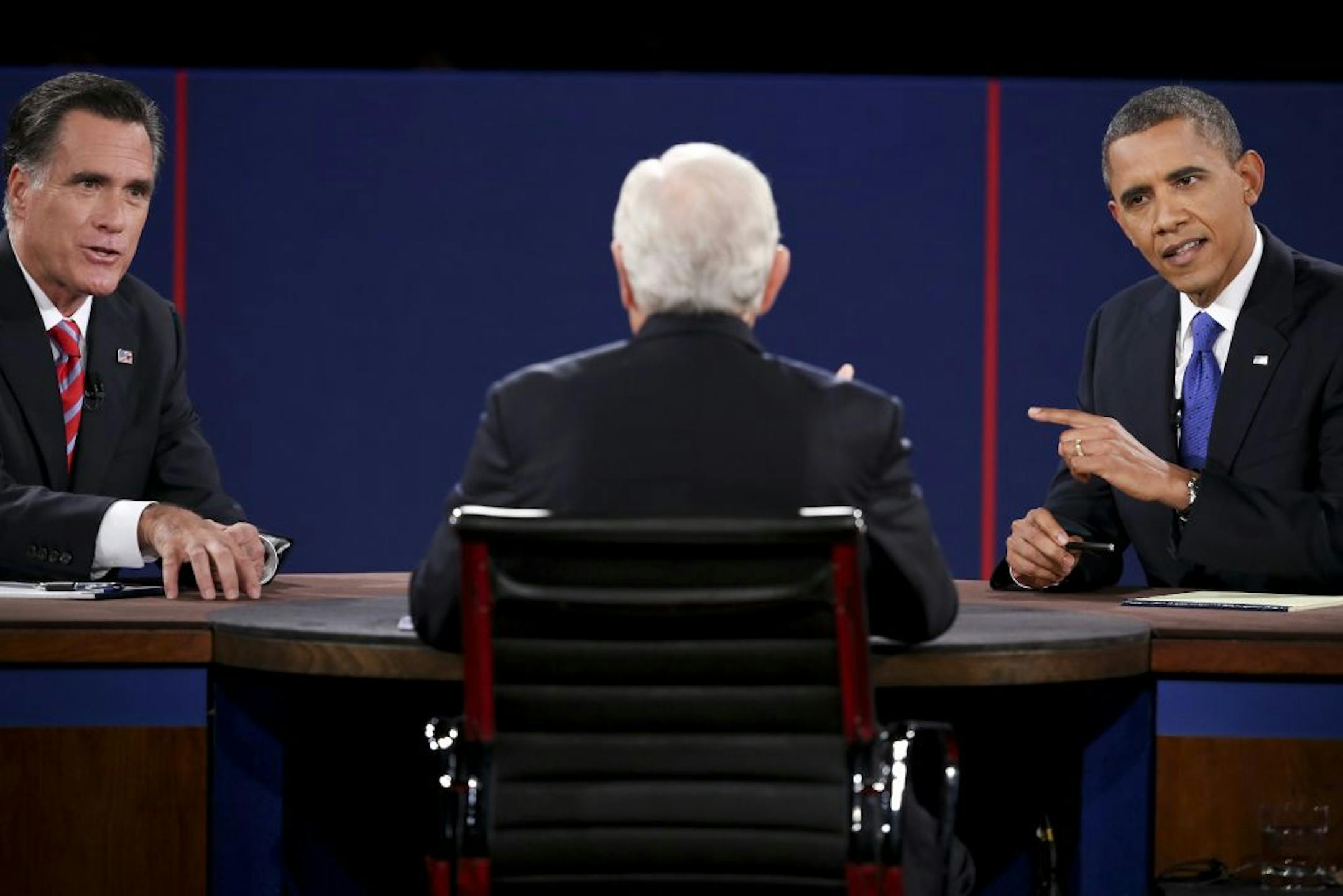
Mitt Romney's task in Monday night's foreign policy debate was to demonstrate that he could be a credible commander in chief, prepared to execute U.S. power with more muscle and less compromise than President Obama, but without veering into what Obama called the "wrong and reckless" policies of the last Republican in the Oval Office.
But in a combative debate that veered from whether the United States could control Mideast events to which man has a better chance of forcing Iran to surrender their nuclear program without resorting to war, Romney avoided the more bellicose tone he often struck during the Republican primaries.
While he pushed back at Obama at times, he explicitly said he would not intervene militarily in Syria, remain beyond 2014 in Afghanistan or rush into a confrontation with Iran. He ended up agreeing with the broad outlines of Obama's approach on the use of drones, and opposed a breach of relations with Pakistan, arguably America's most frustrating ally.
Romney had a narrower political task Monday: to show he was conversant in the subject matter and to reassure a war-weary public that he would not plunge the country into new conflicts.
As he did in his previous two debates with Obama, he shifted to the middle, and at times he even sounded the nation-building themes the president talked about as a candidate in 2008, and abandoned after he was elected. "We're going to have to do more than just going after leaders and killing bad guys," Romney argued several times, saying he would provide aid to build up democracies and discourage terrorism -- something he previously has rarely stressed. He frequently talked of bringing about a "peaceful planet."
Yet time and again, the president suggested that managing a world that at once craves and resents U.S. power requires a lot more than martial-sounding declarations about calling in airstrikes or threatening to turn on and off U.S. foreign aid. And he cast Romney as a man unwilling to recognize how perceptions of U.S. strength have changed: When Romney complained that the Navy had fallen to its smallest size since World War I, Obama dismissed the criticism. He noted that the capabilities of U.S. ships are far beyond what they once were and added, "Governor, we also have fewer horses and bayonets."
Bringing the debate home
For Romney, this final debate before the election in two weeks was clearly his weakest. While he seemed familiar with a range of topics, speaking about rebellions in Mali and ticking off the insurgent groups in Pakistan, he also took every opportunity he could to turn back to economic issues at home, his campaign theme. Soon the two men were arguing about job creation at home and support for education.


