

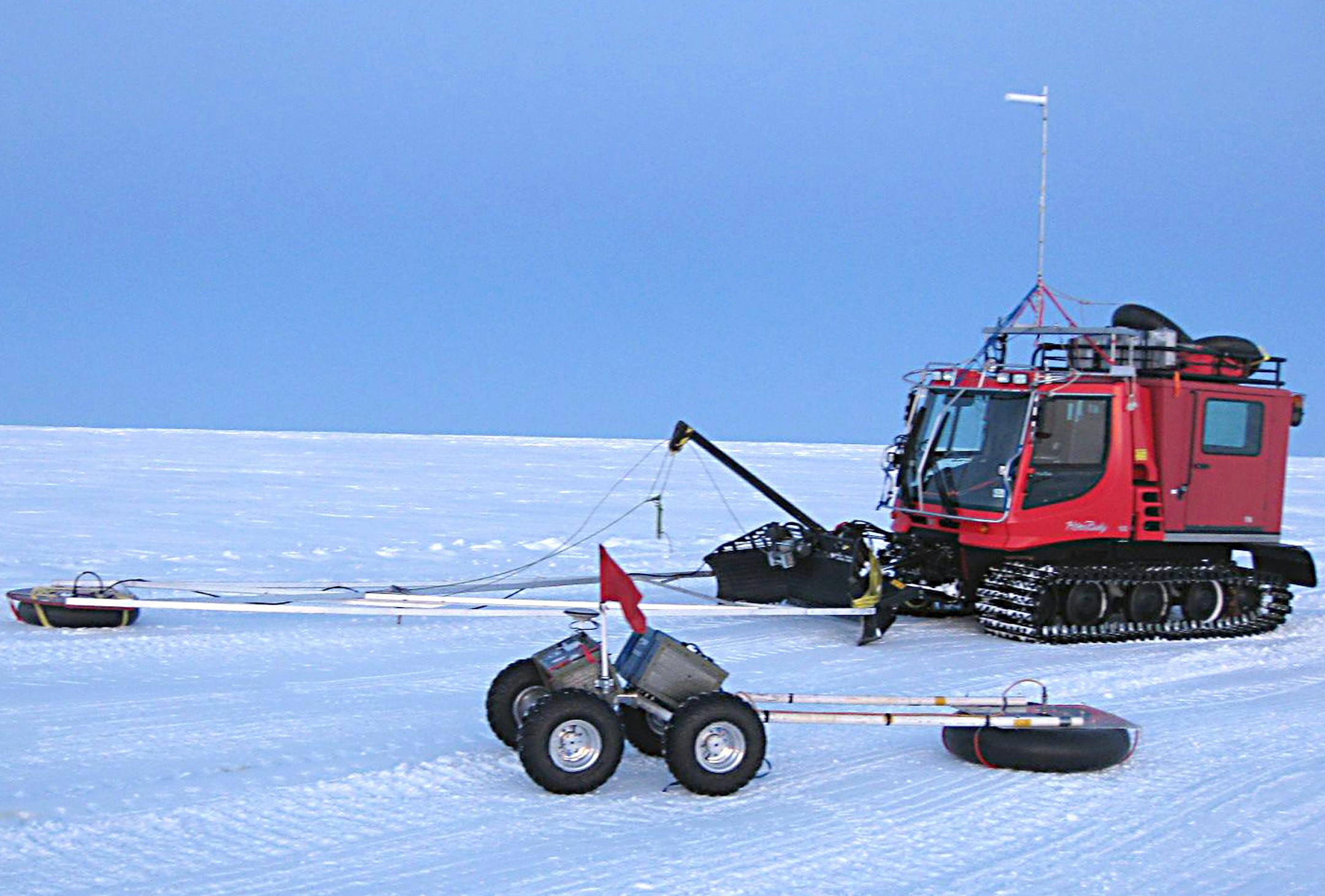
You're traveling more than 1,000 miles across the barren snowscape of Antarctica. Along the way, many crevasses lie hidden between you and your quest to resupply the hungry scientists at the Amundsen-Scott South Pole Station.
The good news is you can detect these death traps with a radar arm.
The bad news is it only gives you about 4 seconds of warning before you and your tracked vehicle, which weighs several tons, plummet to a dark and silent tomb. If only there were a robot that could map crevasses ahead of such expeditions. Preferably one with an adorable yet mildly ferocious name.
Meet the Yeti. This four-wheel-drive rover drags a ground-penetrating radar arm capable of logging information that tells scientists what lies — or more important, what doesn't lie — below.
At just 180 pounds, the bot crosses snow-covered crevasses with ease. It functions at temperatures around minus-20 degrees F. In short, Yeti is an awesome little minion redrawing the boundaries of hazard georeferencing.
Most of us don't have to think about such things, but doing science on the bottom of the world is a tricky endeavor. In addition to dangerous weather conditions and 30-foot-wide trapdoors in the ice, the logistics of assembling personnel, equipment and supplies at the South Pole are nothing short of extraordinary.
"The focus of this effort was to support the actual operations and logistics side of the Polar Program," said James Lever, mechanical engineer and specialist in over-snow mobility for the U.S. Army's Cold Regions Research and Engineering Laboratory. Lever and co-principal investigator Prof. Laura Ray published their findings this month in the Journal of Field Robotics. "Whether you have researchers in Antarctica or Greenland, you have to keep people safe and comfortable. You're a long way from everything else and so it's expensive to do science there."
The little Yeti — and its predecessor, the solar-powered Cool Robot — have found support from the operations and science arms of the National Science Foundation as well as NASA's Jet Propulsion Laboratory. After all, rover work on Earth's poles isn't so different from rover work on Mars or other celestial bodies. And the lessons we learn from tweaking Yeti may one day help us in space.


