

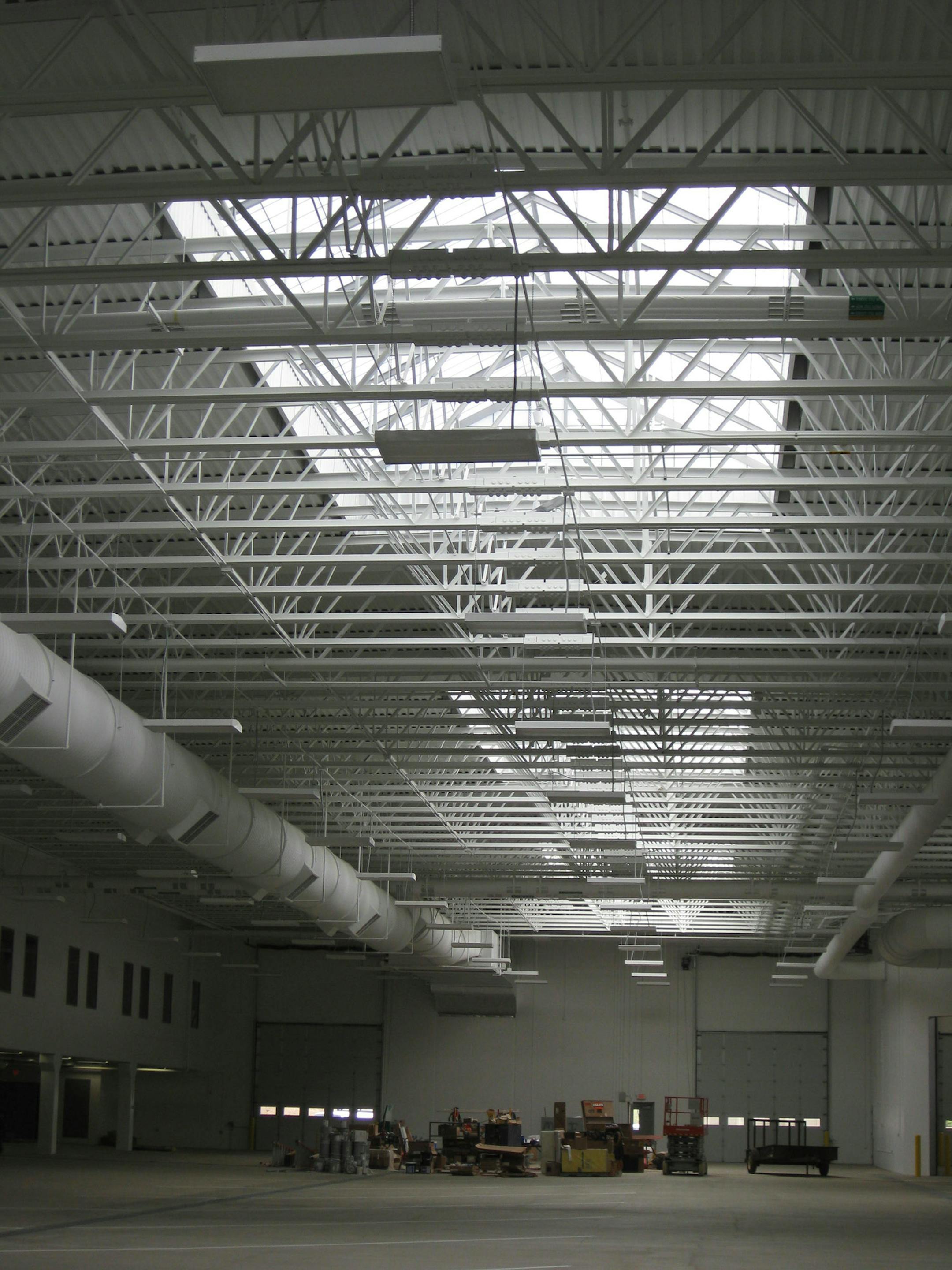
When Richfield decided to build a new public works maintenance facility, it wanted it to make it as green as possible.
Though the machines inside might be oily and spattered with salt, the City Council reasoned, there was no reason the building and its site couldn't be a model of environmental sensitivity.
Now, the $12.9 million public works garage is set to open later this month. And what looks ordinary from the outside -- a gray 98,000-square-foot industrial-style building with garage doors -- isn't ordinary at all.
Nearly surrounded by water-collecting rain gardens, the site features a parking lot with permeable paving that should allow rain to seep into the ground as easily as if it were sand. Eighty hidden 200-foot-deep wells use the constant 50-degree temperature of the Earth to moderate water temperature in a closed system that will heat and cool 40 percent of the building. Massive skylights over the main vehicle storage area will light the area on all but the darkest days.
In the second-floor administrative area, sensors will turn lights on when someone enters an office and turn them off if there's no activity for 8 minutes. An energy recovery unit will save heat from air that leaves the second floor. Desk partitions were bought used from a furniture dealer.
The carpet was made by a company that uses a zero-waste manufacturing process. When the carpet needs to be replaced, the company will take it back and reuse it. Even the paint on walls inside the building was selected for its environmental friendliness.
The building should be 30 to 35 percent more efficient than a structure built to standard construction codes, said architect Nancy Schultz of Short Elliott Hendrickson Inc. in Minneapolis. It was built on just four acres at the southeast corner of W. 66th Street and Hwy. 77, adjacent to runways at Minneapolis-St. Paul International Airport.
"The big challenge here was lack of area," Schultz said. "We compacted the footprint to make a more eco-friendly design."


