

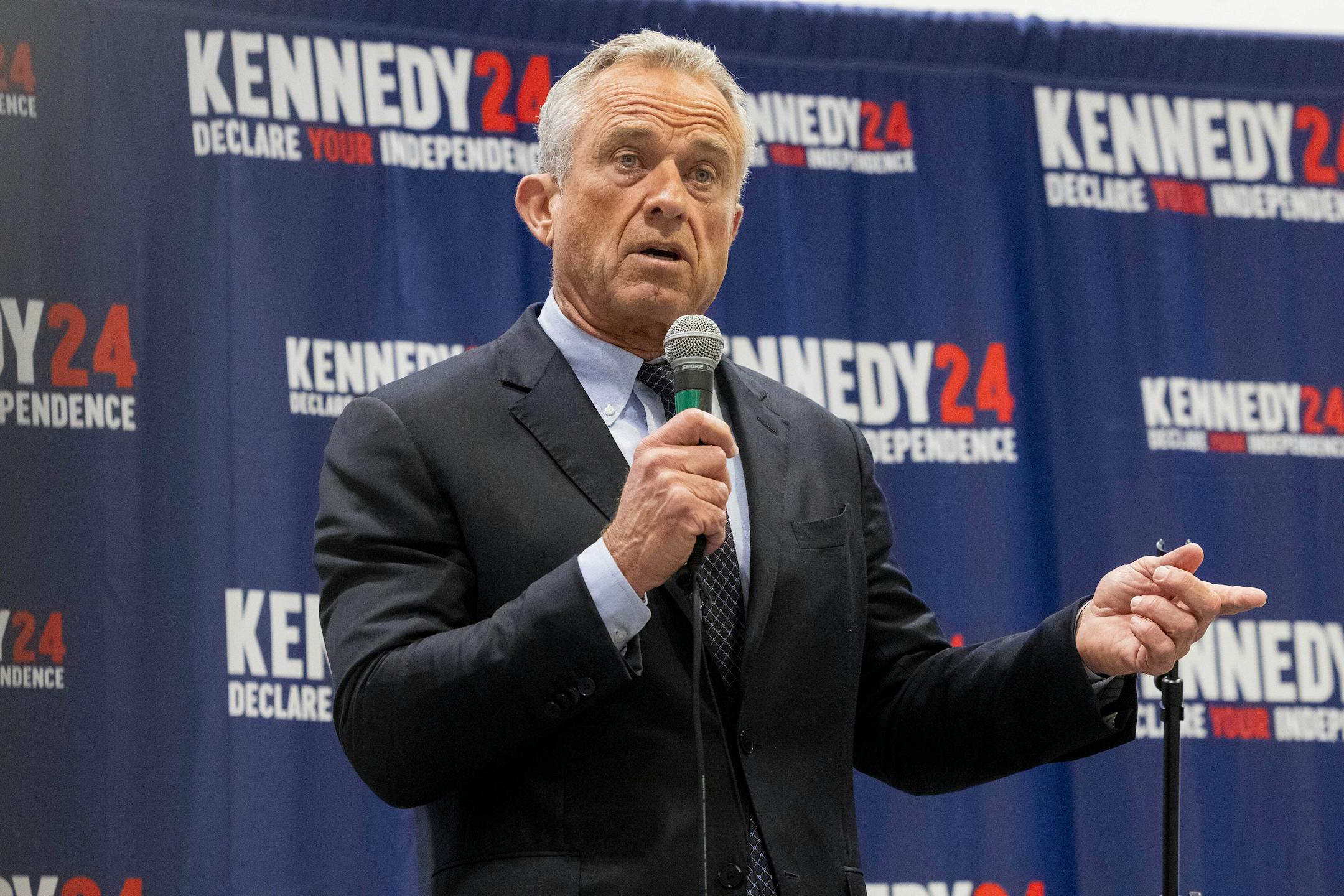
Independent presidential candidate Robert F. Kennedy Jr. has repeatedly claimed that he appears on enough statewide ballots to qualify for next week’s debate between President Biden and Donald Trump and has threatened to sue CNN for not letting him on the stage.
But a Washington Post survey of state election officials found Kennedy is not on the ballot in several states where he has claimed he is — and he will not reach the requirement by Thursday’s deadline to qualify for the debate. The rules of CNN’s debate indicate candidates must appear on enough ballots nationwide to earn the requisite 270 electoral votes needed to win the presidency, along with earning 15% support in four national polls.
Election officials in Utah, Delaware, Oklahoma, Michigan and Tennessee have confirmed Kennedy will be on the ballot. Additionally, CNN has counted California and Hawaii, where Kennedy is the presumptive nominee of minor parties where the states have either not certified him or received paperwork. Those states add up to 100 electoral votes. Kennedy also has not yet met the polling requirement for the debate, though could if a qualifying poll is released before Thursday.
Kennedy intended to get on all 50 states’ ballots quickly as he sought to gain national attention that would come from sharing a debate stage with the two major-party candidates. Kennedy has pointed to his exclusion as evidence that he has been treated unfairly by the parties and the media.
His campaign has spent months gathering the signatures that states require for independent candidates — those not affiliated with a political party — to appear on the ballot in November. Those signatures are then verified by state election officials before the candidate is certified to appear. Kennedy can also appear on states’ ballots if he’s nominated by a minor political party that has already petitioned for ballot access. But many election officials told the Post they won’t certify those petitions or green-light minor party nominees for several weeks, making it impossible for Kennedy to check off the requirement in time for the debate.
Kennedy’s campaign has argued that Biden and Trump similarly should not qualify for the stage under CNN’s rules because they have not yet officially been selected as the presidential nominee by their respective parties. The Republican and Democratic nominating conventions are in July and August, respectively. But CNN has said that because Trump and Biden are their respective parties’ presumptive nominees, and major-party candidates don’t have to petition states for ballot access, both satisfy the electoral college criteria for the debate, according to CNN.
“The mere application for ballot access does not guarantee that he will appear on the ballot in any state,” a CNN spokeswoman wrote in an email to the Post. “In addition, RFK, Jr. does not currently meet our polling criteria, which, like the other objective criteria, were set before issuing invitations to the debate.”
Statements from Kennedy’s campaign and on his website have depicted Kennedy’s ballot effort using various descriptors. A tracker on his campaign website lists 23 states where it declares “petitioning complete,” but when you select a state, it is then described as “on the ballot.”

