

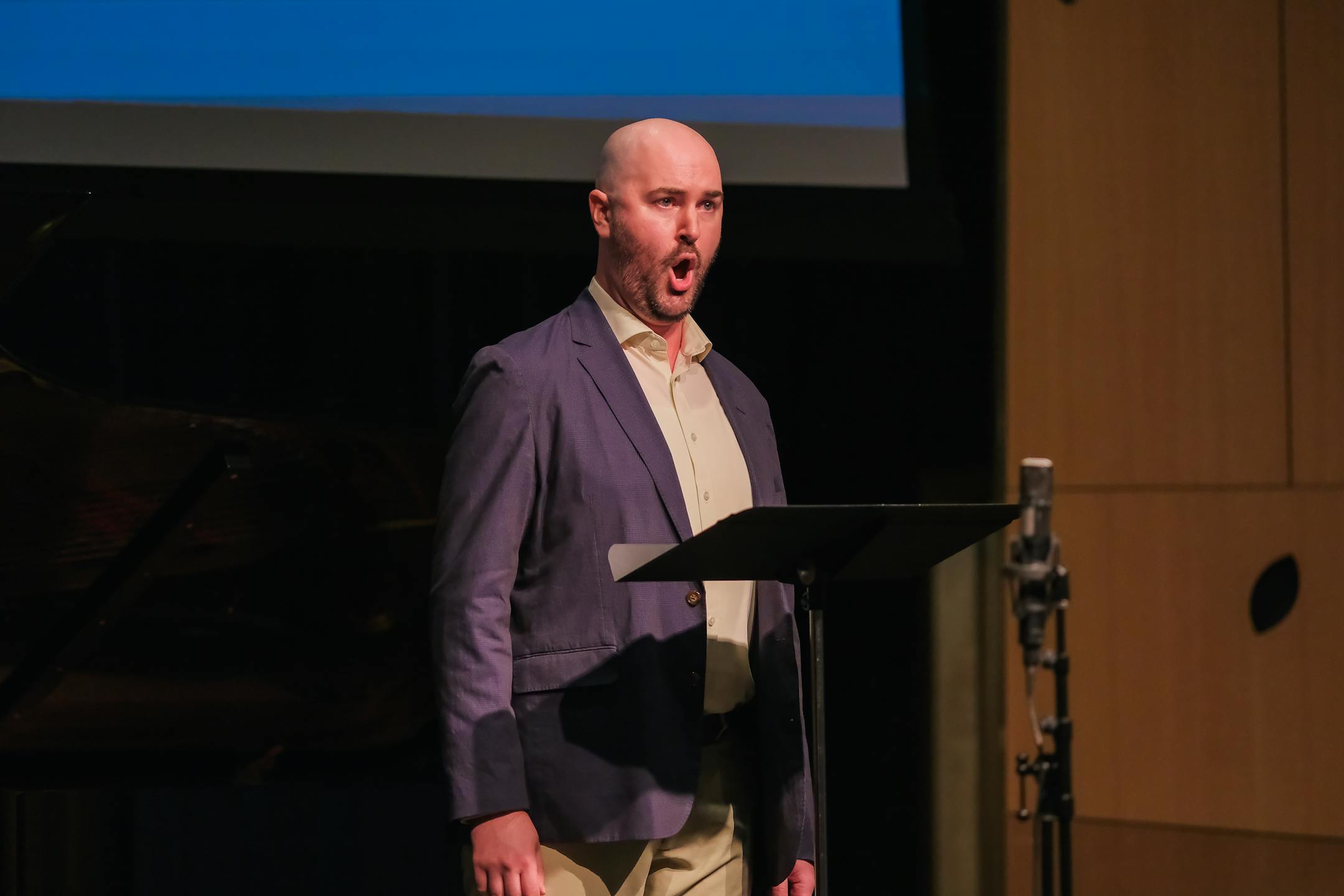
Ever since Bob Dylan won the Nobel Prize for Literature in 2016, there’s been a debate in the literary community about whether songs count as literature. But one of the benefits of Minneapolis’ annual Source Song Festival — in its 12th year — is that it shows how poetry can blossom into something far more meaningful when set to music.
Source is a celebration of the creation and performance of art song, and the new works premiered at this festival usually are at their best when at their most adventurous, defying the constraints of tradition.
On Tuesday evening, the first concert of the 2025 edition at Minneapolis’ Westminster Presbyterian Church featured the premieres of new song cycles by three American composers who have been mentored by Minneapolis-based composer Libby Larsen for the past two years. In each case, a composer took a collection of poems by a particular author, enhanced them immeasurably with their music, and premiered them as part of a very rewarding concert.
Source’s founder and artistic director is mezzo-soprano Clara Osowski, a rising star in the classical vocal world. She and pianist Casey Rafn launched the concert with “Invitation to Love,” Twin Cities-based composer Steven A. Ward’s setting of poems by Paul Laurence Dunbar, an African American poet whose short life ended in the early 20th century. For his musical adaptation, Ward chose six poems that each describe a different time of day, taking the listener from “Dawn” to “Night.”
On the page, Dunbar’s words can seem simple and direct in their descriptions of nature, but Ward’s music and Osowski’s interpretation brought unexpected insight to the texts, never more so than when the mezzo made “Morning” a feast of wonderment and urgency, or combined with Rafn to bring a gentle wistfulness to “Twilight.”
For her composition, “Sue — forevermore,” Boston’s Laura Nevitt set to music five poems by Emily Dickinson that make a particularly strong argument that the poet was passionately in love with her sister-in-law, Susan Gilbert Dickinson. While soprano Regina Stroncek’s interpretation of the cycle sometimes lacked lyrical clarity, the feeling came through consistently, particularly as the intensity built on “If you were coming in the fall” and as “Meeting by Accident” floated atop a hypnotic ostinato.
The audience was then asked to depart the acoustically sublime Westminster Hall for the church’s woody sanctuary for a performance of the most imaginative of the concert’s compositions, James A. Devor’s “The Workers’ Prayers.” Jeff Rath was the only living poet on the program, and his “Prayers” are sardonic and often sarcastic slices of working class gallows humor.
To Devor’s credit, he chose to stretch well beyond the confines of just a single singer and pianist, spreading the vocal duties to four voices and also employing organ, 12-string guitar and percussion. Tenor Scott Brunscheen was a standout for his soaring lines on “The Son” and “God of Industry,” the latter also a showcase for Stroncek’s lovely upper register, as was “The Girl.”


![Brandi Carlile performed "You And Me On The Rock" in concert Saturday, July 30, 2022 at Xcel Energy Center in St. Paul, Minn. ]](https://arc.stimg.co/startribunemedia/P4TW2YOFYDOM6HK7YPPI7CCG2U.jpg?&w=252&ar=3:2&fit=crop)
