

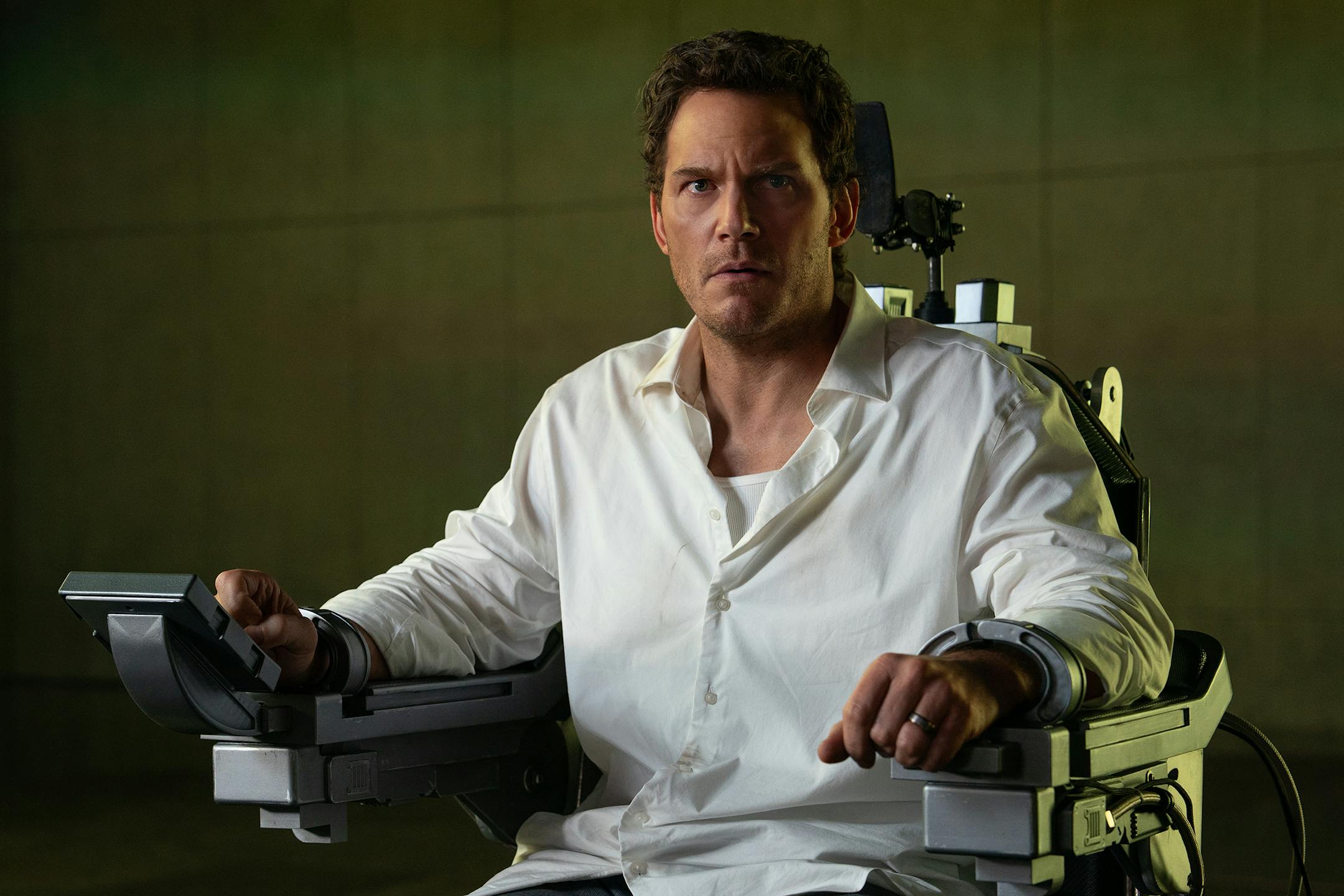
The schlocky dystopian action-thriller “Mercy” touts itself as having been “filmed for IMAX,” but that’s not such a selling point when almost the entire film is a dim close-up of Chris Pratt strapped to a chair.
This real-time AI mystery is a mashup of “Judge Dredd” and “Searching,” in which a Los Angeles detective (Pratt) has to prove himself innocent of murder during a 90-minute trial conducted by an artificially intelligent system called Mercy, presided over by an entity known as “Judge Maddox” (Rebecca Ferguson).
Written by Marco van Belle and directed by Russian action auteur Timur Bekmambetov, “Mercy” is a remarkably — though perhaps not surprisingly — conservative film, which manages to be both pro-cop and pro-AI. It uncritically presents a city that has been rapidly transformed into a militarized surveillance state, with a judicial system run by robots serving as judge, jury and executioner.
Detective Chris Raven (Pratt), one of the first cops to utilize Mercy to try a murder case, finds himself on the wrong side of the law when his wife (Annabelle Wallis) is found stabbed to death at home, and he’s found blackout drunk at a bar at 11 a.m. He wakes up already inside the Mercy system, with 90 minutes to prove his innocence, or at least get his probability of guilt under 92% and avoid instant death. He has the entire AI surveillance apparatus at his fingertips, including police bodycam footage, video doorbells and social media accounts connected to the “municipal cloud,” and he gets the option to phone-a-friend, like his partner, Jaq Diallo (Kali Reis), distraught daughter Britt (Kylie Rogers) and sponsor Rob (Chris Sullivan), to try and pull the pieces together.
Of course all of this material is to make the film more cinematic, because watching Pratt and Ferguson talk to each other when they aren’t even in the same room isn’t all that compelling, filmed for IMAX or not.
But Bekmambetov and cinematographer Khalid Mohtaseb, as well as a team of six editors, have stitched together the shaky camera footage and the hands-free interface into a visual “surfing the web” aesthetic that can only be described as “stomach-churning.” Don’t sit too close to this one — the quick swiping through bodycam and cellphone footage on an IMAX screen is migraine-inducing.
Since the film is a little over 90 minutes, our street-smart detective Raven, who has relied on his gut and the terrifyingly invasive AI tools throughout the trial, is finally liberated from the chair in the third act, as the twisty-turny tale morphs into an attack on Mercy itself. There is some excellent location-shooting in downtown Los Angeles during the climax, seen through the lens of a bodycam or quadcopter or drone camera. It’s not enough to save the aesthetic of the entire film, though, which is somehow both gray and nauseating.
“Mercy” essentially argues that it’s the people behind the prompts that makes artificial intelligence work (or not). Every person and system is fallible, but there’s no substitute for instinct and street smarts — can a robot achieve that kind of intelligence?


