

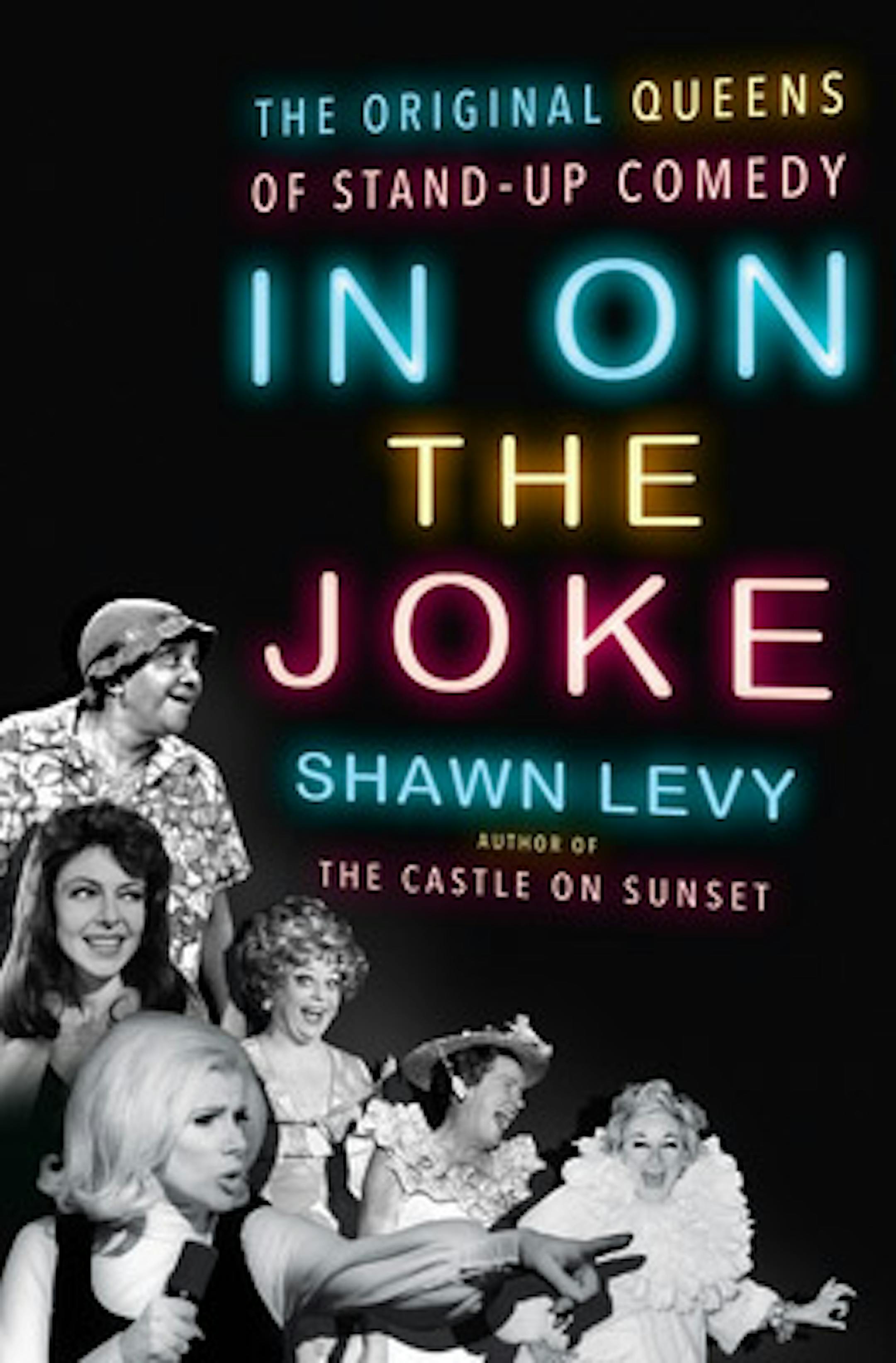
Before I started reading "In on the Joke: The Original Queens of Stand-Up Comedy," I was reasonably sure I was not interested in learning about Minnie Pearl, the country-styled comedian who wore a straw hat with a price tag hanging off the side and opened her act by bellowing "Howdy!" I was certain I was familiar with Joan Rivers' biography, as we had briefly worked together on a project and I had been a fan of hers for years.
But Shawn Levy, whose previous books include biographies of Jerry Lewis and the Rat Pack, has done a sensitive job telling the stories of nine pioneering women he has designated as those who cracked the glass ceiling of comedy.
Jackie "Moms" Mabley was a Black ex-vaudevillian born in 1894 (or 1897; birth date is in dispute) in North Carolina and who ran away with a theatrical troupe, ending up in Pittsburgh playing in a variety-show sketch called "The Rich Aunt in Utah." Vaudeville, especially on the less-affluent Black tour, required a performer to sing, dance, tell jokes — and do it multiple times a day, 30 shows per week.
Entertainers might couple up, like "Buck and Bubbles," or emerge as a star in their own right, like actress Ethel Waters and musician Fats Waller. Mabley's grandparents had been enslaved. Her road to "The Merv Griffin Show" and "The Smothers Brothers Comedy Hour" was the least likely of any of her contemporaries, especially as she performed her act in a housedress and a cap and, later, often without her teeth, playing elderly before she even was.
Her material was risque, and she was a barely closeted lesbian. Her journey was made possible on the Chitlin' Circuit, the network of nightclubs and theaters that catered to Black entertainers and audiences in the 1930s and '40s. Many famous musicians such as Duke Ellington, Ella Fitzgerald, Billie Holliday and Sammy Davis Jr. got their start at these venues. At Harlem's renowned Apollo Theater, Mabley killed.
I'd never heard of an entertainer named Jean Carroll, but like several of the stars in this book, she began her performing life as a singer-dancer. When she added jokes to her repertoire in the 1940s, the term "stand-up comic" hadn't yet been coined. (That would happen in 1950, by Variety, the trade magazine.) She was called a "comic monologist," and she was famous for being attractive. From a review: "Miss Carroll does not hurt her cause by being lovely to look at and by enunciating like an elocution teacher. ... Her timing is faultless and the laughs follow each other in almost unending succession." Perhaps she was a real-life inspiration for "The Marvelous Mrs. Maisel," an idea Levy floats a few times.
The reason Minnie Pearl caught me by surprise, it turns out, is that her persona was completely invented and invested in by one Sarah Ophelia Colley, a graduate of posh Ward-Belmont College, where she was a theater major. Though not a fan of the "hillbilly" arts of the Grand Ole Opry, Colley auditioned for it and was a huge hit on the radio institution for years, until she had to figure out what Minnie Pearl would look like on the new medium of television. The costume in which she became famous was a hastily improvised purchase at a Nashville thrift shop. She died, after a long career, as an eminence in Nashville.
Levy salts his texts with anecdotes about Bob Hope, who could make comedians stars by featuring them as guests on his many USO tours and TV specials. Ed Sullivan, the Broadway columnist turned Sunday night TV host, was even more powerful. Hope and Sullivan let Phyllis Diller and other female joke-tellers walk through their velvet ropes, but the men also kept out many would-be entertainers such as Belle Barth, who was arrested numerous times for obscenity. She told dirty jokes. "She knew she was never going to be on Ed Sullivan or Johnny Carson," Levy writes.

