

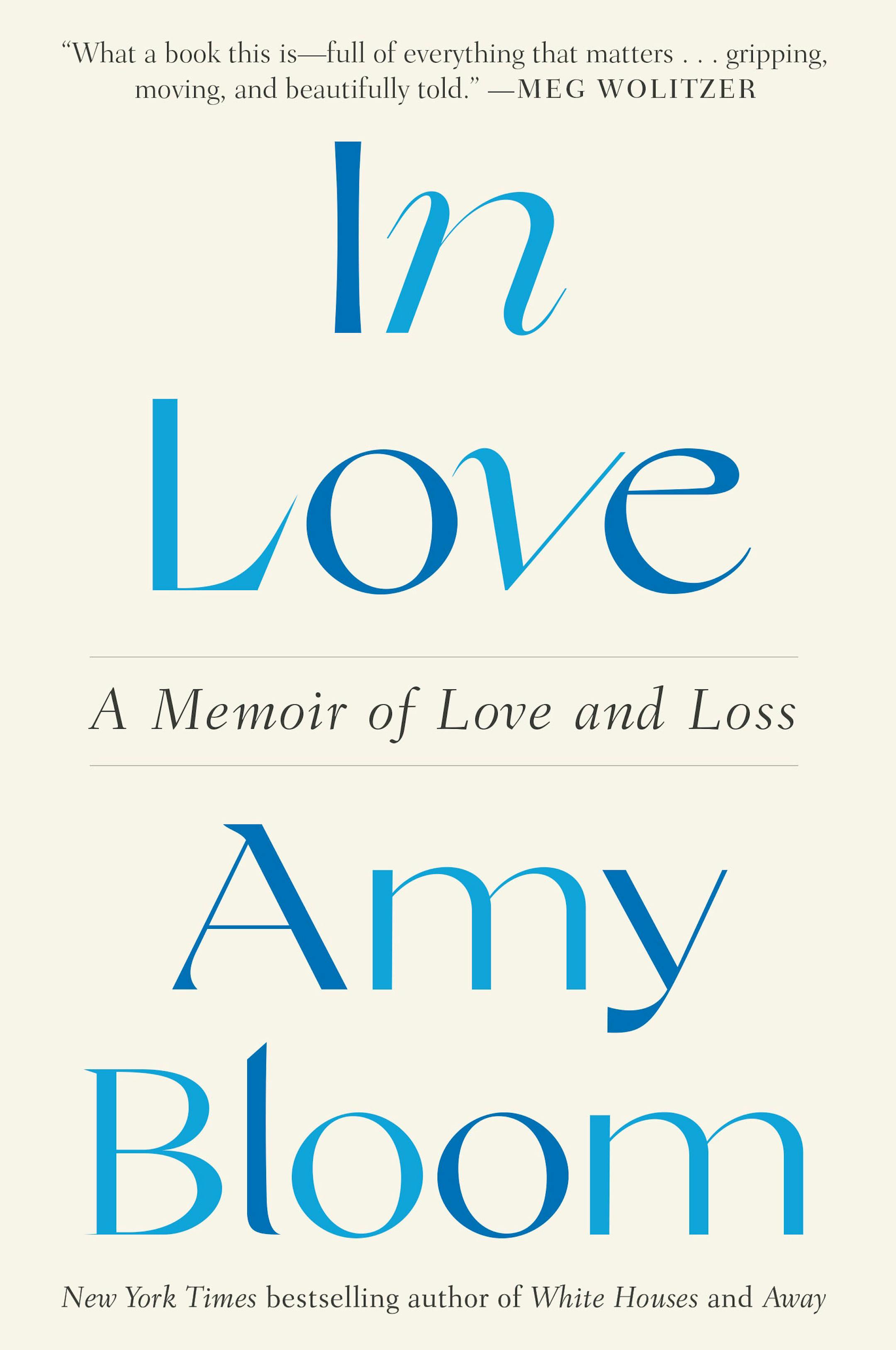
In her deeply stirring memoir, "In Love," Amy Bloom recounts the emotional journey she takes with her husband, Brian, who chooses to end his life after being diagnosed with Alzheimer's. The story is told through an archipelago of relevant back story and episodes that chart the brutal process of helping a loved one die in a way that is not painful, frightening, traumatic or illegal. The couple's exhaustive and often desperate quest eventually leads them to Dignitas, "an organization based in Switzerland that empowers a person to end their own life with dignity and peace."
To manage such hefty subject matter, Bloom artfully divides the book into manageable chunks of very short chapters that are titled with either a date and place, or something playful, such as "Birdseed" and "Ring the Bells."
Bloom summarizes the early stages of her husband's disease through scenes of marital disruption — "Suddenly, it seemed, we argued endlessly about everything" — and the more commonly known symptoms of Alzheimer's, which in Brian's case meant "names disappearing, repetition, information turned upside down, appointments and medications scrambled."
There are also medical charts and illustrations (mostly related to how neurologists score a patient's level of severity) but any scientific data is limited to that which enhances the reader's experience of Bloom's struggle to honor her husband's wish.
"I don't want to end my life," Brian admits in one of the early telephone interviews with Dignitas, "but I'd rather end it while I am still myself, rather than become less and less of a person."
Philosophical questions regarding the self and ethics orbit the largely secular narrative without dominating it. Wisely, Bloom remains in the trenches of daily life, where the juxtaposition of normalcy with what's happening to her husband maintains emotional torque for the reader, who is never asked to "wait outside" — even for the 20 minutes after Brian has drunk the sodium pentobarbital that will end his life.
That said, there are moments of humor. "A few months ago, [Brian] got me a very expensive and very odd present, a hooded marled sweatshirt with tulle trim for five hundred dollars," Bloom writes. "I'm still surprised that I didn't look at that sweatshirt and think, I see that you have Alzheimer's."
Bloom's technical prowess is evident in her conscription of banal details to preface profound and sobering insights into love, marriage and death. En route to Switzerland, Bloom describes the couple's experience at a steakhouse in JFK Airport. "At the Palm, Brian ordered onion rings and a rare ribeye with a side of hash browns and a Caesar salad and garlic toast and he would have ordered a shrimp cocktail, except that I whispered, like the circa-1953 stage Jewish wife I seem to have become, missing only my home perm and rickrack-trimmed apron: Really? Shrimp in a steak place, in an airport? Brian shrugged, to say: I'm not that excited about airport shrimp anyway and, also, what's the worst that could happen?"


