

Big numbers can become abstract and lose their meaning. But not always.
A title card that introduces the new limited series “We Were the Lucky Ones,” adapted by Erica Lipez (“The Morning Show”) from Georgia Hunter’s 2017 novel, tells us that by the end of the Holocaust 90% of Poland’s 3 million Jews had been annihilated, an incomprehensible fact.
What makes the Hulu show work as well as it does is that it’s first and foremost a family drama; it never leaves its characters’ sides to take in the bigger picture. The Warsaw ghetto uprising is shown only as noise and smoke across a wall, glimpsed from afar.
The title suggests that this might not be the most depressing of Holocaust films, which is true, but there’s an encyclopedia of horrors that phrase might include. “You say I’m lucky,” one character will observe, “but maybe luck is relative.”
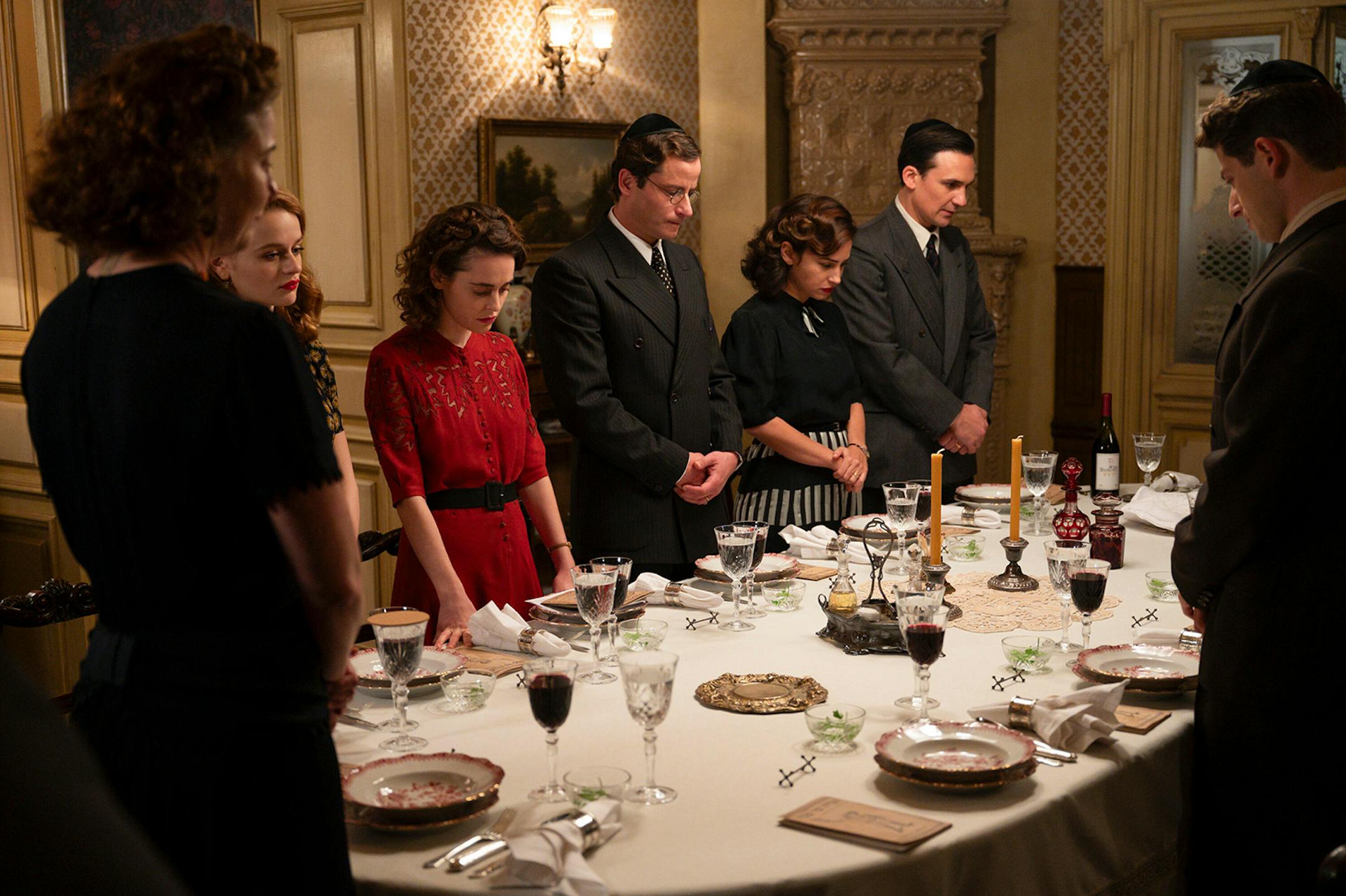
It’s 1938, and the Kurcs, an upper-middle-class family in Radom, Poland — mother and father, five adult children and their significant others — have gathered for Passover. Father Sol (Lior Ashkenazi) and mother Nechuma (Robin Weigert) deal in textiles and dressmaking. Dapper Addy (Logan Lerman) is visiting from Paris, where he works as an electrical engineer and aspiring songwriter. Jacob (Amit Rahav), long engaged to Bella (Eva Feiler), is in law school but prefers taking photographs; and Genec (Henry Lloyd-Hughes), a lawyer, has a new girlfriend, Herta (Moran Rosenblatt), who is still a secret.
Older sister Mila (Hadas Yaron), married to Selim (Michael Aloni), a doctor, is pregnant when we meet her, but soon struggling with motherhood. Headstrong Halina (Joey King), the baby of the family and the series’ center of energy, favors a bright shade of lipstick and is not thinking too seriously about her future, but she’s also ready to make a leap. Adam (Sam Woolf), the lodger, is an architect on whom Halina has set her eye.
It’s a convincing family portrait, filled out with food and music and gossip. Between them, the Kurcs offer a range of opinions on what might or might not be coming, and what should be done. Even after the Nazis invade Poland, halfway through the opening episode, things advance by degrees, so that the next worst thing can’t quite be imagined, and once imagined really believed.
“You can’t look scared,” Halina instructs Mila about passing for gentile, at which she’s something of an expert. “You need to make your posture normal; and you need to laugh more when Germans tell jokes.”


