

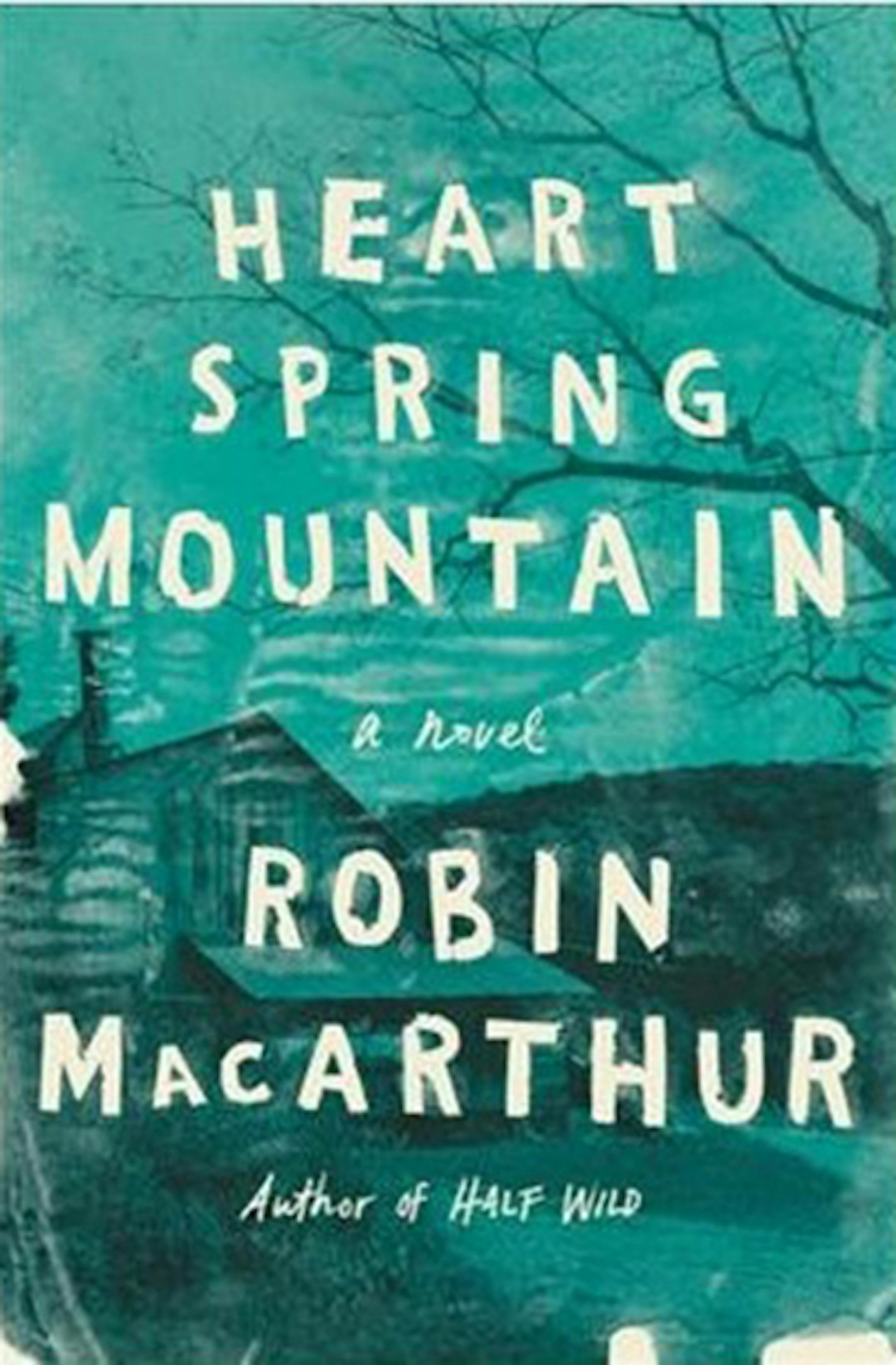
After winning the 2017 PEN/New England award for her debut story collection, "Half Wild," Robin MacArthur returns with a second effort, "Heart Spring Mountain," a novel drenched in the natural world. This is due not only to its setting, in the days after Hurricane Irene, but also to its obsessive attention to landscape and weather. Nearly every page is crowded with flora; even the call during which Vale learns that her mother, Bonnie, is missing, takes place under "a thick-trunked magnolia." This call sets the central story in motion: 26-year-old Vale, a stripper and bartender in New Orleans, returns to her hometown in Vermont to search for her drug addict mother.
There are some nice parallels in the settings MacArthur chooses. Although the novel is set primarily in 2011, Vale lives in a city haunted by 2005's Hurricane Katrina. To consider Bonnie "missing" is one of the work's better complexities — in a concrete sense, there are days after Irene when no one can locate Bonnie. In a metaphorical sense, her presence — at least in Vale's life — has always been flickering, enigmatic, unstable.
MacArthur relies heavily on flashbacks, and in many of them, Bonnie is laughing and offering platitudes. For the reader, too, she is increasingly spectral and hard to see.
The brief chapters each have a specific character at the helm — among them, Vale, Bonnie and Bonnie's mother, Lena; Hazel, Lena's sister; Stephen, Hazel's son; and Deb, his wife. The novel seems most interested in Vale's search for Bonnie, and the other characters' chapters can feel digressive. The burden of so many perspectives weakens the prose, and there is a tendency toward sentence fragments and single-word sentences, such as "Possibility. Redemption." or "Long legs. Cheekbones. War-damaged. Song-strewn."
MacArthur's poetic voice offers an abundance of images, some of which are quite lovely, such as the "fur coat, snagged on a branch of a still-standing pine tree, six feet up in the air" after a storm. Vale has an exquisite passage, comparing New Orleans and Vermont: "Living in New Orleans you get used to the shadow of storms, the earth's quiet yet undeniable sinking. You get used to recognizing the impermanence of the ground, the trees, the walls, your own skin. But here? She isn't used to that temporality."
Much is made of family secrets that are more intriguing to Vale than to the reader. Nonetheless, the novel's sense of place is one of its strengths; this is a love song to the natural world, and a plea for its protection.
Jackie Thomas-Kennedy's writing has appeared in LennyLetter, Narrative, Crazyhorse, The Millions, Harvard Review and elsewhere. She held a 2014-16 Stegner Fellowship at Stanford University.
Heart Spring Mountain
By: Robin MacArthur.
Publisher: Ecco, 354 pages, $25.99.


