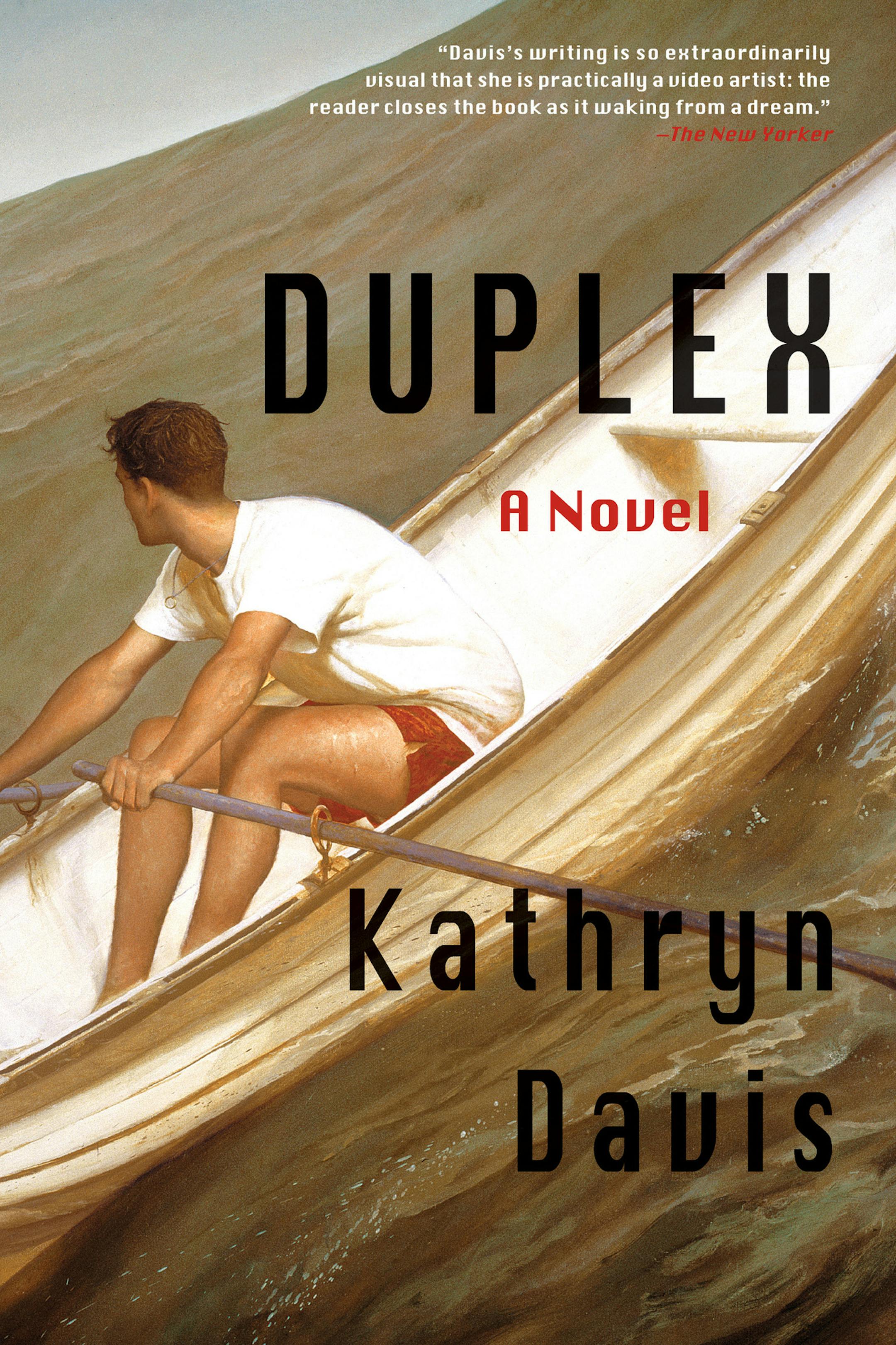
One of the standard definitions of the word "duplex" is this: having two parts, double, twofold. However, as you enter Kathryn Davis' latest novel, "Duplex," you realize that it is not made up of merely two parts but of hundreds, like a dressing room mirror reflecting the souls of the book's characters over and over in an infinite parade.
Davis' previous novels such as "The Thin Place" and "Versailles" have been described as "hallucinatory" and "dreamlike," and "Duplex" is no exception. For fans of the fantastical, Davis' writing style is a glass of ice cold water in today's desert of conventional fiction.
At its heart, "Duplex" is the love story of Mary and Eddie, which sounds simple enough until you quickly meet the sorcerer known as the Body-Without-Soul, the robots next door, a thing named Downie (who, in my mind, appeared as a yeti) and scows — what a wonderful word — that hover over the neighborhood.
The characters in "Duplex" struggle with many of the same issues as in mainstream fiction. There is unrequited love, infidelity, an irritable — and irritating — teenage daughter, nosy neighbors and urban legends meant to warn wayward children against the dangers of straying too far from home.
Davis' prose forces the reader to focus, to keep up with her rapid storytelling, as in this excerpt that begins, "After she returned home the girl washed the breakfast dishes." Simple enough. But then, before you realize what is happening it veers away with you hanging on for dear life to "She stood there with her head bowed, crying into the sink, leaving the nape of her neck exposed all the way through the many different layers of her house and the debris floating in the upper atmosphere to the X-ray vision of the operational apparatus of the scow hovering in the air above." Wow.
Time has a certain fluidity in "Duplex," but Downie emphasizes to Mary that "a duplex's properties are stretchable but they aren't infinite." In this same heart-to-heart chat, he stresses the importance of the hinge, an emphasis that reappears toward the end of the novel, as Janice, a fabulist or historian depending on your outlook, explains that a hinge "is the place where you could go forward and back with equal ease." One just needs to be on the lookout for this temporal sweet spot, a place Davis navigates with her admirable sleight of hand.
Meganne Fabrega is a writer and member of the National Book Critics Circle.