

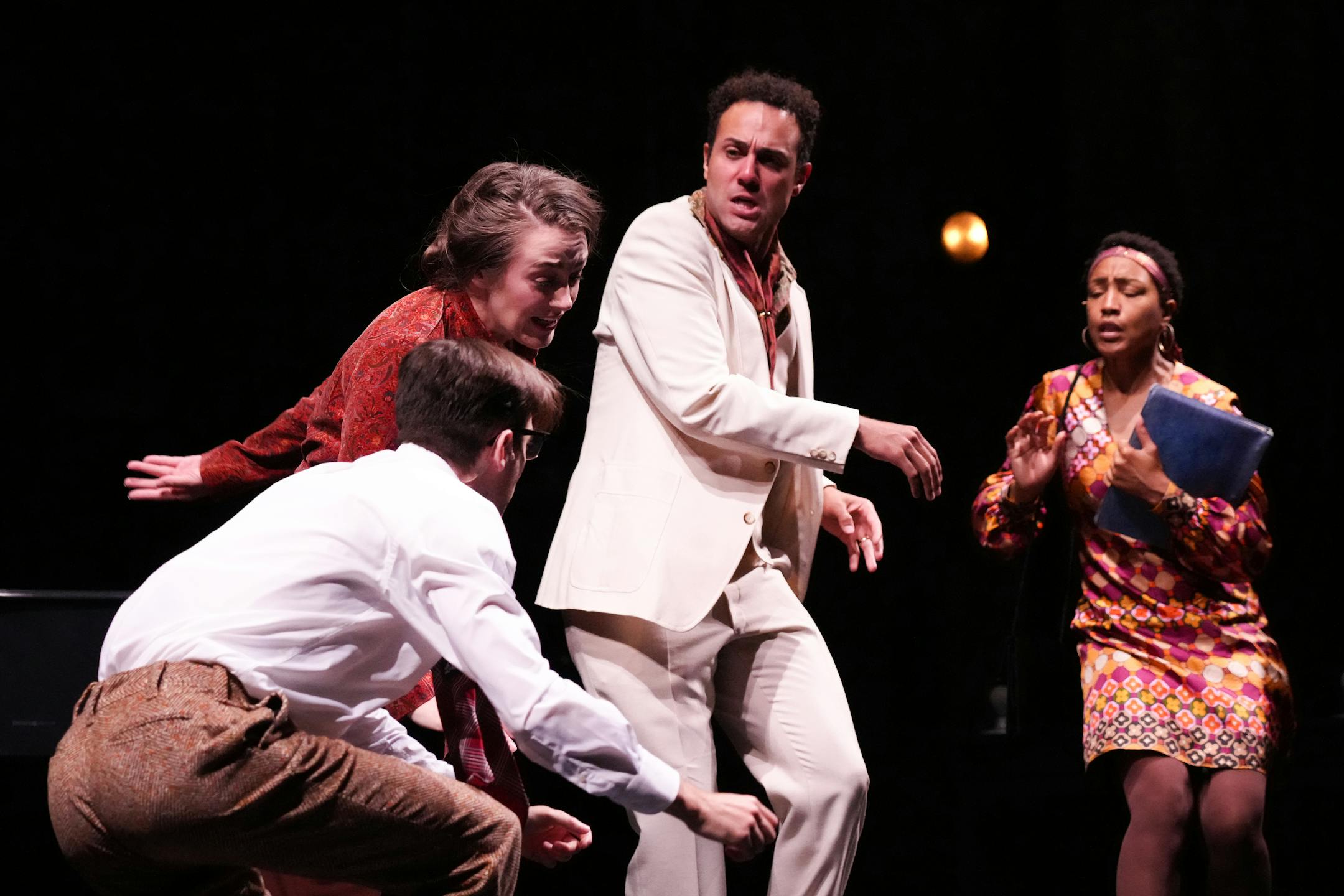
At the beginning of "Merrily We Roll Along," it may seem a better title would be "Angrily We Roll Along."
The Stephen Sondheim/George Furth musical, which proceeds in reverse from the characters' rancorous 40s to their wide-eyed 20s, introduces Charley, Frank and Mary at their worst. Dylan Frederick's delivery is showstopping when his Charley is introduced in the middle of a nervous breakdown of a song. Frank has abandoned his ideals. And Mary only interrupts her two-fisted cocktailing to insult people.
One of the tricks of "Merrily We Roll Along," which bombed on Broadway in 1981 and has not been revived there since (a production starring Daniel Radcliffe may change that next year), is how to interest audiences in a show that begins on such an unpleasant note. The solution, in Peter Rothstein's production for Theater Latté Da, is to cast leads — Frederick, Becca Hart and Reese Britts — with innate appeal while emphasizing clarity and simplicity.
This "Merrily" is set on a mostly bare stage, with only racks of costumes to hide the band and to function like most closets do: as regretful reminders of choices we once made, colors we thought looked good, pants that used to fit. The actors are seated around the stage, watching the action with us, as if to signal we're all together in creating meaning from what's happening in "Merrily." There's some Bertolt Brecht in the approach, a smart choice that keeps us mindful that these are actors playing roles (nimble Kim Kivens is three people in one scene) and makes us worry less about them needing to be as believable at 25 years old as they are at 45.
"Actors play people who aren't their own age all the time," this "Merrily" seems to say. "We can deal with that." Similarly, the settings/years are projected on the back wall, another no-big-deal technique that makes sure we always know where, and more trickily, when we are.
One thing that sets this production apart from other "Merrily's" I've seen is that it's more about Mary and, specifically, her unrequited love for Frank. Hart is dazzling — in her nonverbal asides, her playful body language and her devastating counterpoint to Frank and soon-to-be-wife Beth's "Not a Day Goes By" duet. She may be at her best in the last scene — again, the first chronologically — when we see the moment she falls in love-at-first-sight with Frank. Hart's is an achy, thoughtfully calibrated performance (listen to her voice get higher as Mary gets younger), revealing a woman who writes her feelings instead of feeling them. In my book, Hart is the — sorry/not sorry — heart of this "Merrily."
Vie Boheme is the opposite of genial Mary as Gussie, a been-there/hated-that performer who exploits every other character on stage. Boheme has been a terrific singer for some time but she's also a deft comic actor, a must for anyone tackling this difficult role.
"Merrily" has changed mightily since its debut (if you know it from the original cast album, you may be surprised by missing/added songs). Furth's book has been criticized and it's true that it feels like sketches of a play but those sketches work beautifully in Latté Da's spare take.


