

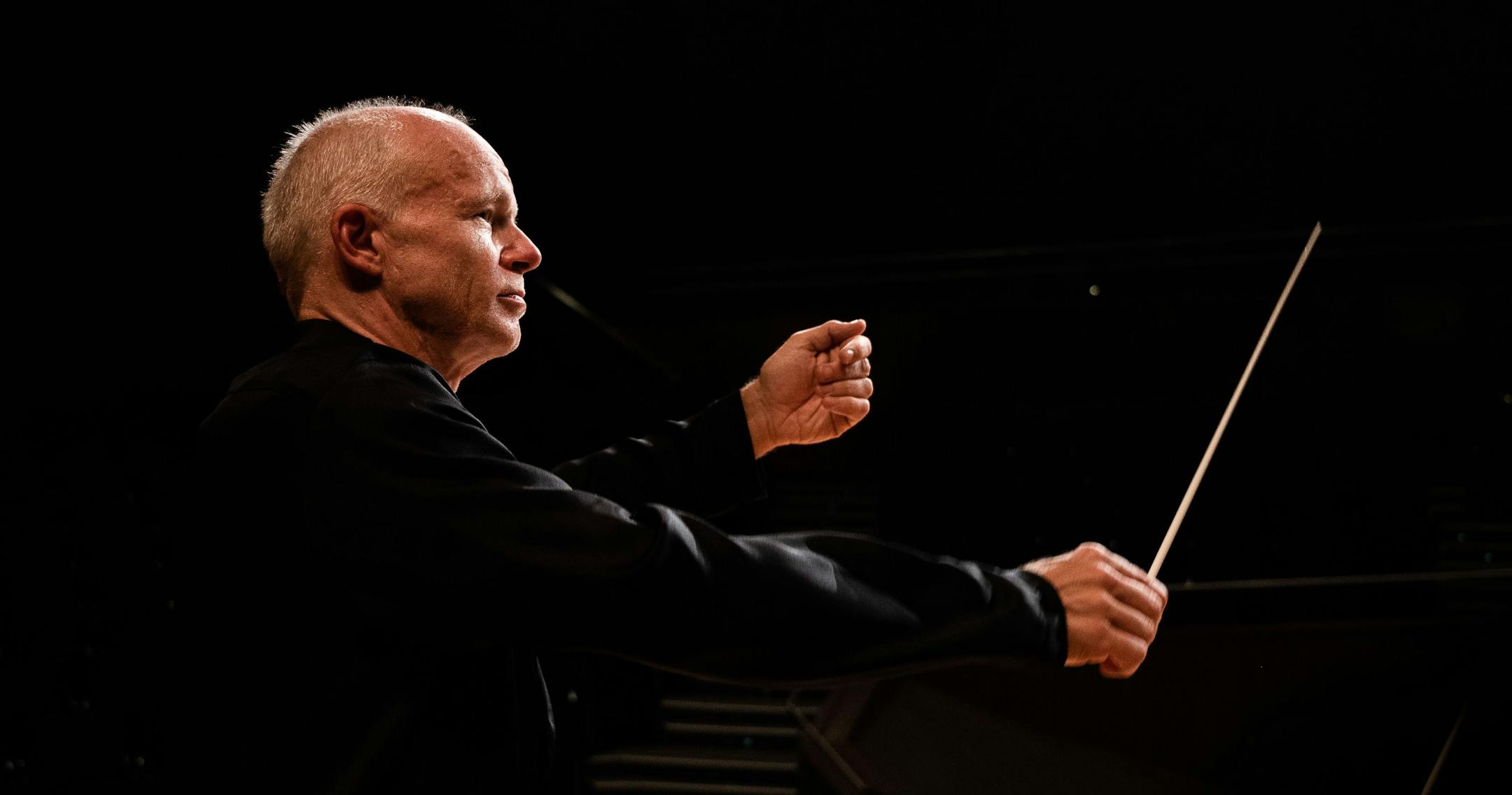
Over the course of its 66 seasons, the St. Paul Chamber Orchestra has earned a glowing international reputation for expert interpretations of music from the baroque, classical and contemporary eras. Romanticism? Not so much.
The 19th century’s second half was largely given over to big sounds and big emotions, delivered by orchestras considerably larger than the SPCO’s core of fewer than 30 musicians. But the orchestra launched season 67 on Friday night at St. Paul’s Ordway Concert Hall by making a strong case that it can get romantic with the best of them.
Oh yes, there was one of those Mozart symphonies that the SPCO plays as powerfully as any orchestra in America, in this case conducted by the composer’s fellow native of Salzburg, Austria, Thomas Zehetmair.
Opening the concert was Zehetmair’s Passacaglia, Burlesque and Chorale. It takes inspiration from J.S. Bach, ancient chant and the 12-tone school of the early 20th century, and the SPCO strings handled its wildly shifting moods impeccably.
But opening night reached its peak with music from arguably the consummate romantic, Johannes Brahms. His Double Concerto for Violin and Cello proved a captivating musical conversation between the featured soloists, the orchestra’s concertmaster, Steven Copes, and principal cellist Julie Albers. Each musician was arrestingly expressive, whether bringing explosive urgency to a solo, uniting their voices in the mellifluous slow movement, or thrusting and parrying through the vigorous folk dance of the finale.
Copes and Albers skillfully brought forth the sense that this concerto was a celebration of friendship, the soloists exchanging phrases with affection and empathy. And, indeed, Brahms wrote it in hopes of inspiring a reunion with a longtime friend with whom he’d had a falling out, the violinist Joseph Joachim. On this night, the two soloists forged a fine balance between asserting their individuality and investing in the relationship.
Meanwhile, Zehetmair made sure the orchestra’s fortissimos were as breathtakingly furious as one could wish. In the outer movements, he encouraged decibel levels that made the ensemble seem much louder than just 37 instruments. Thus, the contrasting reflective atmosphere of the concerto’s slow center was all the more involving.
Speaking of softness at a work’s center, that was the most exciting thing about an extremely well-played take on Mozart’s 41st and final symphony, nicknamed the “Jupiter.” Zehetmair leaned into the intimacy of the symphony’s quiet second movement and maintained that sweet spirit during a mesmerizing take on the ensuing minuet.


![Brandi Carlile performed "You And Me On The Rock" in concert Saturday, July 30, 2022 at Xcel Energy Center in St. Paul, Minn. ]](https://arc.stimg.co/startribunemedia/P4TW2YOFYDOM6HK7YPPI7CCG2U.jpg?&w=436&ar=3:2&fit=crop)

