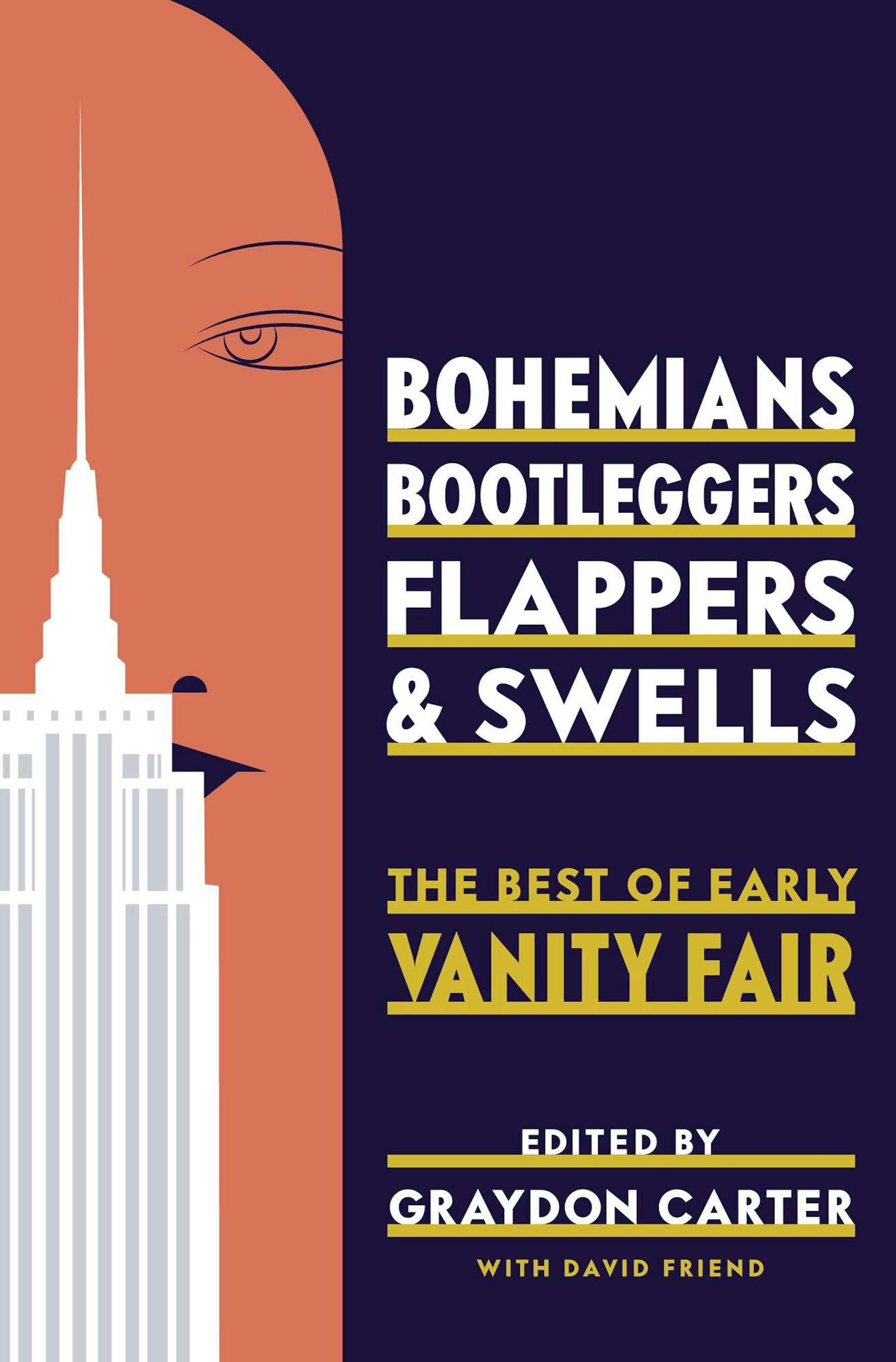
If you are a bedtime reader, you may, like me, be questing for the perfect bedside book. Here are my requirements: It must be easily divisible into 15- to 20-minute chunks; it must be interesting but put-downable, and, since it might insinuate itself into my dreams, it can't be too depressing or terrifying. I am happy to report that "Bohemians, Bootleggers, Flappers and Swells" fits the bill most admirably.
The collection celebrates the 100th anniversary of Vanity Fair, reprinting articles originally published in the magazine's golden era: the 1910s, 1920s and 1930s. Since the contributors make up a veritable who's who of the intellectual and literary lions of the time — Dorothy Parker, Noël Coward, Djuna Barnes, P.G. Wodehouse, Jean Cocteau, Colette, Gertrude Stein, Edna St. Vincent Millay, Sherwood Anderson, Robert Benchley, Langston Hughes, D.H. Lawrence and many, many more — there's bound to be something that appeals to you whatever mood you're in.
Some of the works are period pieces, windows into the intellectual currents of the times: Clarence Darrow's dismay at how rights for women brought females into the formerly all-male barbershop, for example, and Theodore Dreiser's 1928 celebration of the glories of the Soviet Union. (Stalin and other leaders are "more earnest, more thoughtful, and more sincere, more capable of thinking" than the leaders of other countries, he writes.)
Other essays, while stylistically proclaiming their era, seem delightfully fresh. The opening essay, P.G. Wodehouse's satire of "The Physical Culture Peril," reminded me of nothing more than the Facebook posts of my exercise-junkie friends. Because "the monotony of doing … exercises every morning is so appalling," he writes, "it is practically an impossibility not to boast of having gone through with them." Sure enough. But the boasting has a deleterious effect on "moral fiber." "Before, I was modest. Now, I despise practically everybody but professional pugilists." The solution? "A system of spiritual exercises which shall methodically develop the soul so it keeps pace with the muscles and the self-esteem."
Thus, while exercising, one can chant, "This, I know, is where I get the steel-and-india-rubber results on my deltoids, but I must not forget that there are hundreds of men whose confining work in the sweat shops has entirely deprived them of opportunities to contract eugenic marriages." Classic: my newsfeed in a nutshell.
On a more serious note, John Jay Chapman's summary of the American mind ("Mr. Wilson's Inelastic Intelligence") seems worth pondering today: "The American can see things in the clouds: he has magnificent visions and enthusiasms. He can also see a thing which he holds in his hands, or the branch of a tree when it is very near him, and is perhaps about to put out one of his eyes. But the mind of the American has no middle distance." And Jean Cocteau's "The Public and the Artist" still resonates with wisdom and provocation ("The public only takes up yesterday as a weapon with which to castigate today.")
As these few sips of "Bohemians, Bootleggers, Flappers and Swells" — an "inebriating swig from that great cocktail shaker of the Roaring Twenties, the Jazz Age, and the age of Gatsby" — suggest, the book makes for an excellent nightcap.
Patricia L. Hagen teaches English at the College of St. Scholastica in Duluth.