

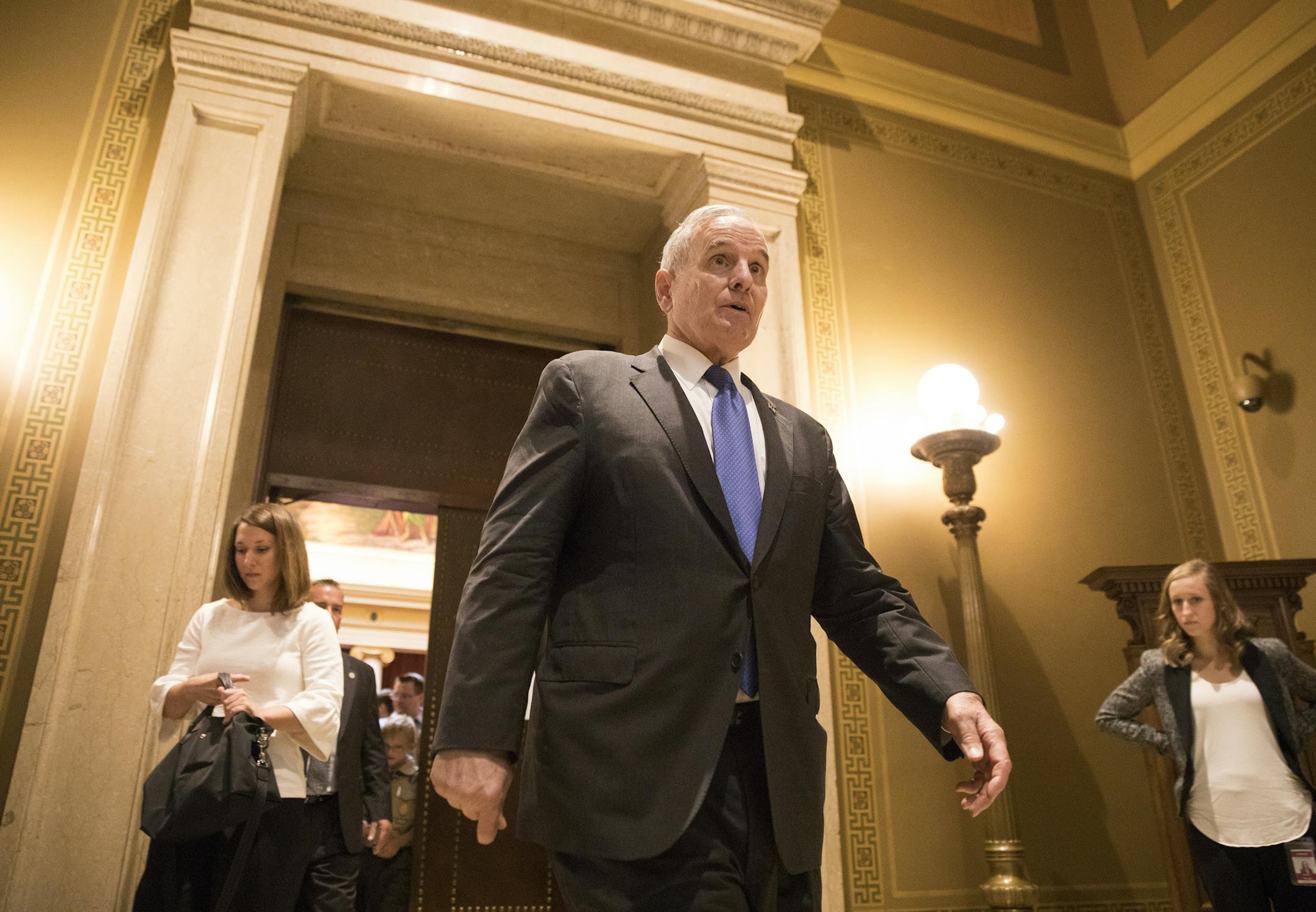
The mediator who will attempt to broker an end to the monthslong political and legal battle between Gov. Mark Dayton and Republican legislative leaders is a retired Hennepin County judge with a long track record of sorting out high-stakes disputes.
Dayton and lawmakers on Tuesday jointly selected Rick Solum, a former trial lawyer and judge who has long focused on mediation, after the Minnesota Supreme Court's recent order that the two sides resolve their dispute outside of a courtroom. Solum is charged with breaking an impasse that threatens to shut down the state House and Senate after Dayton cut their funding with a line-item veto, initiating a constitutional quandary about the limits of the governor and Legislature's power.
Speaking to reporters on Tuesday, Dayton said he hopes that Solum's mediation experience on "controversial issues with very divided parties" — ranging from the dispute over the land value of the site of the Minnesota Twins ballpark, to settlements in the Ponzi scheme of former Wayzata businessman Tom Petters — will help end the stalemate.
"I think his skill and expertise, which both the Legislature and I recognized [by] putting him to the top of our list of recommendations, says he's very skilled at this, very experienced with this," Dayton said. "I'm hopeful that that skill will enable us to succeed at reaching a resolution."
Solum, who retired in 1998, will likely begin meeting with Dayton, legislative leaders and their attorneys next week. The two sides must file a joint report to the Supreme Court on the status of the Legislature's finances by Sept. 15, then produce a report on the mediation by Sept. 30.
It's not yet clear exactly how the mediation sessions will be run, or how much information about them will be released to the public. But it's obvious that Solum faces a significant task in unraveling divisions that flared in May, when Dayton lined out legislative funding amid a dispute over a handful of items in a Republican tax bill, along with policy provisions on teacher licensing and driver's licenses for undocumented immigrants.
Dayton pushed for Republican lawmakers to come back to the negotiating table. Instead they took Dayton to court, arguing that his veto violated the constitutional separation of branches of government.
A lower court ruled earlier this summer in favor of the Legislature. Dayton appealed that decision to the Minnesota Supreme Court, which did not throw out the governor's veto, but said the two sides should seek a mediator's help to end their stalemate.


