

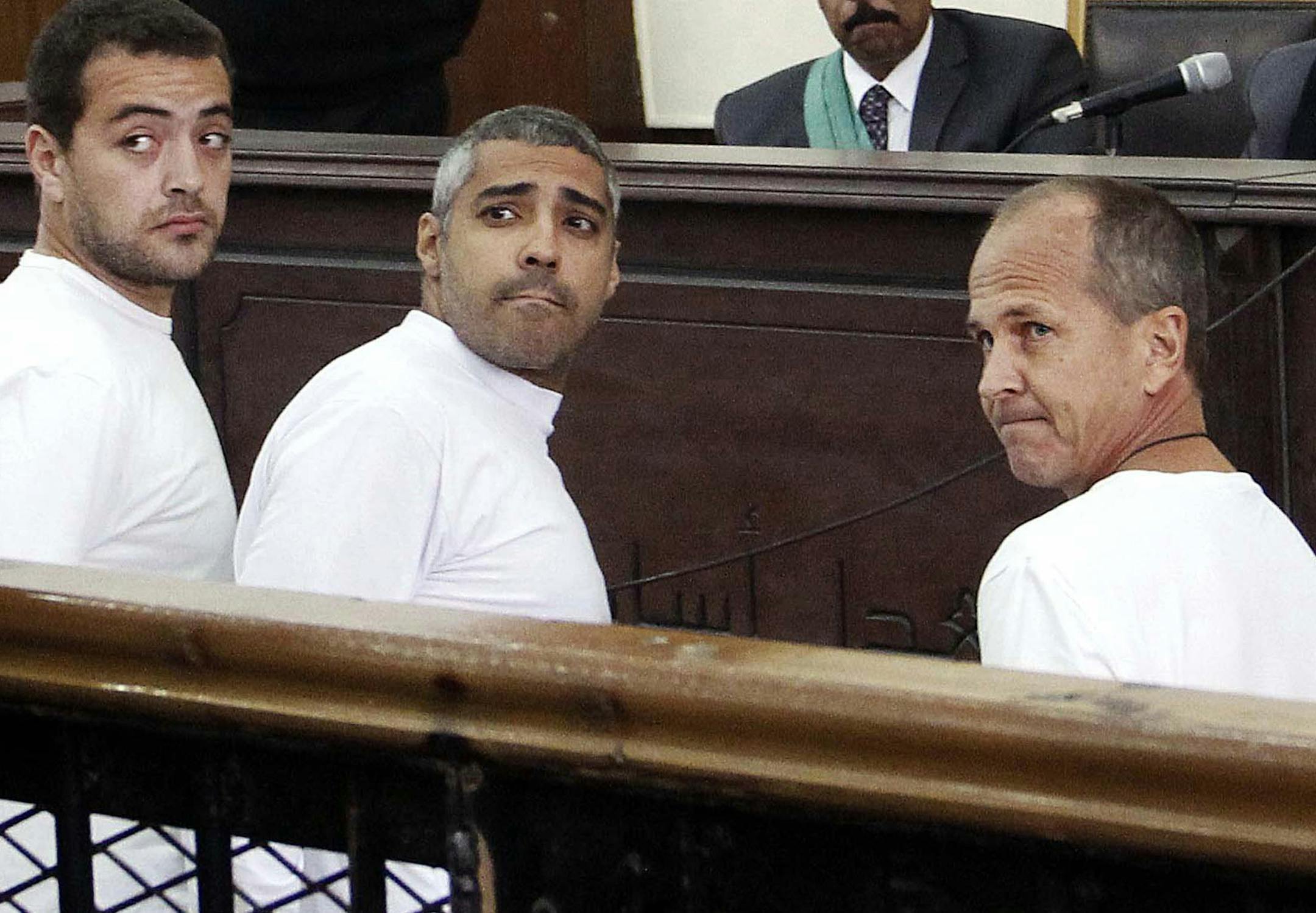
The unjustified conviction of three Al Jazeera journalists on charges of conspiring with the now-outlawed Muslim Brotherhood in Egypt is a miscarriage of justice. It's also a symptom of a broader, brutal repression of post-coup dissent in the country.
Several Western nations, human rights organizations and everyday citizens already have protested the prosecution, which may be a manifestation of Egypt's hostility toward Qatar, where Al Jazeera is based. Pressure should be kept on Abdel-Fatah el-Sissi, the former general who just became president in a sketchy election, to free the journalists and to respect international human rights standards. Already el-Sissi appears to be as oppressive as Hosni Mubarak, the last military man to rule Egypt.
The three journalists — Egyptian Baher Mohamed, Canadian-Egyptian Mohamed Fahmy and Australian Peter Greste — were held in a courtroom cage and convicted in a trial that Amnesty International called a "complete sham." The three men are widely respected by their peers, and their collective reporting resumes include work for CNN, the New York Times and the BBC. They were simply doing their jobs, and now Greste and Fahmy face seven years in prison, while Mohamed, who had kept a spent bullet casing from one of the protests as a souvenir, faces 10 years in an Egyptian jail. Several students were also convicted in the Orwellian trial, and other journalists were convicted in absentia.
Amnesty International, the Committee to Protect Journalists and other organizations say there is no evidence to suggest that the three had links to the Muslim Brotherhood or that they reported anything but the truth about Egypt's turmoil.
Instead, this appears to be a clear attempt to silence them and to intimidate other journalists from exposing, let alone challenging, el-Sissi's autocracy.
"In the last year, there have been a number of attacks on journalists and media institutions by Egyptian authorities in an effort to silence critics," said Sunjeev Bery, Middle East and North Africa advocacy director for Amnesty International USA. "It's all part of a larger crackdown on human rights and basic freedoms across Egyptian society."
The repression has included killing at least 1,400 protesters, detaining 16,000 people, and issuing mass death sentences to the leader and 182 supporters of the Muslim Brotherhood, according to Amnesty International.
The U.S. State Department detailed the crackdown in a searing 2013 human rights report issued in March. On Monday, Secretary of State John Kerry was quick to criticize the verdicts, calling the convictions "chilling, draconian sentences" and "a deeply disturbing setback to Egypt's transition."


