

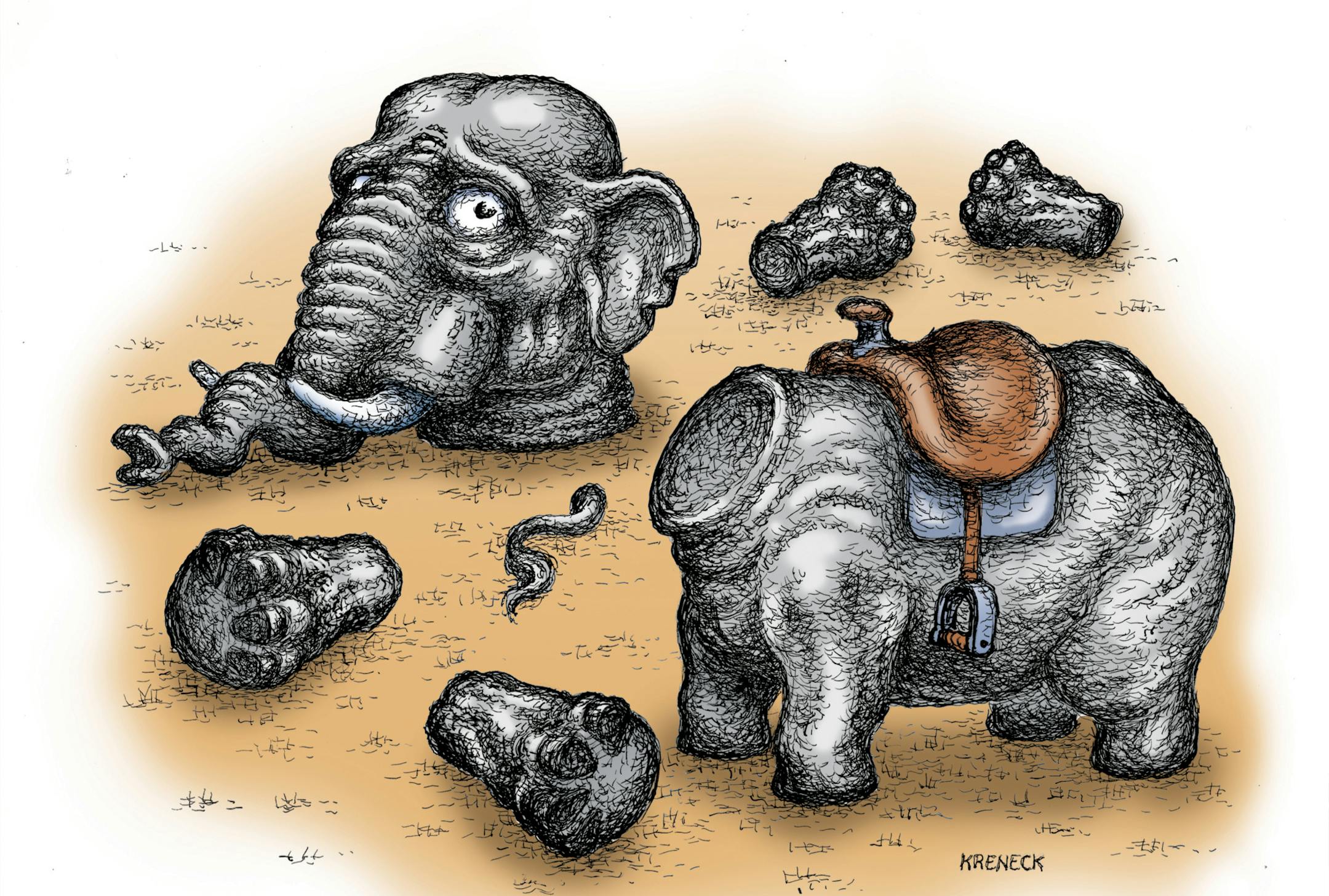
The Republican Party seems to be stuck in the mire of a modern notion that fractious politics can be overcome by reason.
Take, for example, the recent spate of ads in which U.S. Sen. Marco Rubio of Florida and other Republican bigwigs are trying to persuade the little Republicans to line up behind them on immigration reform. Many little Republicans have a simple and, from the Big Republican's point of view, unreasonable position: If you are not legally here, get out.
Unfortunately, there is no universal reason that transcends all of the competing interests. But Big Republicans continue to promote the idea that little Republicans are wasting their time and their votes on their passionately held values. Little Republicans are tired of being told what to do by Big Republicans and talk-show hosts.
In the 21st century, we have come to recognize the incompatible character of competing traditions — that is, competing political value systems. For example, people do not measure justice and injustice in the same way, and this results in completely different accounts of what it means to be politically reasonable. The days when the GOP could discipline members and voters with modern notions about reason and compromise are gone.
Little Republicans and independents are tired of the emphasis on "coming together" — as if there were some universal rational basis on which to do so. Little Republicans want their competing values to have as much influence as possible. They are sick of the Big Republicans insisting on unity — and conformity.
By contrast, the DFL Party back in the 1970s implicitly embraced the idea that politics is about the interaction of factions that cannot agree on priorities or principles. Consequently, it adopted so-called proportional representation within its party process. This process makes individuals feel empowered, because their competing traditions are explicitly recognized by the process. There is no attempt to water down the competing views of what is good and reasonable with the myth of universal reason. There is no attempt to moderate or mutate the influence of competing factions (the gay-rights lobby, the abortion lobby, the environmentalists, the feminists, the ethnic chauvinists, the Marxists) with reason, debate and compromise.
Proportional voting means people at political party caucuses, instead of voting as a whole group for elected delegates, subcaucus and vote in blocs. In the walking subcaucus procedure, people nominate titles for subcaucuses and are assigned a room or area in which to convene. The people who want to join that subcaucus go to that area and elect delegates according to the size of the subcaucus.
For example, imagine a caucus has 100 people in attendance and 10 delegates to elect. The "Progressive Caucus" has 70 people in its group, so it will elect seven delegates. The "Pro-Choice Caucus" has 30 people, so it will elect three delegates. Without proportional voting, the 100 people would together elect the 10 delegates — giving minority subcaucuses less chance to elect delegates who share their focus.


