

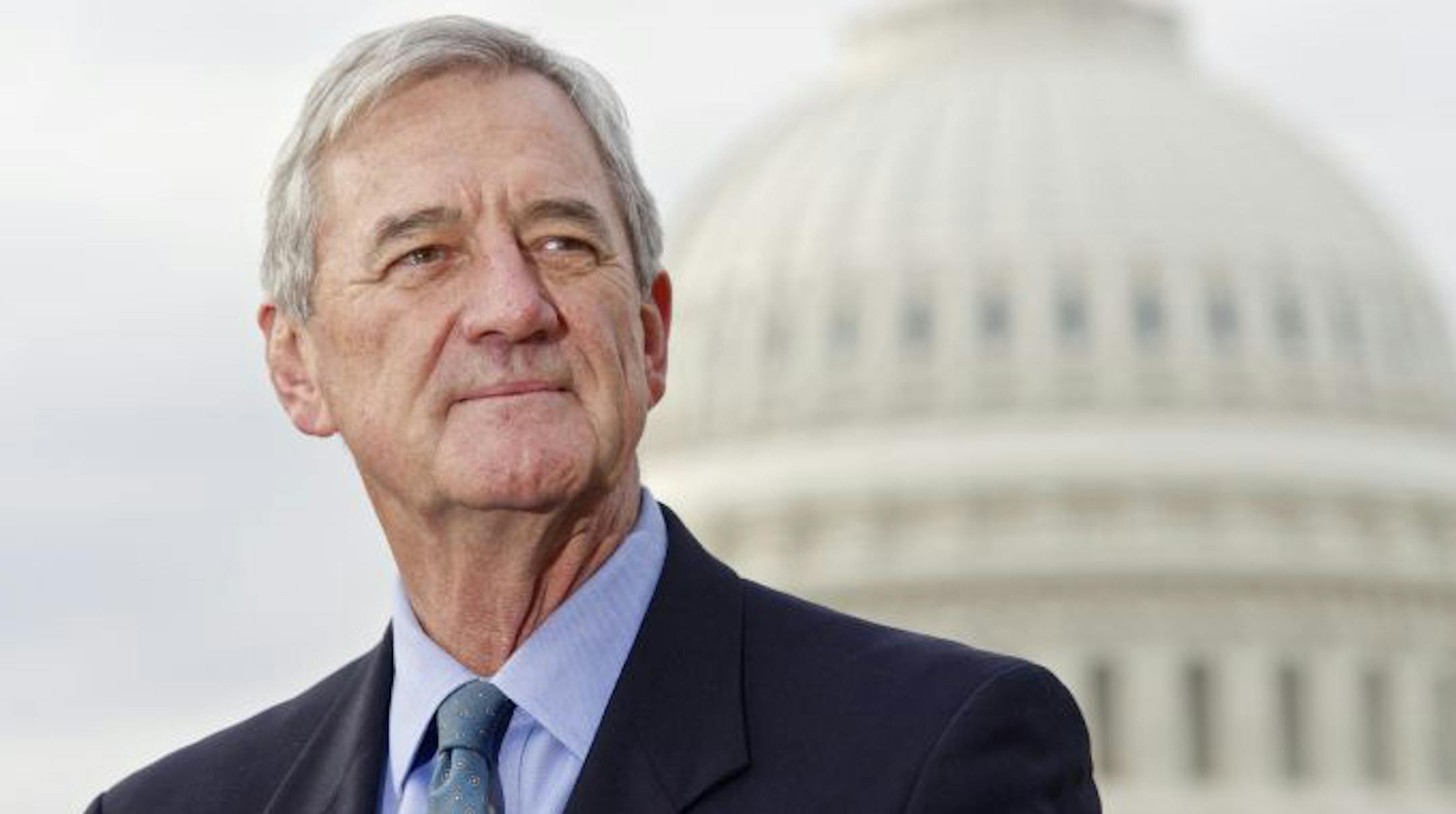
WASHINGTON – Rep. Rick Nolan was annoyed again, clutching a letter he had written to powerful members of House and Senate appropriations committees on his official congressional stationary. The letter, highlighted with yellow marker, underscored the decrepit conditions of a Bureau of Indian Affairs school in his district.
"I want to hand this to the chairmen and the ranking members," Nolan said, glasses on the tip of his nose. "They have a school up there that was designed as a mechanical house and a bus garage. ... It's mold, it's fungus, it's rodents, it's a leaking roof ... for poor Indian kids going to school! They have a very low graduation rate. There is nothing about it that says to them, 'Boy, people think my education is important.' So I'm going to hand-deliver this letter."
Nolan, a Democrat, is unapologetic about how much he loves to bring money home to his district. What others call pork, he calls essential to improving life for his constituents.
When he's not voting on the House floor, Nolan eschews the fundraising calls that consume so much of lawmakers time. Instead, despite a three-year-old official ban on federal earmarks, he spends hours phone-banking federal agencies and beseeching bureaucrats for funds to send back to his 8th Congressional District,
Since June 2013, when Nolan returned to Congress after a 32-year absence, he has steered roughly $60 million in funds to his district. That includes $10.6 million in housing grants for Indian tribes, a $2.9 million U.S. Department of Agriculture grant to promote wood-based products and fuels and $10.9 million for the Duluth harbor.
Nolan, who faces a tight race this fall against a small-government, fiscally conservative Republican, says he is trying to "even the score" for Minnesota in Washington. He says he even helps funnel cash to other districts, when respective members don't want to do the work he does courting federal agencies.
A dollar for a dollar
"It's irritating to think some states are getting $4 and $5 for every dollar they give to Washington. I want to get us at least up to par — a dollar back for every dollar we spend," Nolan said. "They [the grants] are improving the community. They are creating jobs. They are expanding the services available in the community, whether it be the airport, housing, colleges, the roads, the bridges."
As members of the minority party, House Democrats can have a tough time proving their productivity. They have no control over which bills or amendments are considered or how they are debated. They have no control over the floor schedule. Their burning issues — like DFL Rep. Keith Ellison's push to vote on boosting the federal minimum wage, for example — often languish in news release and talking points land, with no prayer of congressional movement as long as the other side is in charge.


