

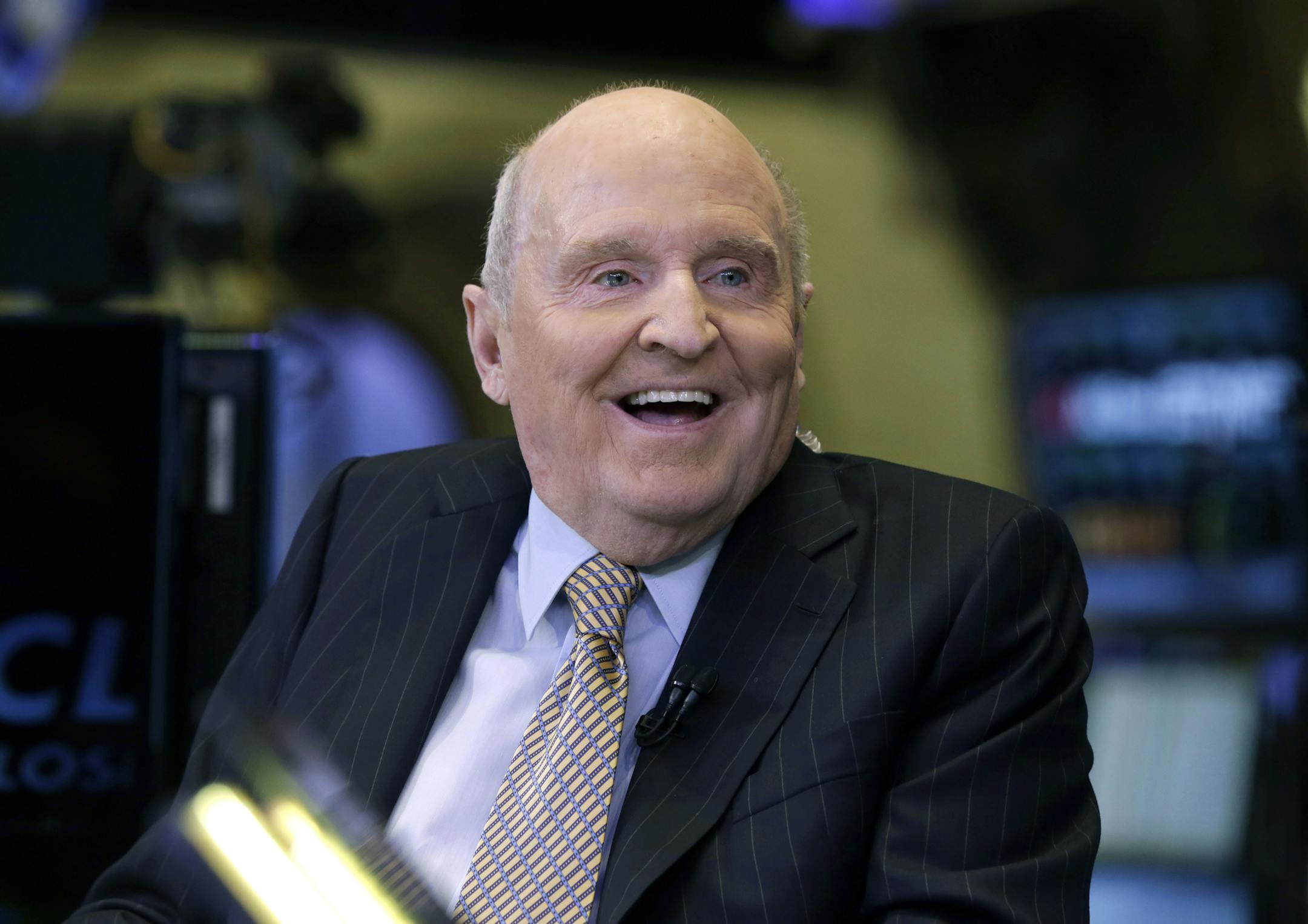
I saw Jack Welch for the last time last August for lunch at one his favorite spots in the world: the Nantucket Golf Club, near his sprawling summer estate on the far eastern side of the island, some 30 miles off the southern coast of Massachusetts. He was already seated in the bar area by the time I arrived. His three-wheel walker was near his side. He referred to it, with a twinkle in his eye, as his "wagon." He hoped I liked his wagon, he said.
He ordered his usual eclectic fare: two chicken hot dogs, a cup of tomato soup, some onion rings and a strawberry milkshake. He nibbled here and there — his appetite wasn't great by this point — and a surprisingly large portion of the meal ended up on his golf shirt.
Sensing that this might be our last visit, I called my oldest son and asked him and his friend to swing by the club and say hello to a living legend while there was still time. Jack couldn't have been more welcoming. He encouraged the guys to order a round of beers.
Jack was treated like royalty at the club — as was I by merely mentioning the fact that we were dining together. Throughout our last lunch, other boldface names, who also were club members, came by to pay their respects to one of the greatest chief executives in the history of American business. The same thing had happened a year earlier during my first visit with Jack — also at the Nantucket Golf Club — when no less a cast of characters than Phil Mickelson, the golf star, and Bob Diamond, the former chief executive of Barclays, as well as a few private-equity moguls, came by to say hello to him.
Jack, who died on Sunday, at the age of 84, loved the attention. He beamed. After all, in this crowd, among many others, he was revered. In 1981, he had taken over a company with a market capitalization of $14 billion, and in 20 years turned it into the most valuable company on the planet, with a market valuation of more than $410 billion. Welch's General Electric was Google, Apple and Microsoft rolled into one massively valuable and admired company.
At our final lunch, Jack was hobbled, physically. But even if his body was letting him down, he was as charming, witty and cleareyed as ever. Especially when it came to the fate of his beloved G.E., which had suffered in the years since Jack stepped down and turned over the company to Jeff Immelt. He blamed himself, and clearly those thoughts preoccupied him during his final days.
Jack never held back. In our many conversations, he told me that he regretted choosing Immelt as his successor (in a public contest, over two other well-regarded executives) and pushing the G.E. board of directors to approve his choice. In our conversations, Jack feared that his legacy at G.E. — creating the world's most valuable company, being named the most admired chief executive of the century, and G.E. being the most desirable place to work — had been utterly eroded.
He was near tears. Our conversations evolved into a confessional of sorts, no small matter for him, the only child of devout Catholic parents who had been trying for years to conceive a child before Jack came along. His mother always considered his arrival to be a miracle. Even when Jack stuttered as a child and was relatively small in stature, she told him that he was a giant and the only reason he stuttered was because his mouth could not keep up with how quickly his brain was moving.


