
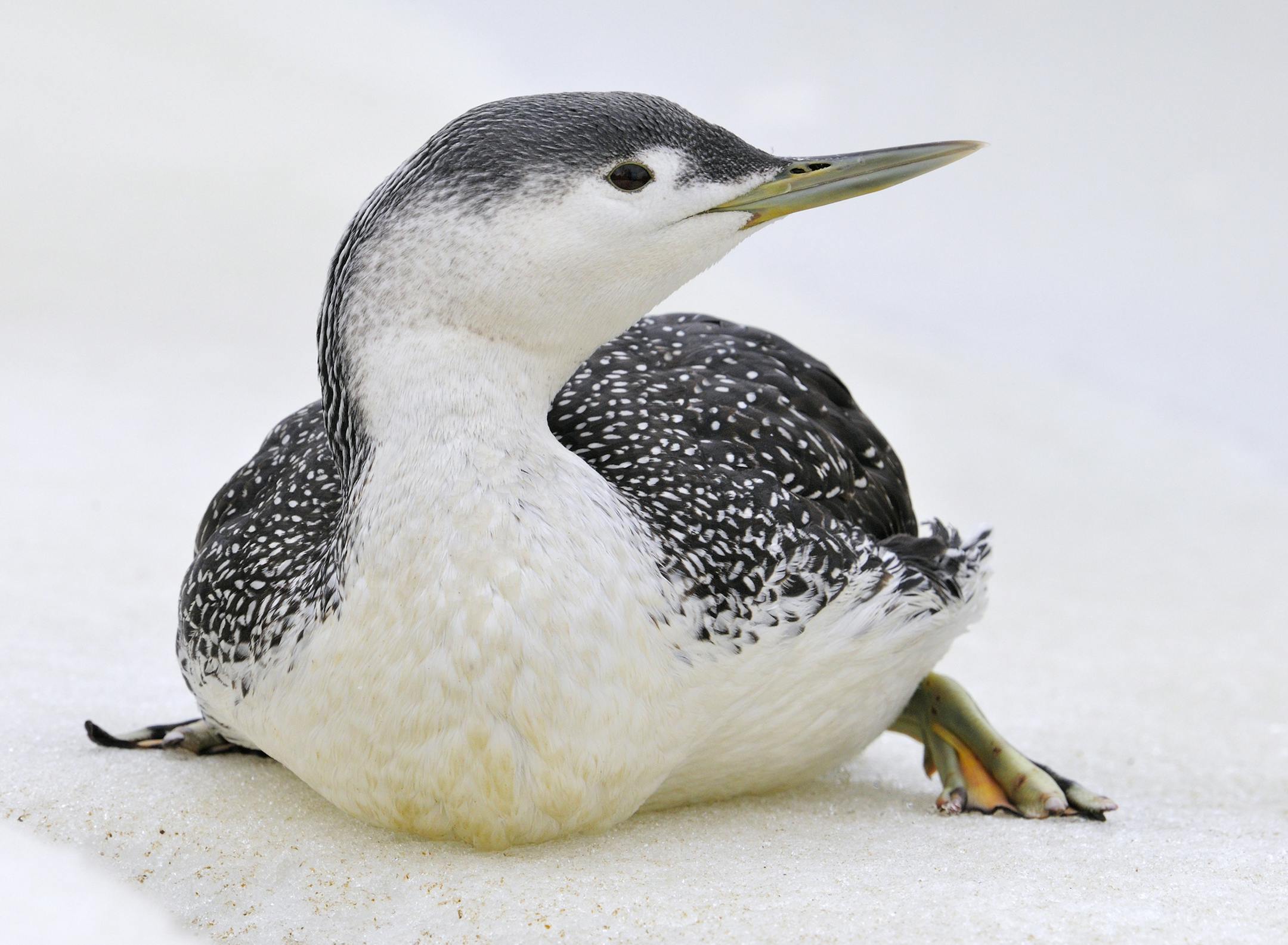
Red-throated loon makes unusual, early appearance in Brainerd

Rarely seen in Minnesota, this bird had people talking, and reacting, when it appeared.

For the Minnesota Star Tribune
March 24, 2016 at 3:42PM
This red-throated loon in winter plumage was spotted on March 14th along the Mississippi River in Brainerd. Red-throated loons nest in the Arctic region and are rarely spotted in Minnesota.
A red-throated loon in winter plumage was spotted March 14 along the Mississippi in Brainerd. (The Minnesota Star Tribune)

Late morning on a Monday, March 14, I received an e-mail notifying me and others of an unusual bird sighting along the Mississippi River.

The e-mail indicated that about an hour earlier, Brainerd area birders Ken and Pam Perry had spotted and photographed a red-throated loon. A photo of the bird was attached.

The Perrys are dedicated birders and also longtime friends of mine. Remember the old TV commercial about E.F. Hutton? "When E.F. Hutton talks, people listen." Well, when the Perrys speak of birds, you know what.

So, I made the short trek from my rural home to the indicated location, hoping to spot and photograph the loon.

Word spread fast. Several birders and photographers were present when I arrived. The red-throated loon was lazily swimming close to shore, seemingly unafraid of us onlookers.

I was hesitant to approach the loon. "I don't want to frighten it," I said to the others. "I want everyone to see it." But the longer we watched, it became evident the bird was very tolerant of us.

Soon the Perrys appeared.

"At first glance we thought it was a gull," said Ken, grinning. "Then it dove underwater. We knew it wasn't a gull. Then we thought maybe it was a grebe. And then Pam said, 'It's a red-throated loon.' "

Ken didn't think the bird would be frightened if I moved closer. I shuffled down the steep riverbank — tripod and camera-mounted telephoto lens thrown over my shoulder — until I was at the water's edge. Thankfully, the loon was unconcerned.

Immediately I began to take photos as it slowly paddled upstream, slicing its way against the current. As a photographer I couldn't help but be disappointed by the heavily overcast sky and drab light. But this was the first red-throated loon I had ever seen, so I was equally excited. After taking a number of images I relaxed a bit and began to enjoy the encounter.

The red-throated loon possessed all of the body characteristics of the common loon. Its torpedo-shaped body and dagger-like bill spoke of a bird that fished for a living.

Red-throated loons nest in the Arctic regions. Their breeding plumage is quite striking. Breeding birds flash a rusty-red patch that extends from their chins down to the breast. Like the common loon, their eyes are blood-red during the breeding season. Red-throated loons spend the winter along the Pacific Coast and along the Gulf Coast and Florida. Migrating red-necked loons are occasionally spotted in Minnesota, but are usually associated with the big water of lakes Mille Lacs and Superior.

Eventually the loon swam closer to me. It seemed as curious of me as I was of it. Occasionally it dove for food and preened its feathers, but mostly it slowly swam in place against the current.

Later, the loon climbed on a sheet of shoreline ice, offering me yet another unique photo opportunity. The bird made an occasional soft, contented purr.

I found out the loon was likely a bird that was found a few days prior on a nearby highway. The loon had apparently mistaken the wet road for water. A passerby had scooped up the loon and brought it to a wildlife rehab facility, where it was examined and deemed OK. It was then released — guess where? — on the Mississippi River about 2 miles from where the Perrys spotted it.

The Perrys said the sighting was the earliest of its kind in Minnesota. And the reality of how it ended up in the Mississippi River doesn't exclude the sighting from becoming a notable statistic.

Bill Marchel is an outdoors photographer and writer. He lives near Brainerd. Reach him at bill@marchel.com.

about the writer

about the writer

Bill Marchel