
Advertisement

Reagan's Hollywood skills served him well in D.C.

The former actor had impeccable timing and delivery; today's candidates could take a lesson from the Great Communicator.

November 20, 2011 at 3:41AM
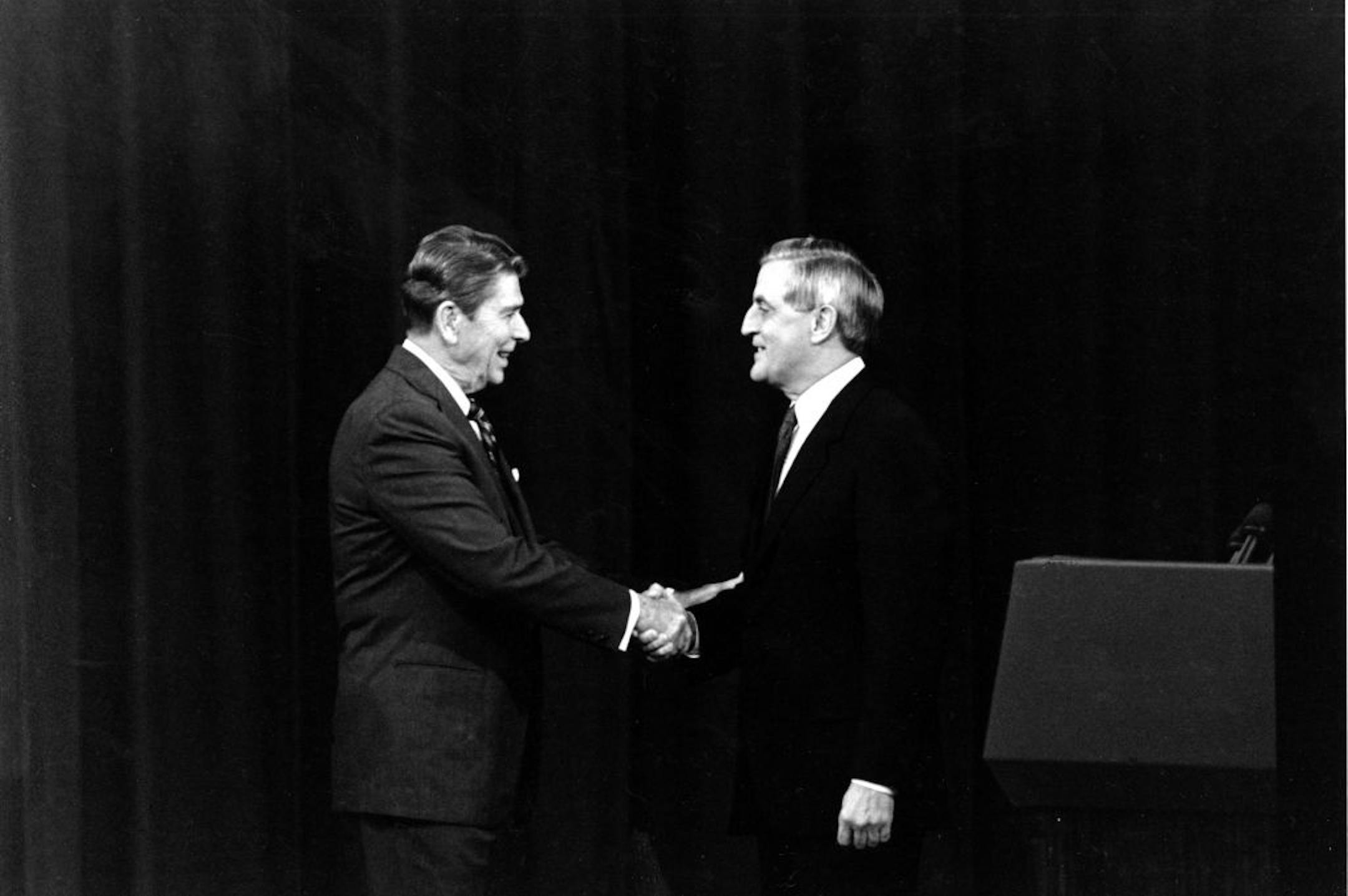
Walter Mondale, the 1984 Democratic presidential candidate, had first-hand experience with President Reagan's ability to use one-liners.
Walter Mondale, the 1984 Democratic presidential candidate, had first-hand experience with President Reagan’s ability to use one-liners. (Associated Press/The Minnesota Star Tribune)
Advertisement

WASHINGTON - To this day, many people still remember how Ronald Reagan used humor during a 1984 presidential debate to deflect questions about whether he was too old to be president.

Sam Donaldson recalls not just Reagan's words, but also the pictures from that night. Reagan, then 73, was running for a second term and coming off of a disastrous first debate with Democrat Walter Mondale in which he seemed tired and at times incoherent. In their second debate, Reagan confronted the age issue head on.

"I will not make age an issue of this campaign," he promised, tongue planted firmly in cheek. "I am not going to exploit, for political purposes, my opponent's youth and inexperience."

Donaldson, who was the White House reporter for ABC News, remembers how the exchange played out on TV.

"The camera was on Walter Mondale," Donaldson recalled. "He laughed! Not at Ronald Reagan, clearly with Ronald Reagan. And then the camera goes on Ronald Reagan. ... The old actor picked up a glass of water, took a sip, put it down with a sense of satisfaction on his face."

"At that moment," Donaldson said, "I knew it was game, set, match. It was over."

Reagan's skills as an actor -- his theatricality, his sense of timing, his ability to connect with an audience -- were often mocked by his critics but are considered by many scholars to be important keys to his success in the White House.

How Reagan took the skills he learned in Hollywood and applied them to politics was the subject of a recent panel discussion at the Washington offices of the Motion Picture Association of America. The discussion was part of a yearlong series of events marking the 100th anniversary of Reagan's birth on Feb. 6, 1911.

Advertisement

Reagan's political philosophy and his deftness as a negotiator began to take shape when he was in Hollywood and served as president of the Screen Actors Guild, said Kenneth Duberstein, who served as Reagan's White House chief of staff.

His sense of timing was classic Hollywood. Everybody remembers the signature line from his 1987 speech at the Berlin Wall: "Mr. Gorbachev, tear down this wall!"

"But if you go back and look at the tape," Duberstein said, "it was the skill of an actor who delivered that line well."

Reagan decided to keep the line in his speech, much to the chagrin of the State Department, and rehearsed it over and over while on his way to the Berlin Wall because he wanted to make sure he had the delivery down pat, Duberstein said.

Reagan also initiated the president's Saturday morning radio address, a weekly tradition still followed by his successors. Reagan conceived of the radio address as a way to speak directly to the American people for five minutes without having his words filtered through an often-critical news media, Duberstein said.

Reagan often rewrote the text of those speeches himself and would rehearse them until he got the timing down. "He used to sit there in the Oval Office with a stopwatch and make sure that he got it right," Duberstein said.

Advertisement

Former Democratic Sen. Christopher Dodd, who is CEO of the Motion Picture Association, recalled that Democrats were almost giddy when it became clear in 1980 that the GOP would nominate an actor for president.

But, "Ronald Reagan had an incredible capacity to relate to people," Dodd said.

Texas Gov. Rick Perry, who stumbled during a recent presidential debate while trying to remember three federal agencies that he wants to abolish, could learn a thing or two from the Great Communicator. "Reagan taught us all you never say I want to make three points," Duberstein said. "He always said, 'I have several points to make.' Because invariably, you get lost -- anybody, even a skilled actor."

about the writer

about the writer

MICHAEL COLLINS, Scripps Howard News Service

Advertisement