

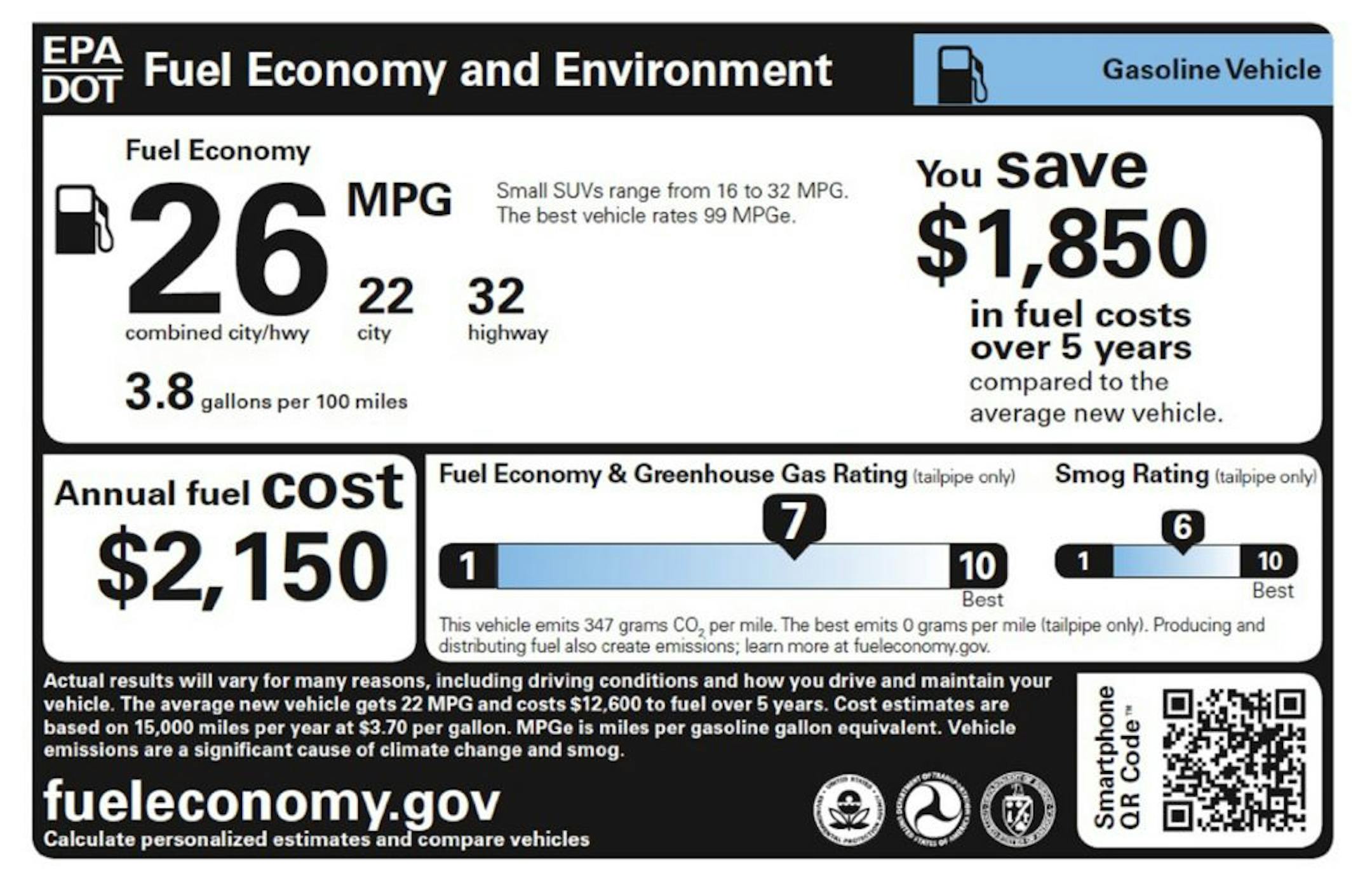
The Environmental Protection Agency has changed the way it rates fuel economy for new cars and trucks, including information such as "greenhouse gas rating" for the first time. But what do the figures mean? And how does the EPA come up with the fuel cost savings and smog ratings? Here's a guide to the new label, with explanations from the EPA. For more information, go to www.fueleconomy.gov.1. VEHICLE TECHNOLOGY & FUEL.
The upper right corner of the label displays text and an icon to identify it as a vehicle powered by gasoline. You will see different text and icons in the labels for other vehicles (diesel, compressed natural gas, hydrogen fuel cell, flexible fuel, plug-in hybrid and electric). Hybrid gas-electric vehicles that do not have plug-in capability are identified as gasoline vehicles since they only use gas.
2. FUEL ECONOMY.
For gas vehicles, the label shows City, Highway, and Combined mpg (miles per gallon) values. The combined mpg value is the most prominent for quick and easy comparison. Some form of the miles per gallon metric has been on vehicle labels since 1977. Combined fuel economy is a weighted average of City and Highway mpg that is calculated by weighting the City value by 55 percent and the Highway value by 45 percent.
3. COMPARING FUEL ECONOMY TO OTHER VEHICLES.
This text indicates the category of the vehicle (e.g., small SUV, station wagon, pickup truck, etc.) and the best and worst fuel economy within that category for the given model year. There are nine car categories, six truck categories, and a "special purpose vehicle" category. For each model year, EPA publishes lists identifying the best and worst fuel economy performers in each category. At www.epa.gov/fueleconomy/data.htm you can find ratings for highest and lowest fuel economy.
For those vehicles that do not use liquid fuels -- such as electric vehicles, plug-in hybrid electric vehicles operating on electricity, and compressed natural gas vehicles -- the labels display miles per gallon of gas-equivalent (MPGe). Think of this as being similar to mpg, but instead of presenting miles per gallon of the vehicle's fuel type, it represents the number of miles the vehicle can go using a quantity of fuel with the same energy content as a gallon of gasoline. This allows a reasonable comparison between vehicles using different fuels. For example, you can use MPGe to compare a compressed natural gas (CNG) vehicle with a gasoline vehicle; even though CNG is not dispensed or burned in actual gallons.
4. YOU SAVE/SPEND MORE OVER 5 YEARS COMPARED TO AVERAGE VEHICLE.
The label shows the estimated fuel cost over a five-year period for the vehicle compared to the average new vehicle. If the vehicle would save you money compared to the average vehicle, the label would state, "You save $x,xxx in fuel costs over 5 years compared to the average new vehicle." If the vehicle would be more expensive to operate than the average vehicle, the label would state, "You spend $x,xxx more in fuel costs over 5 years compared to the average new vehicle." These estimates are based on driving 15,000 miles per year, for five years, and the projected fuel price for the year ($3.70 per gallon of gasoline in this example). For more information on the source of projected fuel prices see "10. Details in Fine Print".
5. FUEL CONSUMPTION RATE.
While a miles per gallon (mpg) estimate is a required feature that has appeared on the fuel economy label for several decades, this can be potentially misleading when consumers compare fuel economy improvements, particularly when they use it in place of fuel costs. The fuel savings, in gallons, for a vehicle that gets 10 mpg versus a vehicle that gets 15 mpg is about 33 gallons (assuming 1,000 miles). On the other hand, the fuel savings in gallons, for the same 5 mpg fuel economy jump, for a 30 mpg versus a 35 mpg vehicle is only about 5 gallons. This "mpg illusion" demonstrates why it may be more meaningful to express fuel efficiency in terms of consumption (e.g., gallons per mile or per 100 miles) rather than in terms of economy (miles per gallon). A fuel consumption metric allows for more accurate energy usage comparisons among vehicles. The revised label includes both fuel economy and consumption information for all vehicle types.
6. ESTIMATED ANNUAL FUEL COST.
The annual fuel cost is based on two assumptions: an annual mileage of 15,000 miles and a projected gasoline price. For more information on the source of projected fuel prices see "Details in Fine Print".
7. FUEL ECONOMY & GREENHOUSE GAS RATING.
The new label assigns each vehicle a rating from 1 (worst) to 10 (best) for fuel economy and greenhouse gas (GHG) emissions (i.e., how much carbon dioxide the vehicle's tailpipe emits each mile), as shown below. Consumers may note that higher fuel economy is associated with a better GHG emissions profile. There are two ratings that apply to each vehicle--one for fuel economy and one for greenhouse gas emissions--but gasoline vehicles will display only one rating. This is because carbon dioxide emissions are directly related to the amount of fuel consumed. This relationship varies from fuel to fuel, but both rating systems are based on gasoline vehicles, meaning that gasoline vehicles get the same rating for fuel economy and for greenhouse gas emissions.


