

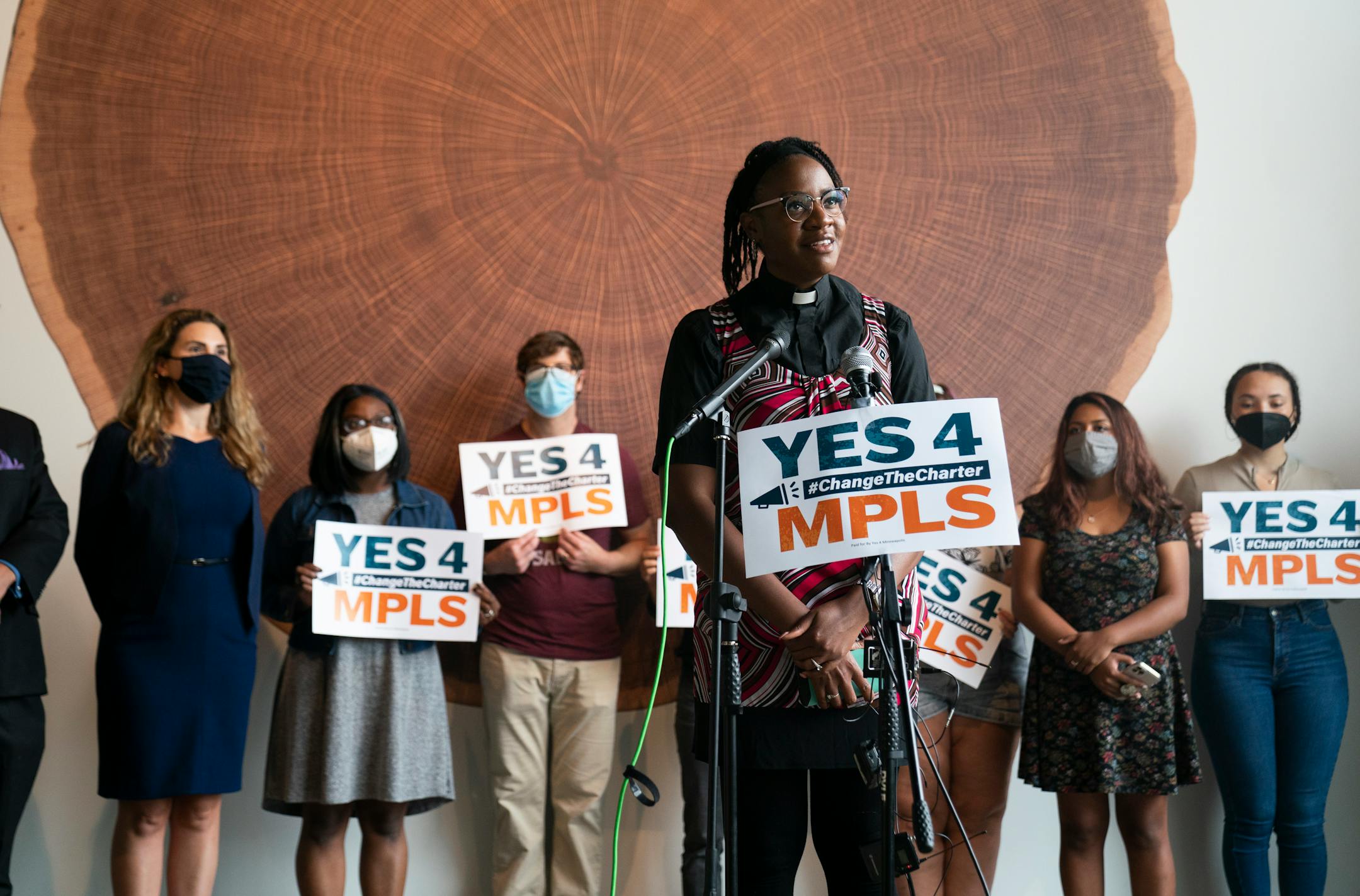
The Aug. 4 article about the fundraising efforts of Yes 4 Minneapolis states that their funding comes from a mix of individuals, local and national groups ("$1M rolls in to fight over cop reforms," front page). Quickly scanning the campaign finance report of the over 2,000 lines of donations, I see roughly 250 individual donors who list Minneapolis addresses. The vast majority of supporters and the preponderance of the money donated has come from people who live anywhere but Minneapolis. How are we to have a fair conversation about how public safety should be approached in our city when these large outside influences are putting big dollars into influencing such an important city decision? I suspect that most of them know little about what life is really like in Minneapolis and perhaps have never even visited here.
Harvey Zuckman, Minneapolis
•••
It was helpful to read two separate Opinion pieces on two different charter amendment proposals, side by side.
The first, from a group of residents in the Linden Hills neighborhood, promoted the Yes 4 Minneapolis amendment ("Why the reform amendment must pass"). It argued, contra Downtown Council CEO Steve Cramer ("Why the defund amendment must be defeated," July 28), that longtime police reform efforts have never achieved results, and the only solution is a restructuring of city government, shifting supervisory responsibility from the mayor to the City Council.
The second, from former Minneapolis budget director Jay Kiedrowski ("The executive-mayor amendment must pass"), argued in support of another charter amendment, which would clarify lines of municipal authority and give more administrative responsibility — over policing as well as other departments — to the mayor.
After reviewing and comparing these two essays, I came to the following conclusions. The very difficult challenges of police reform, public safety and law enforcement require citywide administrative (mayoral) oversight and responsibility. The impatience with "stalled" actions against "killer cops," evidenced by the Linden Hills group, has less to do with specific engagement with these nitty-gritty management issues and more to do with voicing progressive ideals and expressing righteous anger — organized and funded by deep-pocketed national advocacy groups. The remark from the utopia of Linden Hills that "we almost never see squad cars" — because they are a well-resourced community, as all neighborhoods, in a future world, should be — is telling. Linden Hills does not face the immediate problems of police brutality, criminal violence, the murder of children and the desecration of neighborhood and downtown businesses, yet these writers are prepared to lecture the rest of the city on how to fulfill their vague public-safety ideals.
The slow and halting progress on police reform is attributed by the Linden Hills group, and by others, to deeply ingrained systemic racism and social inequalities. There is no doubt that these are some, if not all, of the underlying causes of police misconduct and bad training. But stalled progress in addressing the problems themselves has more to do with the dysfunctional structure of city governance, as Kiedrowski pointed out. The Yes 4 Minneapolis proposal will only increase the muddle of dispersed and conflicting municipal responsibility. The Linden Hills group states that the confusion about lines of authority is a nonissue and even "insulting" to suggest. They write that "if voters understand the difference between Congress and the president, they understand the difference between City Council and the mayor." It is this kind of glib, patronizing attitude that is truly insulting — and I hope they read the Kiedrowski piece, which is illuminating on the real consequences of our current, ambiguous system of city governance.

